2019-01-12

Topsy Turvy


In the wake of the 9/11 attacks, airports became completely different places. Young people have no idea what an airport used to be like. They'll never know what it's like to travel without having to first submit to a humiliating security check. They'll never know what it was like to say goodbye to your friends and family at the gate, rather than at the front doors of the airport, or to greet them at the gate when they arrived.

I'm disappointed with myself that I don't even remember what some of it was like. I know we had to submit our bags for a security check, but I don't remember what that check consisted of, nor do I recall how onerous it was. I'm on the edge of my generation; I didn't do much air travel until I was in college, and 9/11 happened halfway through my college career. So, I'm struggling to remember exactly what it was like. People younger than I am -- younger than 39 years of age -- will remember even less. It is a dying memory that will disappear much sooner than I ever expected.

What makes me sad about this is that it is a tangible loss of freedom -- an enormous growth in the size and scope of government -- that occurred in my lifetime, and when we no longer remember what our freedom was like prior to that loss of freedom, we will no longer hunger for it. We will, collectively, assume that "it's always been that way," and so we will likely never make strides to regain the freedom we've lost.

It was a truly terrible loss, too. For those of us who even vaguely remember pre-9/11 airplane travel, the TSA security checks feel like humiliating assaults. Groping. Unexplained detentions. The power of TSA employees to cause us to miss our flights, often at great cost to us, and the power of TSA employees to initiate a nearly intractable legal process against us, even if we are not guilty of anything. They simply decide we are suspicious, treat us accordingly, and our rights are gone. Poof.

This morning, news reaches me of protests by TSA employees. They're protesting the government shutdown. The article presents the case that the TSA employees are victims in this case. They deserve their money. They deserve their jobs. Mean, bad Mr. Trump is making it hard for them to earn a living.

To earn a living groping us, taking body scanner photos of us that can see through our clothes, patting-down our wives and children. The government shutdown is making it hard for the TSA to earn a living detaining us.

They're the victims.

2019-01-11

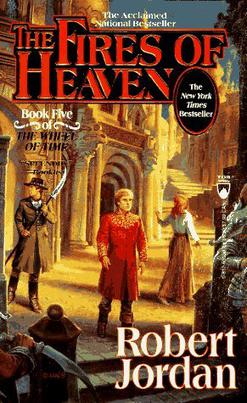
Book Review: Robert Jordan - "The Fires Of Heaven"

Image courtesy Wikipedia.org
The fifth book in Robert Jordan's "Wheel of Time" series is the slowest-paced book of any in the series thus far. There is a lot to enjoy about the book, of course, but there is an unfortunately large amount not to enjoy, as well.

For starters, at least 200 of the nearly 1,000 pages in the book are dedicated to recapping elements from previous installments. It must be a catch-22 for any writer of successful book series, deciding how much backstory from previous books is enough to remind readers of the present book what has happened before. Still, it is excessive in "The Fires of Heaven," and very costly to the flow of the novel. No one who picks up book #5 in a 14-book series requires all that background information; we already have it.

A second weakness is that the book's primary plotlines follow the series' worst character, Nynaeve, a cantankerous, mean, arrogant, and all-around unpleasant woman. I respect that Jordan was capable of making such a detestable character, but given that she is supposed to be protagonist, it is frankly unpleasant to have to wade so deeply into her part of the story. Much better to have relegated her to more of a supporting role...

Which brings me to another strong weakness in the book: Some of the most appealing characters in the story were misused here. Namely, Thom Merrilan, whose place in the series is intriguing and interesting. He is a man that killed a Myrdraal with a dagger in one of the earlier books, all by himself, an extremely intelligent and capable man who plays a key part in several other characters' lives. And yet, in "The Fires of Heaven," his character is mostly played for comic relief. It's so disappointing to watch a very likeable and respectable character play the patsy in a 1,000-page novel, especially when he's playing the patsy to the detestable Nynaeve.

Finally, the book is far more slow-paced than previous novels in the series. At times, Jordan spent ten to twenty pages describing minor events that were not relevant to the plot. It makes no sense to spill ink over ten pages to, for example, describe that two characters are having difficulty finding an opportunity to have a conversation with each other.

One wonders, too, what the title of the book means. There is no reference to "heaven" or "the sky" anywhere in the novel, although there is plenty of fire throughout. But "The Fires of Heaven" does not refer to anything in particular about the novel.

As usual, Jordan packs a lot of action into the last 100-200 pages of the book, proving that he can keep the reader on the edge of his seat, but also leaving me to wonder why the rest of the novel was so slow. He also packs many quotable quotes into the story; two characters, in fact, seem to exist merely to cast such pearls to the other characters, and that's a lot of fun. His descriptions are as strong as ever, so even while the novel is paced slowly, it's well-written, to be sure. There is no escaping, however, that the novel could have been 300-400 pages shorter than it was without costing the story anything.

Five books into the series, Robert Jordan's philosophical messages are finally starting to play out in the series. What "saidar" and "saidin" actually represent -- including the "taint on saidin" -- is becoming more obvious, and it nice to explore what Jordan has to say about the relationship between men and women. Even so, his depiction of female characters has always been a little flat, and in "The Fires of Heaven," they occasionally border on the downright silly. Nearly every female character is psychologically manipulative, catty, passive-aggressive, secretive, conniving, and has a crush on some other male character. If one wanted to make a case for women's empowerment, as Jordan appears to want to do throughout the Wheel of Time series, one certainly can't do that while painting all women with more or less the same brush.

So, while there is plenty of action -- especially that action that separately follows Rand, Mat, and Morgase -- the slow pace of the novel and its cartoonish treatment of its female characters are major detractors to what should actually be a really good book.

What's good about the novel is in fact great, so I can't rate it lower than three stars. I just hope subsequent books in the series prove to be a little better.

2019-01-10

The Horrible, Horrible World Of Data


There's an old blog post out there in cyberspace, somewhere, written by "The Last Psychiatrist," but before he had his own website. In it, he makes the rather interesting point that Sigmund Freud's psychological language reflected the language of his time. One example was the use of words like "pressure" and "stress" to describe psychological states, words that seemingly spring from a world in the midst of an industrial revolution preoccupied with literal pressure and stress in the world of machines. He compared that to the psychological language of the Internet Age, which used terms like "connected" or "disconnected." Interesting, like I said. Google it, if you can; it's worth reading.

It certainly made an impact on me. Over time, I've really come to absorb that concept and adopt it into my interpretation of our present reality. We're no longer living in a world of industrial revolution, and it's clear to me, at least, that we have gone past the Internet Age, too. The internet is still here, of course, but our age is no longer about "the Net." If I you asked me, I'd say it's now the Data Age.

*        *        *

Data age distinguishes itself from "Information age," which was the Nineties. The information age was all about transmitting information from one place to another, communicating faster, communicating instantly, passing along information.

No, in a data age, we're not so concerned with information. What we want is data, ie. stuff that can be harvested, ETL-ed, relationally databased, processed in a statistical model, and then summarized. And hopefully monetized, ugh.

But in any case, data is the order of the day. We already take it for granted that every system with which we interact when we access computers or phones will harvest data related to that interaction, and then process it somehow. It will end up on somebody's report, and drive someone's decision to do something; most often a commercial decision of some kind.

We take that part of it for granted, but we seldom consider how this has begun to shape our own individual behavior. One example is fitness tracking. Twenty years ago, almost no one cared how many steps they take in a day; nowadays, we dutifully track it. We track our meals and our hours of sleep -- light sleep and deep sleep, and the amount of each is tracked and understood to matter. We track fitness-related things that we never thought to track before, such as the cadence of our running stride (which is useless), and the vertical oscillation.

I've already written about how all this information isn't worth anything unless we can somehow develop computer programs that solve necessary problems. It's junk, basically. It doesn't do you any good to know that 17% of your monthly grocery budget is spent on beef. What would be useful if someone developed an algorithm that was able to identify all the meat and meat-substitutes present on your monthly grocery bill and developed an app that told you, "If you replaced half your monthly beef with chicken, you'd spend $20 less; if you replaced it with squid, you'd spend $30 less; if you replaced it with lentils, you'd spend $50 less." Or whatever the case might be.

The key point here is that having a collection of data is as pointless as having a collection of bottle caps. Unless you plan on doing something with your data, it is senseless to collect it. That's an easy point to make about businesses who store terabytes upon terabytes of data in huge data centers. But it's an even more important point to make for people who dedicate a part of their day to recording their meals, their weight, their time spent reading, and so on.

To be sure, I record every data point that relates to my health and fitness regimen that I possibly can, but I have a reason for doing this. In my case, I'm trying to keep my blood sugar readings as low as possible. Normal people have absolutely no reason to care what percentage of their last workout was in Heart Rate Zone 3. Really, it doesn't matter.

Naturally, this point connects to yesterday's point about paperwork. Paperwork is, at its core, data collection, and we have begun to believe and to act as if action is impossible without some parallel instance of data. We've gone from "I think, therefore I am" to "Without data, there is no record that I thought anything in the first place, therefore everything is data." Granted, that doesn't quite roll off the tongue like cogito ergo sum.

*        *        *

I started writing this blog post because I was thinking to myself, if today is the Data Age, then what will the next Age be? But in writing down my thoughts, I've shifted my perspective slightly.

Everyone's always talking about "monetizing" what they're doing, as though having ten thousand people view the acoustic cover of "Careless Whisper" you put up on YouTube isn't reward enough, as though those ten thousand people are irrelevant to you unless they become PledgeMusic donors. I think this attitude is crass and self-limiting. I love making money, but it's not everything I do in life. There are some things worth doing merely because they are inherently meaningful: climbing a mountain, making love, teaching your child how to read, listening to the birds in the trees and feeling the sunshine on your face as you drink coffee on your patio on a warm Sunday morning. Some things ought not be monetized. Maybe not even art.

But maybe this modern age of data, of data collection, could turn out to be something that we can make use of. The Beatles are considered the greatest rock band of all time, mostly because there is a historical record that says so; ie., they are thought to be the best because that's what the data says. The data tells a story about the Beatles. Now there can never be "another Beatles," not because four young guys can't make music that good, but because four young guys can't generate 50 years of data that tells the story of their greatness.

…or maybe they can.

One of the big differences between musical artists nowadays and musical artists when I was growing up is their lack of a story. In most cases, this is because there is no story to tell. Pop vixens basically spend their wonder years in voice lessons, then if they're sexy enough they get pitched to a record company that chooses to develop them or not. That's not a story, it's just a sausage-maker.

When I was in high school, I could tell you exactly how the members of my favorite bands met each other, how they developed their musical style, how they went from nothing to something, the story behind the recording of their breakthrough album, and so on.

There's even a bit of showmanship involved in having a story. What's better, "Raj the Magnificent," or "Raj the Magnificent, who tamed three bears with a song when he was just 13, who drank from the waters of Shangri-Upor and kissed the Queen of Daan, and who, after a decade of study under the harpmasters of the Lower Peaks of Cheryn brings his heart-felt lyrical poetry to your home town, for your listening pleasure?"

Not that one should fabricate a story a la Jared Threatin, but why not get your story out there, whatever it is? We're a culture that depends on the existence of data; we trade in memes, because memes are data points; the more memes, the more data; present your ideas as a well-established meme, and perhaps you're one step ahead of the game.

Meme yourself to success!

Ugh, god. I hate the Data Age.

2019-01-09

Without Paperwork, Nothing Can Happen


I used to pay a monthly subscription fee to "Hand & Stone," a massage spa. That monthly fee covered one massage per month, and possibly other discounts that I never took advantage of.

Some months ago, I cancelled my subscription since daily foam rolling eliminated my need for a monthly massage. I had a lengthy conversation about this cancellation over the telephone. This is to be expected, since the whole grift with subscription services is that they want to keep you holding on to your subscription, no matter what. After having settled the matter, though, we hung up the phone. As far as subscription cancellations go, it was a pleasant conversation, and I thought I'd heard the last of it.

The other day, however, some three or four months later, I received a message asking me to "update the credit card on my account."

I called them back, and the manager answered the phone. When I explained that I had already cancelled my account, and that there would be no need to update my credit card or charge me again, she told me that she had no record of my cancellation. Fine, I thought. That's just a misunderstanding. So I explained again that I had cancelled my subscription, and she explained again that she didn't have record of it.

Then she told me that if I didn't update my credit card, I would be sent to collections.

Upon hearing this last part, I had to interrupt her to verify what she had told me. I asked her to confirm my understanding of the situation: That "Hand & Stone" would continue to charge my credit card even though I had cancelled my account, and that if I didn't pay them I would be sent to a collections agency. She confirmed that this was correct.

At that point, I told her, "Since you don't have a valid credit card on file, and I believe I cancelled my account, why don't you just not charge me?"

She told me the reason was that she didn't have a record of it.

It is truly a bewildering thing to behold a world in which you can verbally state to people that you no longer wish to do business with a person -- a world in which a person is incapable of doing business with you, because they do not have a reliable way to charge you any money -- a world in which no actual services are being rendered because you have not entered the business establishment to collect those services -- and yet that person will nonetheless claim that they are incapable of not charging you money, incapable of not sending you to collections, because they didn't update their records.

When did this happen to human beings? When did we become so tied to paperwork that all action is impossible without it?

2019-01-08

Picking Up The Pace


Lately, I've increased my average running pace from a little under seven minutes per mile to somewhere around 6:25 per mile. That's a significantly faster pace, fast enough to warrant some 'splainin'.

The first question is why I would increase my average running pace, and the most basic answer is, why not? It sounds stupid, but so long as you're running every day -- or almost every day -- why not run faster rather than slower? Provided there is no significant cost to doing so, running faster is more fun than running slower, and as I've mentioned many times in the past, it's also safer. Ceteris paribus, fast is better than slow.

Of course, longtime readers will note that my running seven minutes per mile is already quite a bit slower than I used to run. So, the real question is, why did I ever slow down in the first place? The answer, if I'm being totally honest, is probably laziness. One day, a person feels a little more tired than usual, so he runs a little more slowly. Those tired days start to happen a little more frequently, and before he knows it, the fast days are the rarities. It takes a bit of work to shake all that off and get back to running fast again. It takes some deliberate effort. That's what I'm doing now.

There is also the matter of Texas weather. The summers here being what they are, it is almost impossible to run as far and as fast as I'm used to running when the weather starts climbing up above 80 degrees. The heat here is not the same as the desert heat in which I grew up. The air is much more humid and makes it more difficult to avoid over-heating. It's hard to run under 6:30/mile pace for six or more miles in heat like that. I haven't yet learned the secret, although perhaps I will, eventually.

There were a few other contributing factors, too. In late 2014, I started experimenting with heart rate zone training. It was an interesting process. Initially, training in HRZ 2 involved slowing way, way down. Over time, my pace came up while my heart rate did not increase by much. So in some ways, HR zone training was effective. But I don't think my pace ever really came back up to where it should have. A guy needs to push a bit to have that happen, and without the desire to push, it didn't happen. I also suffered a few injuries over the years that discouraged me from pushing overmuch. My back injury from 2017 was certainly a setback, but the fact that it happened just as I started to get more serious about running made it psychologically more impactful (negatively) than it probably otherwise would have been. Thus, there has been this fear in the back of my mind that, should I ever decide to try to run a little harder, a little faster, be a little better, I'd only injure myself.

I realize now, however, that these injuries were age-related. I've learned a lot from Tony Horton's Beachbody workout programs, and one of the most important things I've learned is that maintaining good flexibility and balance is more and more important as we age. In our twenties, we can run hard and heal quickly. Nothing ever seems to get in our way. As time wears on, all the times we skipped over the stretching routines and the foam rolling start to catch up with us. Getting an occasional massage can lull us into a false sense of security: why bother with daily muscle care when you can loosen everything up once a month on the massage table? But, no. We need to care for ourselves as we age, otherwise we're just priming ourselves for injury.

So: taking better care of myself and returning to my older style of training have inspired me to push a little harder during my daily run, and what I've discovered from all of that is, so far, it's no more difficult to run fast every day than it was to run slow. I'm a little more tired at night, and I sleep a little more soundly, but nothing else is really the same. I'm glad I made a choice to try to run faster. We'll see if it pays off.

2019-01-07

Drifting Apart


I don't know a lot about Dungeons & Dragons, having only "played" (is that the right word?) once or twice in my life. I never really took to it, as I never understood whether what I was doing was supposed to be pretending I was a knight and running around with a toy sword, or sitting down with a pen and paper, rolling dice and keeping score. I suppose that's the allure of D&D for those who like to play: It's a bit of a combination of both things.

But old-school RPGs like Dungeons & Dragons did manage to bring one clever innovation to the world of gaming, and that is the following: In most RPGs, there are various types or classes of characters from which to choose. Players could choose to be a thief-type character, for example, and being a thief meant you scored high on some traits (sneakiness? agility?) and lower on others (strength? honesty?). Wizard-type characters had a different set of strengths. Knight-type characters had others still.

What's attractive about this kind of game feature is that the whole game plays differently, depending on one's strengths and weaknesses. Suppose the player has to open a locked door. A thief might have to pick the lock, a giant might have to break the door down, a wizard might have to cast a spell… In order to build up enough points to manage opening the door, the thief character might have to spend some time acquiring thief-related points, obtaining lock picks, and so on. A wizard, on the other hand, might have to spend time on completely different activities, such as studying spells or acquiring potions or magic wands, or whatever the case might be. The point is that gameplay requires only that the door be opened; how a player managed to do that depended on his or her choice of character. Not only do different players get to have different kinds of experiences, the same game can be played hundreds of different ways, based on one's choice of character and list of strengths and weaknesses.

This gameplay innovation, given to us by the old RPGs of the 70s and 80s, bled over into computer-based RPGs like "Final Fantasy" and "Quest for Glory." This, in turn, inspired fighting games like Street Fighter II, with characters whose controls were radically different from each other; and racing games, in which different cars had different strengths and could approach terrain and speed differently.

Forty years later, it's not much of an innovation at all. Players expect to choose among classes of characters, or to experience gameplay in which one develops some set of abilities rather than others, and the events in the game vary accordingly.

Another benefit to this kind of game feature is the fact that it feels more true-to-life. Rather than everyone's having to pretend to be the same kind of character, we get to choose that character that most appeals to us. Some of us think of ourselves more like wizards than paladins. That's normal and expected. Far better to play the character that seems more like you than to play the only character available. Or, perhaps you'd prefer playing a character that is nothing like the real you. That can be a wonderful form of escapism, too. You might never be a swaggering pirate in real life, but in an RPG, you can play at being one, just for a chance to step out of your own skin for a while.

What makes this all work is the fact that the players know they are playing a game. We can choose which role we want to play, from a relatively small set of options, knowing full well that we can always start the game over again and play as a different kind of character. Today, I can choose to be a great wizard; tomorrow, I can be a swordsman who knows nothing about magic at all. It would be incredibly odd if your ability to play a particular game were defined entirely by the choice you made the first time around. It wouldn't be very appealing to play a game in which you could choose from twelve different characters, but if you chose to be the Elf the first time around, that impacted how you played the game the second time, the third time, and every time thereafter. That wouldn't be a very fun RPG; we might enjoy playing the first time, but subsequent rounds of the game would be frustrating, as a player tried to convert his homunculus character into an evil succubus or something.

In life, we don't get to start the game over and choose again. If we choose one path the first time around, we can always sort of pull back, change our minds, and follow a different life path later on, but that new path will be greatly impacted by the choices we made initially. Life is more like the less-fun version of the RPG.

Even as little as fifty years ago, a person could change course in their careers, go back to school, and have a quite illustrious "round two." Factory workers could become policemen. Teachers could become doctors. Ex-convicts could become lawyers. Author Edgar Rice Burroughs, of Tarzan fame, worked as a salesman, a rancher, a miner, a military man, a journalist… and a famous author. My own grandfather was a farmer, a mechanic, and a consultant for the state Timber and Coal department.

Today, though, this seems almost incomprehensible. The only valid "second rounds" in a person's professional life involve either transitioning from ground-level work to sales or management, or going from a low-skill job to a skilled profession. No one goes from ranching to mining, as Burroughs did, unless that means being a Manager of Data Science for a ranching concern to being a Manager of Data Science for a mining concern, and that's not really the same thing, is it?

The more exposure you get to any given world, the more you realize how small that world is, especially as you climb your way toward the top. There are only a handful of noteworthy university professors, for example. If you're one of them, chances are you know or have heard of most of the others. The same is true for any industry, be it cars or oil or pharmaceuticals or chemicals or software. There are millions of people at the ground-level, but once you've worked your way to one of the higher echelons, the world gets really very small. Before you know it, you couldn't possibly imagine playing as a new character and starting over again.

I don't know whether this is good or bad. I don't know whether this is "just life" or whether there was a benefit to living in a bygone era, in which one could try one's hand at all manner of work and live a contented life throughout. Or was it simply not very contented at all? Was it considered a personal failure if a person sold their farm and went to work in an automobile factory?

In any case, these days I have the feeling that the Elves don't hang out much with the Knights. The Knights don't have a lot to say to the Thieves. The Thieves and the Sorceresses don't intermingle. Once someone gets swept up by a life in politics, say, that becomes their world. They don't spend much time hanging out with auto mechanics; not because they don't like mechanics, but simply because there's no common experience uniting those people to each other.

It's possible for specialization of task -- and industry -- to drive people too far apart. When I think back to the school kids sitting in a circle, playing RPGs, I think of their diverse backgrounds, but that they were basically united by the fact that they went to the same schools, lived in the same communities, and shared at least an interest in RPGs. They grew up, their life choices caused their paths to diverge, and now they don't even have those things in common anymore. One is a doctor, one is an office worker, one started her own business, one barely scrapes by…

Without any kind of social glue keeping us together, we drift apart.

2019-01-04

The Two Prides


Pride is an unhelpful word because it is basically one name for two distinct concepts.

One concept is unabashedly positive; it's the pleasure a person feels when they experience a sense of self-satisfaction. Suppose you learn how to play a particularly challenging piece of music, or you run faster than you expected during a race. You'd feel pride. I don't know anyone who would argue that this kind of pride is a negative thing. This kind of pride is so positive that you can even feel it when thinking about other people. You can feel proud of your child or your spouse. You can feel proud of your friends or your countrymen. A simple pleasure, a simple self-satisfaction, felt for being connected to someone who accomplished something. Pride!

The other concept called "pride" is negative. That's what you feel when you're so afraid of losing face that you refuse to acknowledge your own shortcomings. Suppose you're having an argument with your spouse, and it turns out that you're wrong. Some people won't apologize. Some people won't admit to any wrongdoing. Instead, they'll huff and puff and harrumph and pretend as though, even if they were wrong, it was someone else's fault somehow. It's a deflection of negative feelings, and a protection against narcissistic injury. This negative version of pride is also a sense of being so self-satisfied that one can't see one's own weaknesses, as when a sports team with a winning streak starts to feel so confident that they underestimate the ability of the underdog team who goes on to beat them in the end.

As far as I can tell, the only thing these two concepts have in common is that they involve positive self-appraisal. Other than that minute point, they are completely different feelings, totally different emotions, and should have entirely different names.

I first became aware of the distinction when I was a teenager in religiously conservative Utah. There, the mormon church teaches emphatically that all forms of pride are negative. I think the basic idea is that the more highly you think of yourself, the less time you spend thinking about how sinful you are, and how inferior to god.

But what clued me in to the distinction between negative and positive pride was the fact that so many religious people I knew used the word "prideful" to describe people who were proud. That is, these folks didn't use the word proud at all. It was always "prideful."

When I look these two words up in the dictionary, the word "proud" gives me both a negative and a positive definition, reflecting the distinct concepts described above; the word "prideful," meanwhile, only gives me a description of the negative version.

Perhaps, in some years, "prideful" and "proud" will be the two names for the distinct concepts I've just described. At least they will be distinguished in adjectives. I guess that would result in a world in which "pride" is the positive name and "pridefulness" is the negative name, although that distinction doesn't presently exist today.

2019-01-03

Know What Garmin, Strava, Google, Etc. Are Selling You


When you use a smart watch or fitness tracker, what generally happens is that the watch/tracker's operating system generates fitness-tracking data using its hardware.

So, for example, if you go for a run, your fitness tracker's operating system pings a GPS satellite to confirm geographic location. Then, the watch OS starts its chronograph to keep track of time. As you move, the system keeps pinging the GPS satellite to gather location data; different trackers do this at a different rate, but it's generally every X number of seconds. The difference in time divided by the difference in GPS location is a simple arithmetic calculation that establishes your running pace. Meanwhile, the OS pings its heart rate sensor at a different rate to establish your heart rate while you're running. If your tracker is equipped with additional sensors, they are also triggered at various rates to calculate altitude, change in altitude, running cadence, number of steps, and so on. All of this data is gathered into a single file, usually a .GPX file, and transferred to a permanent location: your phone, table, home computer, or "the cloud."

GPX files are as complete as your fitness tracker is capable of making them. Whatever data your tracker collects will end up in the GPX file. It's a standard file, containing more or less standard fields, and to my knowledge every company's fitness tracking platform processes it in a near-identical way[1].

If you, the consumer, were as agnostic as your fitness tracker's operating system, all you'd really care about in a fitness tracker is the hardware. Which sensors does this watch have, how frequently do they collect data during exercise, how robust are the readings, and how long with the hardware last until product failure?

The smart watch industry offers roughly the same things. Pedometers only track steps, low-level "bands" add basic watch and Bluetooth functionality to this, then you get into trackers that have built-in GPS sensors, heart rate sensors, and so on. The more sensors, the pricier the watch.

The first "trick" you have to look for is the watch screen. Bright AMOLED touch-screens are visually impressive, but they eat a lot of battery power. If you charge your watch once every 1-2 days, then this is no issue, but if you insist on not charging your watch except every 3-4 days, then you'll want to skip the fancy screen. The problem here is that some companies don't offer a watch with an LCD screen, and all the sensors you want. So by bundling certain sensors with an AMOLED screen, they induce you to spend more money. Some of us would skip the screen to get the sensors; others would skip the sensors to get the screen. Instead, we all pay the same high price and get someone we don't want along with something we are willing to pay for.

The second "trick" is the more frustrating, at least to me. The fitness tracker collects all the data it can and dumps it into a GPX file. Every other graph, metric, calculation, and table is provided via software. It's not the watch that does that, it's the app. Some of what you are paying for is software. Companies will only give you access to the output of the software with the purchase of certain watches.

For example, in order to gain access to a VO2-max estimation in Garmin's smart watch platform, you have to spend extra money on one of their Forerunner or Fenix model watches. These flagship watches will set you back $500 or more. That's a lot of coin. But you can estimate your own VO2-max using a simple arithmetic calculation based on data that can be extracted from any fitness tracker with a heart rate monitor. This means that Garmin could actually estimate the VO2-max of any of their customers, but they refuse to do so for any except Fenix and Forerunner owners.

Strava, meanwhile, has a new series of fitness metrics that are very much like VO2-max estimations -- they're based on heart rate, age, weight, and running pace data found either in the GPX file or in your user settings -- but they only make them available if you pay an annual fee for their premium product. It is naturally in their best interest to keep this proprietary arithmetic a closely guarded secret. If you knew what the formula was, you could just do it at home on a 99-cent calculator or a spreadsheet.

So companies extract a premium from their customers by ensuring that the customer knows as little as possible about the contents of a GPX file, and the formulas used to calculate things like VO2-max and estimated recovery time.

But this is the internet age. Just search for it on Google. Plug it into a calculator. Save yourself the money.

Google, Apple, and Samsung all offer free spreadsheet software that is every bit as powerful as Microsoft Excel. If you know how to install a Linux instance on your home computer, you can also access the Linux version of Excel for free. Or run it on a $35 Raspberry Pi box. Whatever.

None of this requires anything more than a basic knowledge of how to download files, upload files, fill out a spreadsheet, use a calculator, and perform arithmetic. This is not secret "tech knowledge" that only hackers understand. This is like knowing how to put gasoline in your car.

This is a bit of a passion project for me. I would love to be able to proof-out a platform-agnostic smart watch that can simultaneously run on iOS, Android, Linux, and Windows, and feed GPX files to Strava, Garmin Connect, Runtastic, Smashrun, Apple Health, Samsung Health, and so on. I can "see," in my mind's eye, exactly how to do it. The barriers appear to be time and money. But if I ever do it, I think I'll give the software away for free. The hardware is the only thing that's really worth selling.

____________________________

[1] There are some time codes at the beginning and end of GPX files that are processed slightly differently. When you see that Strava, for example, has given you a slightly different mileage reading than Microsoft, this is because the two APIs are pointing to different time codes. It's unclear to me which one is the "real" code to use. However, it looks like Samsung and Microsoft use one time code, while Garmin and Strava use another one. I don't know which one is used by Apple, Polar, Runtastic, etc.

2019-01-02

Book Review: Robert Jordan - "The Shadow Rising"

Image courtesy Wikipedia.org

Book four in Robert Jordan's Wheel of Time series, The Shadow Rising is perhaps the best of the series up to that point. There are a few reasons I say so.

First, in contrast to the conflicts in the earlier novels are "man versus self" conflicts, in which the young novice characters are wracked by self-doubt and self-denial, the conflicts in The Shadow Rising are pure action. Finally, most of the main characters have grown self-assured enough to act as heroes, even if they don't consider themselves heroes. This is a much more entertaining kind of plot, in my opinion, because there's only so much brooding and bumbling a reader can handle before going crazy. Would you rather read about a guy who's too scared to do the right thing, or a guy who does the right thing despite his fears? The latter, right? And so it is for The Shadow Rising.

Second, I am a sucker for a great love story, and The Shadow Rising has it in spades, although perhaps not where the reader most expects it. The love story between Perrin and Faile teeters on the edge of young-adult-literature type schmaltz at times, but by the end of the book, their story has it on all the important parts of a great love story without really over-doing anything. Furthermore, the characters are likable enough that we're cheering for them rather than against them, which is quite different from some of the other romantic arcs in the series.

Third, and further to the above point, the book spends a lot of time on my favorite character, Perrin, whose quiet, humble, deliberate, and definitively ethical behavior is a bright spot among a long line of characters whose vices advance the plot as much as or more than their virtues. Perrin is an easy character to cheer for, a thrilling character to watch when he's at his best. While many other characters in the series have changed for the worse over time, Perrin's core character hardly has, and where it has, only for the better. He's become more self-confident, more capable within what powers and abilities he has, and still as honest and kind as ever. Who wouldn't want to read more about a character like that?

And even beyond those strengths, the other storylines are told beautifully as well. Rand's adventures with the Aiel are fascinating, owing largely to Jordan's remarkable ability to have invented an entire human culture -- the Aiel -- for the reader to explore. It's a culture with a rich history, mythology, set of cultural norms, music, fashion, sense of humor… If a writer were to have written so completely about an existing, real-world culture, it would be truly impressive. But when you stop to think that Jordan thought this whole stuff up out of thin air, the genius of it really takes hold.

It's not a perfect book, though. I've actually grown to despise Nynaeve, one of the series' main characters. It's simply not fun to read those parts of the book because she is such a detestable character. There are also elements to the plot that seem to be less cohesive with the overall Wheel of Time universe, namely a few of the "Forsaken" characters, about whom we know nothing until they suddenly appear to do battle with the main characters from time to time. Their presence in the book feels a little disjointed, considering how cohesive the rest of the "universe" is, almost leaning toward deus ex machina levels of plot interaction.

All in all, though, it's a great book, and highly recommended.

2019-01-01

Even Mistakes Demarcate Success


This is an odd sentiment, but one worth mentioning. Perhaps my daughter will read it one day.

Yesterday, she was rough-housing with her mother. I was in the adjacent room, reading a book, so I'm not entirely clear on what happened, but I heard it, whatever it was. Apparently my daughter had taken to pulling on her mother's hair, thinking it was an innocent part of the overall game. Her mother repeatedly demanded that she stop, and at last her patience was exhausted and she gave my daughter a bit of a tongue-lashing.

I don't like it when either of us raise our voices to our child, but I could tell from what I had heard that my daughter had legitimately done wrong, so I stood up, walked into the room, and wordless picked my daughter up and carried her into the quiet room I use for discipline.

Usually, it takes my daughter some time to calm down before we can progress to the actual talking about things and resolving the matter. This time was different. She sat quietly on my lap. She actually leaned into me for emotional support. I gently held her in my arms and very calmly asked her about her feelings. I asked her if she understood why she needed to listen to her mother, and when she shook her head and said that she didn't really understand the situation, I explained it as softly as I could.

Then, something remarkable happened.

What usually happens is that my daughter waits for me to ask her to apologize for what she's done, and gets up and does so. She waits because apologizing is unpleasant, because she doesn't always feel genuinely sorry, because she can be stubborn and resistant sometimes. She doesn't always see eye-to-eye with me.

But this time, she didn't wait. She didn't delay. She got up from my lap, all on her own, sheepishly walked over to her mother, and apologized. She apologized voluntarily, and she was specific about what she was apologizing for. She apologized for being too rough and for not listening to her mother. She gave a full, complete apology, and she made things right, all without being asked or instructed to do so.

She's four, so this is hard. For that matter, I know adults who would have taken pains to avoid such an apology.

So, here's the odd sentiment: I was so proud of her! I was so pleased that wanted to make things right, all on her own. I was so happy that she cared enough about her mother's experience that she wanted to make it right. Not only did she do the right thing, she did so for the right reasons, all on her own.

I'm so happy about it that I'm still thinking about a day later. Again, this strikes me as a bit of an odd sentiment, but I wanted to make sure I described it, to articulate and preserve it in hopes that someone else will see it some day.

One of the truly amazing things about children is that they make you happy even as they misbehave. For every minor infraction, you can see clear marks of personal growth. My daughter will be a wonderful woman some day. I consider myself fortunate to be able to watch her grow into that fate.

2018-12-31

New Year's Wishes, And My Resolution


I had an offhand thought this morning. For a long time, I've simply assumed that "the flu season" exists primarily because flu viruses peak at a certain time of year, much the same way that pollen peaks at certain times of year. I can't say why I thought so; I just sort of took it for granted.

This morning, however, it occurred to me that one reason people get the flu in the wintertime is because we tend to spend more time cooped-up indoors. This leaves us essentially locked up with people who carry the viruses. Of course you're more likely to fall ill if you're quarantined in the same airtight box as someone already infected with the virus!

Curious, I spent a few moments with an internet search engine before discovering an article that more or less confirmed my suspicions:
Here are the most popular theories about why the flu strikes in winter: 
1) During the winter, people spend more time indoors with the windows sealed, so they are more likely to breathe the same air as someone who has the flu and thus contract the virus.
The article didn't stop there, however. Most of the latter half of the article actually confirms my prior belief, that the flu simply thrives in wintertime. The author of the article discusses research that confirms exactly that; the flu is more communicable in cold, dry weather.

This might be a matter of the-chicken-and-the-egg. After all, if the flu season is generally caused by people staying indoors, then we might expect flu viruses to evolve such that cold-and-dry-preferring viruses are naturally selected, while flu viruses that favor warmer and more humid weather would tend to die out, at least in regions that are further away from the equator.

*        *        *

I was thinking about flu viruses in the first place because I fell ill last week. I don't know if what I had was a flu or a cold, but it laid me out most of Christmas Day and the day after. I felt generally miserable for two days on either side of Christmas, too, and am only now starting to feel more like my old self again.

Colds and flus are very hard on diabetics. We have weaker immune systems to begin with, and then on top of that our blood glucose levels tend to skyrocket whenever we get sick, making our immune systems even weaker, and thus rendering it even more difficult to kick the bug. What for most people would be a three-day bug ends up being at least a week-long bug for diabetics. Sometimes non-diabetics have colds or flus that are so vicious that they last a week or two. Imagine how long it takes us diabetics to get over that kind of illness.

The sheer length of time we spend fighting off these illnesses, combined with the increase in blood glucose, tends to make us -- or at least tends to make me -- shed pounds like crazy. I'm about 155-160 pounds, depending on the day. I easily drop five to ten pounds whenever I get sick, and that's five to ten pounds of body mass, not five to ten pounds of unwanted fat. The flu doesn't care about what weight you want to keep or lose. It all goes.

What keeps my blood sugar down? What keeps my body healthy and able to easily fight off infections? Exercise. What keeps my body full of lean muscle mass and with minimal amounts of excess body fat? Exercise. What's the last thing anyone can or wants to do when they're laid up in bed with a bad cold or flu? Exercise.

Put it all together, and it adds up to this: When I get sick, I lose a lot of my physical fitness. It's a race to fight off the infection before my body wastes away to a 145-pound skeleton with no muscle to speak of.

*        *        *

Thus, in the middle of wintertime -- generally around New Year's Day -- and despite my best efforts, I am generally at the point where I feel weak and unfit, ready to get back into shape, put muscle back on my frame, take on a new challenge. For most people, "New year, new you" is the order of the day. Not for me, though. I just want the old me back, the fit guy who can run 15 miles without think about it and who can do a bunch of push-ups and pull-ups.

Nor am I getting any younger. I'll finish up my fortieth year on earth this year. Don't get me wrong, I look and feel great for my age. Still, I remember seeing the photos of my old classmates at the ten-year high school reunion. Even at age 28, many of them looked middle aged for failing to take care of their bodies. They were visibly carrying extra weight, both physically around their waists, and mentally. Take it from a goddamn diabetic, it feels just awful to be unhealthy. You can see it in a person's eyes.

That was twelve years ago. Ten years of unhealthy living had already caught up to people who should have been physiologically peaking. (The last estimates I've seen for average physiological peak were ~28 years for men and ~32 years for women.) And, I hasten to add, this is among a cohort of people who by and large eschew alcohol, tobacco, and drugs. Twelve additional years of unhealthy living has surely caught up to these folks even further. Meanwhile, I can generally pass for someone who is at least ten years younger than I really am.

So, I firmly believe that when it comes to being in shape and looking younger, it's use it or lose it. Be steadfast. Stop exercising even for a moment, and you may be leaving years on the table, withering like a bouquet of gas station roses.

That's the urgency I feel after having been ill: My body just lost a ton of muscle mass and I have to cut my weekly running mileage down in order to build back up again. I've lost some conditioning; I need to get it back. Use it, or lose it. I can rest when I'm dead. That's the idea.

And it always happens around New Year's Day. It always tends to be that I'm at my lowest point around the start of the new year, having been ransacked by some virus.

This year, however, I did a little extra. With all that P90X-ing I did, I managed to build a little more muscle mass, make my muscles a little more flexible, bring myself up to even greater levels of physical conditioning. I have still preserved a great deal of that, and I'm going into the new year with a new exercise regimen and a good, solid VO2 max in the upper fifties.

In 2019, by my fortieth birthday, I might well be as fit as ever.

*        *        *

Wisely (for once), I didn't spend my sick time idly staring at a computer or television screen. I didn't spend my time in bed, trying to sleep away my feelings. I spent my time reading.

I'm already three books deep in the Wheel of Time series, as readers know, and wrapping up the fourth book in the next two days or so. Consider the scope of that, though: each one of these books is over seven hundred pages long. The one I'm reading now is over a thousand. That's well over a thousand pages of reading per week, since I started on my vacation earlier this month. Prior to that, I was barely reading at all. I had the impression that I had no time to read at all, but I found time to read by stealing it from time wasted on social media. That's a good trade-off.

I remember the last time I read as much as I'm currently reading. That was the year I got rid of my television. But that was 2008, ten and a half years ago, when social media was a strong presence, but not nearly as strong as it is now. I spent lots of time online back then, and used to joke that I had "read the entire internet. All of it." Back then, though, reading the internet was time not completely wasted. A person could read all kinds of ideologically neutral information about almost anything in 2008. Nowadays, advertising has undermined a person's ability to get unbiased and useful information from the internet. Gotta monetize, amirite?

So, the internet has become what television was ten years ago: A complete waste of time. Almost a complete waste, anyway. One can still study and learn with the internet, but one has to be deliberate about it now; just as with television.

And, anyway, books are cheap. Because everything is online now, or in "Kindle format," the relative price of an actual, physical book (or an actual, physical CD, or etc.) is so low that anyone with a thirst for knowledge or of entertainment that doesn't constantly scream advertisements at you all the time can get it on any budget. Best of all, it can be had used, i.e. for even cheaper.

Market forces, sociological forces, personal preferences, and finally a bad cold all conspired to drive me back into the world of books, the beautiful world of books, and I am reading again. And writing again.

There will be much more of this, too, in 2019.

*        *        *

A strange calm came over this past year. No, calm isn't quite the right word. Enlightenment is closer, but too grandiose…

It could have been as simple as leaving my former workplace, a vicious, ugly place full of vicious, ugly people; racists, back-stabbers, social climbers, sycophants… and a few really nice people that I truly enjoyed knowing. It's easy for such an environment to bring a person down into a bad headspace. I'm the kind of person who desperately wants to be friends with people, albeit in my quixotic and uncompromising way. Consequently, it's easy for such an environment to riddle me with self-doubt, even shame.

But it wasn't really as simple as getting out of a bad work environment. As I've grown my hair out, I've started to become a long-haired kind of a guy. It's difficult to explain why exactly, but I feel more like my own true self with longer hair, even if I'm not quite sure I look better. People certainly treat me more like myself. I even play the guitar differently, more self-assuredly, more expressively.

The world becomes a much clearer place when you feel self-confident. 

That's another slightly inaccurate phrase, "self-confident." It's the right phrase, although I've never before understood what it really means. For years, I think I've believed self-confidence to be a feeling or an emotional state. I felt self-confident when I dressed in a nice suit. I felt self-confident when I stepped up to the starting line of a road race. I felt self-confident when solved a tough problem at work.

That is no longer how I experience "self-confidence." Now, to me, self-confidence is a plain acknowledgement of the reality of one's own being. (Hmm, I might have to add that definition to the lexicon.) Self-confidence means knowing that when I try to solve a statistical problem, I'll likely succeed. Self-confidence means that I'm a guitar-playing guy with long hair who likes to wear dress slacks and ties, not because I think people "should" dress that way, but because I like it for me. I like the way I look. My daughter likes the way I look. And my wife.

My gorgeous wife! I still get butterflies. People in the office see photographs of her and they're rightly impressed. They pat me on the back for being able to land myself a beautiful woman like that, and that's well before they learn about her career success and her brain. She has stop-the-world caliber beauty, truly, with rich, dark hair and eyes like liquid obsidian; her skin is like smooth, soft caramel and her voice like velvet. And on top of a beauty like that, she has the ability to do seemingly anything. She speaks three languages fluently, holds advanced degrees, she completed both Hyperfitness and P90X with relative ease. She once learned professional-level cake decorating just to prove a point. And in her career, she is seemingly unstoppable. (I could go on and on, here; I seldom do, on the blog anyway, because for some reason people get turned off when a guy spends too much time singing his own wife's praises. But it's worth elaborating a bit here, because it is directly relevant to my point.)

No fool could ever take a woman like that for granted, but at the same time, I have to admit that it fills me with self-confidence to know that she is mine. The plain acknowledgement of who she is is likewise a comment about me: That a woman like that took my last name means something about me, too. I am grateful for what I have. I am also deserving of it.

I am. I don't want to be arrogant, but my life is what it is. It's a good life, and I'm surrounded by good people, not the least of whom includes my beautiful wife and a daughter who is, I'm half-convinced, literally magic. My choices brought me to where I am today. Self-confidence means simply acknowledging and being comfortable with that fact.

I'm comfortable with all of it. The shirtless running in the rain. The P90X. The guitar-playing, the prog rock. The nerdy books. The libertarianism. The fact that I mostly want to be left alone on the weekend and not see anyone except my wife and my daughter. The coffee consumption, the love of beer. The electric bike. The large words that few understand, and the peculiar sense of humor that nobody understands. The oatmeal, by god! My favorite food is oatmeal!

I am what I am, and being what I am has resulted in a fine life indeed. I'm happy about that. I'm self-confident in it. I never expected to feel this way, and I never really did anything to try to cultivate that feeling. But in 2018, I somehow managed to achieve it. In 2019, I might just be able to channel it somehow.

*        *        *

Working out, reading, playing music, being self-confident. I guess 2019 will end up being a lot like 2018, but just marginally better. That's what I'm aiming for. That's my New Year's resolution, to live one more year of the good life, but to live it better than I did last year. And so I shall.

I wish the same for all of my readers, even if the only ones still "reading" are Russian spam-bots. May you be the best damn Russian spam-bots you can be; may you be better spam-bots than you were the previous year. May you find ever more comfort and self-actualization in your life as Russian spam-bots.

But seriously, to any and all still reading after all these years -- and those of you who just accidentally stumbled upon this post while you were searching Google to figure out how to sync up Google Fit with Strava -- may you have a healthy, happy, and deeply satisfying 2019. Happy New Year.

2018-12-30

Emotionally Intelligent Men


I have a rather large idea in my head, but I haven't been able to straighten it out in such a way that it makes comprehensive sense. Sometimes, when we encounter a thorough and intractable knot, it is better to unravel one small piece at a time than it is to attempt to straighten the whole thing out at once.

I want to tackle the matter in pieces, to see whether that straightens things. I'm not fully confident in where I'm going with this line of inquiry, so take this blog post in that spirit. Don't nail me to my every claim here. Let's see if we can improve the state of the knot, even if only slightly. These are the front lines of my ideation.

Let me begin with something that should hopefully be the least controversial aspect of the whole matter.

The stereotype says that men and boys are less emotional than women and girls. The stereotype says that boys are pushed into a kind of machismo that hamstrings their emotional sensitivity, rendering them incapable of communicating their emotions in a healthy way, i.e. in the same way that women do it. This culturally enforced strangulation of emotional connectivity, so the argument goes, causes all kinds of mental problems for the men, and can cause them to lash out at women in all manner of problematic ways. According to this argument, the solution is to foster emotional sensitivity in young boys while they are children, so that they can grow into the kind of emotionally sensitive men we want them to be.

I think this argument is partially correct. I think boys are discouraged from being outwardly over-emotional. I think they are discouraged from crying and from talking a lot about their feelings. I also think spending more time guiding young boys through their emotions would make them better off as men. These aspects of the argument ring true to me.

By the same token, I think it's unreasonable to use female emotional sensitivity as a template for how boys and men should behave. I also think that there are a whole slew of female-concentrated emotional problems that males mostly avoid, because their behaviors are less inclined to cultivate those problems. It is also not clear to me that so-called "toxic masculinity" stems directly from matters of emotional sensitivity.

So, first this: Boys are encouraged to be masculine, and I think that is mostly appropriate. If a boy is just dead-set on rejecting anything that looks like traditional masculinity, I don't think his life ought to be made miserable. To the extent that boys want to self-actualize as men, though, I think they ought to be encouraged in that endeavor. To the extent that boys endeavor to be courageous, strong-willed, physically dominant, confident, and self-determined, I think they should be encouraged. To the extent that they sometimes waver in their endeavor, I think they ought to be pushed, lead, guided, and cheered-on. We should help boys who want to become men, become men.

Second, this: Emotional awareness, emotional intelligence, emotional sensitivity, and the possession of a language with which to discuss emotions are all vital for good mental health. This is as true for men and boys as it is for women and girls. We do boys a disservice if we do anything to discourage them from obtaining and using knowledge of their own emotions. It's not as if boys don't have emotions. Even the most macho of men experience the full spectrum of human emotion. And because emotion is a bellwether of psychological activity, boys and men need to recognize what's going on with their emotions so the matters can be dealt with in a healthy and appropriate way.

Third, this: Emotion is one of the areas of human psychology in which males really and truly differ from females. Although men and women both experience the same set of emotions, those experiences are different for the sexes. This matters because boys want to be men, not women. They will tend to reject any solution that is geared toward girls. They don't want to be girls. There is no use wringing hands over it. People want to be the gender with which they identify. (Leave aside discussions of non-binary sexuality as exceptional cases for the time being.)

Fourth and finally, this: Given the above, female emotional health cannot serve as a template for male emotional health. Rather than trying to teach boys to handle emotions more like girls do, we ought to be clarifying how an emotionally intelligent but masculine man handles his emotions. Rather than encouraging boys to talk about their feelings the way girls do, we should make an effort to discover and understand the language of human emotion that is unique to men, and teach that language to boys, so that they can grow up to be well-adjusted men, not emotionally intelligent men who discuss emotions like their mothers.

In the unraveling of this great knot I have been thinking about, the first point I think needs to be made is that men and women experience emotions differently, and that an emotionally intelligent man will behave differently than an emotionally intelligent woman. While it is true that boys are often discouraged from becoming emotionally intelligent as they journey toward manhood, it is not true that their emotional needs will be satisfied by a template of mental health first established by women. Boys don't need to be more like girls, they need to be more like emotionally successful people; especially where those people are men.

Thus, we ought to endeavor to teach boys how to be emotionally intelligent men.

2018-12-29

Running Is The Best


After having spent the better part of the last three weeks reading every chance I get, the other night I decided to watch a movie before bedtime instead. I chose a genuinely interesting documentary about an obscure artist -- precisely the thing that should have captured my attention. And it did… basically.

Still, I was surprised by how much more boring it was to watch a movie, compared with reading. By the end of the two hours, I felt a pang of regret at not having spent that time with my book instead. I'm glad I took the time to do this, because it was instructive to be reminded how much better it is to do X rather than Y, but now that I've confirmed this, I'll stick with X from now on.

It's not that I think everyone would be better off reading than watching TV. (Although who among us would dispute the veracity of that claim?) No, what I found interesting about this discovery is that it hit me emotionally, similar to the way I discovered that I'd much rather be running than doing hardly anything else.

On one significant occasion, I remember golfing with my father on a beautiful course set within a state park, near where I grew up. Lush and beautiful forest land rose up from a pristine lake and twisted high into the mountains before dwindling into the tree line. Anyone in their right mind would be beyond pleased to golf in such a picturesque location. Instead of that, though, I found myself peering deep into the trees, searching for little winding singletrack trails where I could imagine myself running; running free with the birds and the deer, high into the mountains, leaving the golf course far behind me.

It happened again on another occasion. This time, I wasn't golfing, I was hiking with friends. We were laughing and having a great time, too. Still, it felt wrong. Somewhere in the back of my mind, I was pining for a missed opportunity. It was only after hiking a long time in silent reflection that I finally realized what I was pining for. I didn't want to hike this trail, I wanted to run it.

Dozens of such experienced piled up over the course of my youth until I finally relented to the realization that all these various activities just aren't for me. I don't want to waste my precious time meandering along boardwalks or swinging expensive clubs. All I want to do is tie my running shoes on and go. The only thing that's come anywhere near that feeling for me is cycling, but it's still a second-best option.

I don't know whether other people have similar feelings. I expect that many people place at least some significant value on variety. No matter how much they love running, or reading, or movies, or golf… they still desire variety to such an extent that they'd rather engage in second-tier and third-tier activities if only for the sake of change. I don't think this is a bad way to go, but it's not a sentiment with which I can identify. For me, once I've established what my favorite activities are, that's what I'd like to spend my time doing. In fact, I dread having to be pulled away from my books and my running shoes and my guitars in order to go to some party or have some picnic somewhere. More often than not, I will figure out a way to work a run into the excursion, or bring a guitar or a book along.

I like my primary hobbies so well that I'm willing to sacrifice even refreshing changes in order to keep to my favorite activities. There might be no one else out there like me in this regard, but I am what I am, and I enjoy it this way.