2012-03-19

Eating Speed and Postprandial Hyperglycemia

I have been unable to find any information to back me up on this, but this morning I have come up with a hypothesis: For insulin-dependent diabetics, eating very quickly may induce postprandial hyperglycemia.

This makes sense at a logical level, because the opposite is definitely true. That is, it is possible to eat so slowly that the effect of one's short-acting insulin kicks in before the effect of the full meal's carbohydrates. That being the case, it does not seem to be too far a stretch to reason that it is possible to eat so quickly that the sugar enters one's bloodstream much sooner than the insulin.

I have no data and can find no references to this phenomenon on the internet. (Although, granted, I haven't looked as thoroughly as I might like to.)

Therefore, I am asking my readers to share any experiences and information they might have. How does it work for you and your loved ones? Does eating very quickly cause high blood sugar? Please comment.

2012-03-18

What Passes For Fight These Days

The infamous celebrity muckrakers TMZ.com have video footage of a fight outside a chic restaurant as Paris Hilton was driving away. The fight involved a photographer, a valet, and a male restaurant patron.

It's early Sunday morning, I have nothing better to do... yeah, I watched the video. Why not?

What I find most interesting about the fight on this video is how utterly girly it all is. These guys are prancing around, trying to steal one good shot on the others. They swing, miss, and run away, then repeat. It is despicable.

I haven't been in a fistfight since grade school, and even then, it was only one or two. But what I know of fistfights is this: If you're going to fight, you stand your ground like a man instead of hopping around like a couple of cats at play. When the fight is over, you've settled your score and you both walk away a little wiser. That's how men do it.

This whole idea of simultaneously fighting and running away is so pathetic that I am basically at a loss for words. It is childish to get into a fistfight outside of a restaurant, but once you've decided to stand up for yourself, dig your heels in and hold your ground.

This kind of wishy-washy "fighting" only serves to demonstrate that none of these men thought they had a defensible position. It was just posturing; but it's worse than that. It's posturing without the posture. It's pretending to be a man without having the cajones to live up to the ideal. 

2012-03-17

Ryan Ruins Requests

It's that time again, folks. Time for another "fabulous" installment of Ryan Ruins Requests!

Today's installment, dedicated to PG, is the Maroon 5 (featuring Christina Aguilera) classic Moves Like Jagger. As you will soon hear, I do not quite have them moves like Jagger, but you might discover that the moves I do have are somewhat Jagger-esque.

Enjoy.

2012-03-16

The Invasion of the Imaginary Knaves


Our lives are full of what I call Imaginary Knaves. These are the folks who are responsible for the global financial crisis. They are also responsible for keeping the electric car and solar power from being viable technological phenomena, making poor people poor, preventing international development from happening, and causing whatever other important bad thing that keeps happening.

This may be difficult for us to admit, but the Imaginary Knaves are just that: imaginary.

It is tempting for us to believe that the world would be a happy, smiling, prosperous, peaceful place if it weren't for those Knaves who keep us from attaining all that our species is capable of. However, in my view, no such Knaves really exist.

Where does that leave us? If there is no such thing as "Big Business" or "Big Oil"or "Big Farming" or "Big Government," then what is going on?

In my view, the world is a collection of people and their various desires and perspectives. That includes all of us. We know us pretty well, because we are us! So we know that a few of us are saints and a few of us are sinners, but the rest of us are people with occasionally competing needs and imperfect moral performance. (That is, most of the time, we're reasonably ethical, but we are all far from being perfect.)

What this means in an every-day sense is that no matter how destructive, say, bank bailouts are, it is not exactly the intention of investment bankers to empty the public finance coffers and stick us all with the bill.

No really, think about it. Consider what might be going on in an investment banker's head. I submit that it is far less likely that these guys are thinking "MOO HOO HA HA HAAAA!!" than it is that they are basically trying to do a good job in a highly stressful and competitive industry. You can probably imagine that the investment banker who best protects his shareholders' interests and his company's bottom line is going to feel best about the job he's done. Naturally, if that means negotiated a big corporate bail-out, then why wouldn't an investment banker do it?

To appreciate this, you have to keep two things in mind:

(1) No one individual is responsible for the environment in which he/she operates. If corporate bailouts and corrupt politics are how a given industry operates, that is certainly a problem; but it is not the fault of one individual, or a small group of conspirators.

(2) Society's needs are not better served by a lone dissident. If one SVP at an auto-company refuses a government bailout or subsidy, he will get laughed out of the office and/or fired. The auto-company itself, however, continues on, business-as-usual.

The Point
What this indicates to me is that most of our social problems reflect poorly designed institutions, not the evils of conspiratorial Knaves. Hayek famously wrote that the worst rise to the top in modern welfare states; they have every incentive to do so. But of course, the worst never really think that they're the worst. They think everyone else is the worst. The worst think they're doing the right thing.

The solution, as I see it, is to impose strict limits on the institutions that impact our lives. Limit the size and scope of government, limit the number of rules in the company handbook, limit the number of demands you place on your significant other.

The bigger and broader an institution gets, the more it tends to fail. This is an intuitive result expressed first by the age-old aphorism, "The bigger they are, the harder they fall." Freedom doesn't just give us the benefit of more control over our lives, it also makes our institutions more dynamic to the few needs they must satisfy.

2012-03-15

Chinese Inflation

How bad must Chinese inflation be, if Chinese nationals are willing to over-pay for Toronto housing by half a million dollars?

The CBC reports:
Canada’s stable government and banking system and the relatively low prices draw investors, he said, pointing out that while condos in downtown Toronto can sell for $800 per square foot, in Beijing, the price is $2,000 per square foot and in Hong Kong it's double that. 
Moreover, to control prices, the Chinese government allows each family there to bank finance only two properties — one to live in and one to invest in — and buyers must pay 100 per cent cash for anything above the two-property limit, Ma said. 
Not only are prices in Canada more affordable, homes and condos are a better value proposition, since they come ready to move into, unlike in China, where buyers get a concrete shell they have to pay to finish, he said.
One is left with a series of rather fascinating question. Where do these Chinese immigrants acquire this much cash in the first place? Why are prices so incredibly high in China? Even taking into account the two-property limit imposed by the government, the average Chinese citizen is poor, not wealthy. It strikes me as being incredibly unlikely that such a law would drive prices well above the level of eight times higher than Canadian housing? Furthermore, Canada is a more globally coveted location than China.

Add to this report the fact that it is widely accepted that Canadian housing is in a bubble on the cusp of popping, and one ends up with a rather alarming picture of Chinese inflation.

2012-03-14

HIIT Clarity

In a recent post called "Pop Fitness," I discussed the modern trend toward HIIT-dominant training in popular exercise regimens. One might almost be left with the impression that I advise against HIIT (high intensity interval training). If one did have that impression, though, one would be mistaken.

In short, HIIT is a great addition to any exercise regimen, but one should be careful viewing it as some sort of fitness panacea, and one certainly shouldn't use HIIT as the predominant cardiovascular exercise activity. In this post, I'd like to describe why I'm right about that.

Problems With the Clinical Studies Reinforcing the Supremacy of HIIT
At a cursory glance, all (or most) of the clinical evidence seems to suggest that HIIT is healthier than what we might call "traditional cardio training." To understand why this is not necessarily the case, I'd like to make a few points about these studies and their results.

1. Study Cohorts
In most of these studies, sedentary people are introduced to a new diet and exercise regimen. One group engages in traditional cardiovascular training, while the other follows a HIIT-dominant regimen. Invariably, the studies reveal that the HIIT cohort out-performs the control group.

What you do not see is a comparison of, say, marathon runners separated into classic marathon-training cohorts and HIIT-only cohorts.

While it certainly appears to be true that exercise newcomers can realize major gains from a cardio regimen that emphasizes HIIT, it is less clear to me whether experienced, life-long health nuts are better served with one over the other. As far as I can tell, no study has net tackled that particular question.

2. Short Follow-Up Periods
Another problem with these studies is that they typically range from about three to twelve months; usually, about six months. Six months is more than enough time for an otherwise-healthy, sedentary person to get into great shape. That said, a person with five years' exercise and fitness experience has already been training for ten times longer than a six-month study period.

In short, six  months is a drop in the bucket. I consider six months to be a short-run time horizon. While HIIT-dominant training has been repeatedly proven to yield excellent results in six to twelve months, it is less clear what are the comparative impacts of, say, a decade of HIIT training versus a decade of traditional endurance training.

One important question would be: is it even possible to engage in HIIT training for that long without experiencing over-training, injury, and eventually defaulting to more traditional forms of cardiovascular exercise?

3. Is An Exercise Program's Efficacy Simply A Question of Total Calories Burned?
Too often, the benchmark for concluding HIIT's superiority is the fact that the study participants burned more calories than their counterparts. Is that really all that matters?

As I alluded to in Point #2 above, doing HIIT absolutely every time you do cardio will almost surely fatigue your muscles and present a risk of injury. Recovery, including long periods of less-strenuous activity to help neutralize intramuscular acidity, is an absolutely vital aspect of using HIIT training effectively. A few weeks of HIIT plus a few weeks of injury-recovery is obviously inferior to the same number of weeks of consistent, injury-free exercise.

Moreover, muscle tissue basically comes in two varieties: that which serves strength/speed, and that which serves endurance. The strength/speed tissue is highly efficient in an anaerobic context, but it is the endurance tissue that burns fat cells most efficiently. (See my post on fitness trade-offs for more information.) A HIIT-dominant plan will get you burning calories and building muscle - and these two things are great! But only endurance training will maximize your body's ability to burn fat.

Finally, while HIIT is an effective way to burn calories and fat, it is probably not the best way to manage other aspects of physical fitness, such as flexibility, balance, agility, muscle coordination, and so forth. Which brings me to my next point...

Pop Fitness "Big Picture" Conclusions
If you spend all your time reading Women's Health or Men's Health or other such magazines, you begin to construct a view of the world that emphasizes diet to achieve weight loss and resistance training to achieve physical fitness. For your the remaining cardio-needs, you are advised to engage in HIIT. What this paradigm creates at its ultimate conclusion is much of what you see at the average fitness club: Lots of people with good body composition who haven't played a real competitive sport at a competitive level for years.

I'm not saying you have to, either.

What I am saying is that the question starts to become meta: What is fitness, anyway? If the average gym denizen is the picture of fitness, then where does that leave Lance Armstrong? Is he "fit" despite having smaller muscles and bench-pressing less weight than your Gold's Gym personal trainer? Is a world-class marathon runner "fit?"

Here's the point: I assert that competitive endurance athletes are more fit than the average CrossFit participant. This is not because I think endurance training is superior in every way, but rather it seems obvious to me that anyone whose body can perform any activity at a level that only a handful of other human beings even understand, it stands to reason that that person's body is in better physical shape than the average person who gets 3-6 days of weight training done per week.

And just to be perfectly clear, I think the same is true of world-class weight lifters, even though they could never run a 5K as quickly as I can. They are fitter than I am because their bodies can meet demands that can only be met by a small minority of people.

So, to sum up: Is fitness simply a question of eating right, lifting some weights, and doing some HIIT, or is there more to it than that?

Answer: There's More To It Than That
It is patently absurd to boil fitness down into three simple activities that will turn anyone into someone worthy of being on the cover of a magazine. You can't just eat walnuts and do CrossFit and turn yourself into the picture of perfect health.

That's not to say that walnuts and CrossFit are bad for you. They are obviously very good for you. Just like HIIT. But these things are not a panacea.

True physical fitness involves a wide array of training options. A good running program, for example, will include long runs, IT, HIIT, weight training, plyometrics, and recovery workouts.

See, fitness is the whole picture. HIIT is great, and highly effective, but you can't do it every day. Doing it once or twice a week, though, is a whole other story. In the right doses, HIIT can take your fitness to the next level. Too much is at best a sacrifice and at worst a risk of injury.

So don't just assume that HIIT is the only thing you need, just because it got some positive press. Use your head! Being fit means more than just exercise X or exercise Y. Being fit means pushing your body to the limits and reaping the rewards associated with a higher level of athletic performance.

2012-03-13

The Strange Medicine That Is Running


Despite the rain clouds out there, Spring has apparently sprung in Ottawa. We set our clocks forward over the weekend, and the temperature is going to remain in the low-10s (mid-50s, Fahrenheit) for the remainder of the week. 

This bodes well for my favorite recreational passtime, which you all know to be running.

By necessity, and always despite my best intentions, I have to work out predominantly indoors during the long Ottawa winters. I did manage to get in quite a few runs this winter, as it was a relatively mild one, but for the most part my training consisted of exercise machines and plyometrics. I fared well, despite the indoor limitations, though, and have maintained a pretty good level of fitness. According to my electronic scale, I've put on about three pounds of muscle since December, while shaving off a pound or two of body fat. I have stuck to keeping myself lean, rather than doing another big bulk-up like I did in 2010. For me, the extra muscle weight is an impedance with respect to the things I like to do: hike, jump around, walk a lot, and most of all run.

Now that winter is finally wrapping up and the weather is getting warm, I have been reacquainting my body with running on something other than a treadmill. As we all know, it is easier to run when you have a mechanical advantage such as a treadmill than it is to strike out on your own two feet without the aid of a moving sidewalk. So my calves are a bit sore, my back muscles tightened up (but were thankfully relaxed - marriage is a wonderful thing), and interestingly, my abdominal muscles have been sore, too.

Despite the initial pain, within a few days of running outdoors consistently, I have felt my body return to a state I can only describe as normal. I feel like myself again.

Ultimately, I have no good explanation for the wonders that running seems to work on my body. It causes my blood sugar to plummet (in a good way), it strengthens my leg muscles such that they are suddenly capable of many more things, even things that have nothing to do with running, it normalizes my metabolism, and somehow gives me more energy despite the major increase in energy expended. It also seems to improve my immune system, reduce my overall stress level, calm my mind, improve my alertness, and increase my creative ability (for songs, stories, and such).

All I can really say about running is that it is a strange and wonderful medicine for my body. I won't venture to guess what impact running has on others' bodies, but I can only conjecture that if it has such a profound affect on both my body and my mind, surely this is also true of many other people than myself.

As a long-term goal, I have committed to one day moving to a place in the world where I can run outside all year long, and not have to compromise myself with indoor training or risky cold-weather running. For me, running is "it," running is the thing that brings it all together. Without it, I am less myself.

Please feel free to share your feelings about this wonderful sport in the comments section.

A Brief Look Ahead
Going forward, I'm going to do a slightly better job of tracking my running for the benefit of my readers. Using the excellent website MapMyRun.com, I'll be showcasing some of my usual runs and inviting local readers to feel free to join up with me for a run some time. Details on this feature to follow.


2012-03-12

For Once, I Prefer Becker's Take

In a surprising reversal of circumstances, the two recent posts at The Becker-Posner Blog present an analysis of what Charles Murray has been writing about, and Gary Becker has the more profound insight. Avoiding what we might call "the Tyler Cowen school of economic blogging," Becker presents a view that is fully consistent with Murray's data, but that differs significantly from Murray's (and others') conclusions:
This seems to be the implicit view of the job market behind an op-ed piece this week in the NY Times by Charles Murray. In discussing what can be done to reduce the advantage of children from the upper classes, he advocates eliminating unpaid internships, eliminating the use of SAT scores in determining college admissions, and ending the ability of companies to list a college degree as necessary to apply for certain jobs. On the view that the number of good jobs is rather fixed, that many young persons of all backgrounds are capable of handling these jobs, and that having a college education does not generally signify greater knowledge and other skills, his suggestions might reduce some of the “artificial” advantages that children from the upper classes have in getting these jobs. 
A very different view of the labor market is much more consistent with the substantial growth in the number of “good” jobs during the past century in every developed country. On this human capital inerpretation, the number of good jobs is not fixed but depends on the skills of workers, so that companies provide many more good jobs when the skills of workers increase. This approach implies that children from the upper classes are much more likely to get good jobs because they have much better skill sets than do children from the lower classes. This skill set includes not just knowledge and information, but also the ability to get to work on time, to start and finish tasks successfully, and to get along with colleagues. Children from the lower classes have fallen further behind in their earnings because their skill sets have fallen further behind those of children from the upper classes.
I apologize for the lengthy quote, but there is a lot of good information in there that merits a full quotation. Becker then conjectures that the lag in skill-sets among "lower class" children comes from a less-stable, less-nuclear family.

Much has been written about Murray's thoughts and opinions. I have mostly tried to stay out of it. Part of the problem with this line of discussion is that there are major class- and gender-biases built into everyone's opinion on this. I don't think prejudices serve the discussion much.

It does seem that virtually everyone agrees with Murray that a problem exists, and that Murray's telling of the problem properly defines what that problem is. I'm not sure I agree. In part, this is because I have extreme difficulty viewing "groups" and "classes" as anything other than collections of individuals.

Put another way, anything a person says about an entire category of people is both true and false at the same time. Some examples buttress the statement, some completely refute it. Would the real lower classman please stand up?

2012-03-08

When To Admit Defeat

ABC reports on the statistic that about one out of every four teenagers in the United States smokes tobacco cigarettes:
Despite decades of anti-smoking education, one in four U.S. high school seniors still smokes. And three in four high school smokers continue to smoke as adults, according to a new report from the U.S. Surgeon General.
I crunched the numbers. According to that quote, the total number of people we would expect to be smokers in the USA would be (25% x 75%) = 18.75%. The CDC has estimated that the total number of smokers in the United States is 19.3%.

Told from one perspective, we could point to the terrors of teens who learn to smoke at an early age. The idea here is that so many of them continue smoking into adulthood (virutally all of them, in fact), that we should do everything in our power to stop teens from smoking.

But haven't we already done that? Short of making tobacco illegal, what more can we do? And considering how many people use illegal drugs, it's safe to say that even making tobacco illegal is insufficient to prevent people from smoking it.

We have sunk millions and millions of dollars into the lost cause preventing teen smoking. Considering all the money we've spent, the total percentage of teens who smoke is greater than the percentage of smokers across the entire population.

Is this sufficient evidence to suggest that the money we have spent on this was a waste and that our anti-smoking campaigns have been failures? If not, what is sufficient evidence?

Anyone?

2012-03-06

Discussion Revisited: The Lost Art of Diplomacy

Not long ago, I left a series of comments over at the Worthwhile Canadian Initiatives blog, discussing whether public infrastructure spending could be considered "capital" in the economic sense of the word.

I don't want to re-hash that debate on the pages of my own blog. I bring it up here because I noticed something that speaks to me about the "climate of discussion" in today's world. We hear all the time that the climate of political discourse is disintegrating. I think it's true.

I think one of the major contributors to this decline/disintegration is the apparent disappearance of real diplomacy and tact.

First, An Example
User "Bob Smith," for example, refused to concede even the most minute ground in the capital discussion. When I pointed out that no one ever accounts for "public roads" in a Cobb-Douglas function (meaning, during a microeconomic analysis), "Bob Smith" insisted that it could be done. I admit that it theoretically could be, but who would do such a thing? First, it misses the point of microeconomic analysis; and second, it yields precious little information. In that sense, public roads are not a "capital input."

But this point of argument came up after I had conceded in good faith that "Bob Smith" was right about  "public capital." A gesture of good faith on the part of "Bob Smith" would have been to say something like, "Oh, I see where your error came from, and so I see your point. But nonetheless, public capital is widely understood to be capital."

Such a statement would have demonstrated a desire to seek common ground. In absence of such a desire, what is the purpose of a technical discussion at all?

The Example, Generalized
"Bob Smith" was clinging to his point with a stubbornness that defies truth-seeking. He didn't want knowledge, he wanted vindication. He wanted to win.

How many times have you discovered this in your own dealings with people? How many times are you guilty of such a thing yourself?

This is a rather fascinating concept. Perhaps "Bob Smith" was merely joshing me a bit, engaging in some fiery discourse, and going home to the peace and comfort of his family and friends. That is the best-case scenario, and I hope it is the real one. The alternative scenario is not so pretty.

The alternative scenario is that the various "Bob Smiths" of the world believe that truth comes down to who wins the debate. Not "right is might," but "might is right." "Bob Smith" might have far more at stake in the discussion than I do, because he's not seeking to discover the truth, he's seeking to determine the truth.

For him, it may well be that the victor's view of the world is what the rest of the world accepts, and his lone viewpoint floats away into obscurity, never to be utilized by anyone. Given that we were discussing an academic matter on an academic blog, this is certainly a plausible hypothesis, and an understandable fear that an academic might hold. If his ideas aren't the ones that take root, "Bob Smith" loses. I win. My view reigns supreme...

I have said many times (on the blog, probably, but I can't cite a specific article) that truth is not a popularity contest. You don't get to be correct just because a majority of people agree with you. The majority can be wrong. It's happened before, and it will happen again.

"Bob's" Big Brother: Brinkmanship
While academic concepts are debated, resources and outcomes are negotiated.

A classic "game" in Game Theory is called "Battle of the Sexes." It describes a situation in which the Woman wants to e.g. watch a romantic movie, while the Man wants to watch an action movie, but neither of them wish to watch separate movies. The ideal outcome for each person is to to watch the movie they prefer, but an acceptable outcome is to stay together, no matter which movie they want to see. (The equilibrium outcome, by the way, is for each person to recommend seeing the movie that they do not prefer.)

Now imagine yourself in such a situation in real-life (for most of us, it's not difficult to imagine, because it has happened many times). One possible way to resolve this conflict is to willingly give up on your movie preference and completely satisfy the other person, claiming partial satisfaction for yourself.

Still another way to resolve the conflict is to practice brinkmanship, that is, to refuse to see the other person's movie; to hold out until the other person caves in. Plenty of couples do this all the time.

And of course, it's not just couples. It seems to me that society more and more resorts to brinkmanship to resolve conflict. Cling to your version of the truth until the other person gives up. Hold out for everything, because there is nothing to be gained from a partial victory.

What does it matter that you get to see your movie if you have to wash the car later? You know your partner won't leave you over a movie choice, so it's only to your benefit to hold out long enough to win every time. If you push this too far, you can claim moral credence by ridiculing your partner for being so petty as to create major relationship problems over something so trivial as a movie. You know your partner is patient and kind, so you insist on your movie every time, and every time you win.

A Short-Sighted Victory
Any such "victory" over your partner is of course a complete lack of showing good faith and empathy for the other person. For one thing, we really don't want to show a lack of good faith to people whose relationships we value. For another thing, even if we're engaging in brinkmanship with people for whom we have no respect at all, it strikes me as an incredibly short-sighted policy.

It might work once or twice. Maybe three times. Eventually, though, the "loser" in this game will grow unwilling to capitulate. Then you're faced with a new game: one in which both sides refuse to budge an inch, period. When both sides hold out equally, we have reached the wrong equilibrium, the one in which nobody watches any movies with any other person.

Of course, understanding this during the negotiation process requires a decently honed cognitive time-horizon. One must be able to foresee that consistent brinkmanship poisons the well. Even if it's worth it now and then, refusing to budge during every negotiation process is not much of a negotiation at all. You will acquire a bad reputation. No one will enter negotiations with you, for they have nothing to gain by wasting their time. They know you will hold out indefinitely, so they don't even come to the table. With nothing to offer you, you no longer hold any power to affect a positive outcome for yourself.

Simply stated, people stop asking you to the movies.

Poisoning the Well
The "Battle of the Sexes" is such a good case-study that it really doesn't require additional real-world examples; even so, there are many. How about the issue of nukes in Iran? How about the average labor dispute? How about the daily goings-on of Congress?

For major issues, there may be some merit to practicing brinkmanship, but never forget: When you have nothing to offer, you also stand to gain nothing in return. So as we cling to our political ideologies and refuse to concede the good points made by others, we may score some rhetorical points... temporarily.

We can easily claim the short victory and drop the atom bomb on our opponents. We can pull the race card in politics. We can sling hurtful insults at the ones we love until they feel so bad that they are willing to apologize for anything. We can blame absolutely all ills on the shortcomings of the opposing point of view and claim perfection on our own side.

But in doing so, are you poisoning the well? I have lost many friends over silly arguments in which they found it important to claim a total victory over me. I have walked away from many a disagreement scratching my head, wondering why it was so important for the other person to be so right than I was not even allowed to agree to disagree. I have had many of my views discarded before they were considered, under the dismissal that I hold whatever political ideology the listener has pre-determined me to hold, without considering the merits of the specific points I make. And I am not alone.

In our quest to win the debate, we are poisoning the well and rendering further discourse impossible. Why discuss something if the discussion itself offers us nothing in return. If the outcome of every debate is a cold shoulder and wicked gaze, why speak to each other at all. We may as well stick to LOLcats and other memes; they have become the only thing that as yet does not divide us.

2012-03-05

A Stationary Waves Guide to Designing Your Own Workout

As you know, I have made a number of workout plans available on the blog from time to time. Sometimes, in lieu of a full plan, I offer sets of workouts or recommendations. Yesterday is no exception: I provided myself - and therefore, you - with a new A-Day/B-Day workout regimen that could potentially help you build up a good fitness base for a summer's worth of running.

But my goal in writing Stationary Waves is not to amass an army of readers who hang on my every word, unable to make a single move without my clarifying wisdom (although, hey, that would be great...). No, my real goal is to provide readers with helpful building blocks that aid them in becoming fully self-sufficient individualists. That goes as much for my workout ideas as it does for my philosophy.

So what if you're ready to take the plunge and start making your own workout plans? Herein this post, I offer you my approach to creating workout plans.

Step One: Assess the Commitment
Some people can commit to working out every single day. Other people are busy and can only commit to working out a few times per week. You have to know how much total time you're dealing with. Not only that, you have to be honest about the potential gains that correspond to that level of commitment. Regardless of what you may have read in Women's Health, there is no magic bullet that will make you a Hercules or a supermodel in 30 days; or in just 30 minutes per day; or whatever. Big gains require a big commitment. Modest gains, though, are really great - and only require a modest commitment.

Step Two: Apply A Generalized Weekly Template
If you're an endurance athlete like me, then in general you will need to balance speed training with "going long." Putting in a long day of mileage really wears down the joints and muscles, so it is recommended that you only do this once a week or so. Doing speed work (the famous HIIT) primarily takes a toll on your muscles, so it is recommended that you only do this two to three times per week. Finally, given that recovery time is needed between each long or speed workout, we need some recovery days.

Well, that easily creates a convenient workout plan all by itself:

Mon = Recovery
Tue = Speed
Wed = Recovery
Thu = Speed
Fri = Recovery
Sat = Long Day
Sun = (Rest)

Done and done.

On the other hand, if you're more of a "general fitness" type, you have a few more variables to toss into the mix. Sure, you can use the above template without any problem and it would work well. But if you're not someone who plans on testing your overall level of endurance, you have little reason to engage in a "long day." To that end, you might benefit from replacing it with another day of HIIT. To that end, your week might look something like this:

Mon = Core workout
Tue = HIIT cardio
Wed = Weight training
Thu = HIIT cardio
Fri = Calisthenics
Sat = HIIT cardio
Sun = (Rest)

Step Three: Fill In The Blanks With Real Workouts
Now that you have a general idea of what you're supposed to be doing every week, you can start coming up with workouts that conform to your template. Here is where most of your good judgement comes into play.

For you "general fitness" buffs out there, consider the template above. A good core workout should be around 30 minutes in duration and should cover all of your major core muscles. You should also be careful not to give any one particular muscle a disproportionate workout (so 20mins of crunches and 10mins of box jumps is probably not a good balance). So you apportion movements accordingly.

The next thing you want to keep in mind pertains to the HIIT or speed workouts. Doing exactly the same fast workout is a really bad idea. First of all, it wears your muscles down, and second of all, even when it doesn't, it doesn't give your muscles as good of a workout as if you try a few different things.

So, on HIIT days, you might do 200m repeats one day and 800m repeats another day. You might try a fartlek workout one day and interval swimming the next. So long as you're not doing the same thing each time, you should be alright.

Step Four: Anticipate Your Weekly Progress
Whether you're training for a big race, a big vacation, or major social event, your workout regimen should always have some sort of milestone or end point. This end point represents the theoretical apogee of your physical fitness within the time-horizon of your training.

That means, if you want to, say, train for 18 weeks solid to run a marathon, you have to start with simpler workouts that steadily build on your progress, increasing mileage regularly and building on the intensity of your speed training.

If you did 3 rounds of 10 push ups this week, do 3 rounds of 11 next week. And so on... The key here is to look at your workout plan across weeks and make adjustments so that you're building intensity as you go.

And a final word here: For major athletic events like races, you will want to back way off your training in the final two weeks. Take a look at my marathon training program for guidance here.

Conclusion
That's pretty much it. It's not as difficult as it might seem to a novice. Just remember that it takes some experience to get a program "right" for yourself. You may accidentally take on more than you can handle, or you might wind up with a plan that doesn't really challenge yourself. If this happens, don't worry. You can always try again. The more you do it, the better you get.

Good luck!

2012-03-04

When It's Time To Change


For the better part of the last week, I have been trying to avoid admitting to myself that I am suffering all the symptoms of over-training. As of yesterday, though, the truth was too obvious to continue denying.

How Did It Happen?
A major part of my disbelief came from the fact that my workouts haven't been particularly intense lately. As usual, I get up early every morning and work through an A-Day/B-Day regimen consisting of arm-and-shoulder exercises one morning and back-and-core exercises the next. In the evenings, I do cardio - straight, vanilla cardio. I have been mixing up my cardio. Because it is still quite slippery and snowy outside, I run when I can, and otherwise head to the gym and choose from one of the many cardio machines available to me. I try never to do the same machine twice in a row, because I don't want to hurt my muscles, joints, or running form.

So, I have been doing modest levels of daily exercise while giving care to the amount of variety in my workouts. How is it that I became over-trained?

Less Variety In The Morning
Contributing factor #1 is the fact that my morning workouts haven't changed since Autumn 2011. I have increased the resistance and intensity, but the core motions I have been performing essentially haven't changed for I'm not sure how many months now, possibly as many as six.

Now, my muscles are starting to feel it. While I wake up fully alert every morning and rise easily, my muscles groan and burn. The key sign is the fact that I just feel mentally bored by the whole thing, which is quite uncharacteristic of myself. I need a change.

Inconsistent Running/High Ambition
Spring seemed to arrive early in Ottawa this year, and yet no sooner had I purchased a new pair of running shoes and started out on regular evening runs that the snow returned, preventing me from building up a mileage base. For a hardcore runner like myself, this has been pretty disheartening. I crave a nightly run.

Instead, I've been stuck indoors at the gym. I have hazarded quite a few runs on the treadmill, with pretty good success, actually. I've kept my pace up and managed to build up quite easily to 40-45 minutes of treadmill running. But not wanting to completely destroy my good running form - having hard-won it last year in the wake of an entire Winter spent on elliptical machines - I have forced myself onto the various other machines. This has been good for keeping up my endurance without threatening my form, but it has a surprising and unfortunate side-effect: When I find myself back on the treadmill, I push very hard because I am so excited to run again.

That means, my muscles fill with acid that persists for a good two days, further exacerbating the burning in my muscles caused by the morning workouts.

The Result: Something Kind of Like Over-Training
The result of all this has been something that feels like over-training without the injury and fatigue that typically accompanies it.

No doubt about it, I need a change. Fortunately for me, the weather continues to improve and Spring will eventually return to Canada's National Capitol Region. In the meantime, I need options.

The Way Out
The simplest and most immediate way to improve my situation is to get outside and running again. To a certain extent, I am a plaything of the local weather systems, but I have greatly improved my tolerance to cold conditions over the years and, so long as I have an ice-free surface outside the onslaught of oncoming traffic, I can run outside. I may have to summon a bit of extra will-power, but that's doable.

(In general, I find one can easily trick oneself into having will-power by placing oneself in situations where failure is no longer an option. In this case, I know that so long as I can get running out of sight of my comfy home, I'll be able to successfully complete the run.)

Then comes the morning workout. As I have mentioned again and again, I find these workouts absolutely indispensable with respect to glycemic control and an overall feeling of good health. So maintaining them is important. What needs to happen is that they change.

Moreover, they have to change in a significant way if I'm going to overcome this dragging, sagging feeling. As my experience with Hyperfitness taught me, plyometrics are a great way to get over a plateau. No need to reinvent the wheel if I already know what works.

The Workouts
From tomorrow, I'll start a new A-Day/B-Day morning regimen that emphasizes combined movements and plyometrics. Here's how it will all play out:

A-Day
  1. One-legged push-up with jump to switch legs. I don't really know what to call this one. I picked it up from Sean Burch's Hyperfitness. Burch does these while holding his hands on an upside-down Bosu, but I don't own a Bosu. The idea is, you do a push up with one leg in the air. When you reach the "up" position, you jump your legs up and land on the other leg, then repeat.
  2. Jumping Lunges. That's what I call them anyway. They're just like lunges, only instead of just going "up," you jump and switch to the opposite foreleg.
  3. Squats with dumbbells in mid-curl. This combined motion should make the squat more difficult by weighting it, while at the same time requiring effort from both the biceps - to maintain the curl position - and stabilizing back muscles, to maintain a balanced posture. I expect these will be pretty difficult.
  4. Side planks. My abs have not gotten much of a workout for a good two or three years. I have very strong abdominal muscles, but that's no excuse not to push them a bit.
As you can see, the focus of A-Day will be core muscles and stabilizers.

B-Day
  1. Isometric cross. Stand in one place, feet shoulder-width apart, holding dumbbells out beside you with your arms straight, so that your body forms a cross. Hold that position until you can hold it no longer. This should work out a variety of arm, back, and shoulder muscles.
  2. One-arm pushups. While A-Day's push ups were core-centric, B-Day's push ups are all about arm strength. A couple of years ago, I was doing fifteen one-arm push ups at a time. I'd like to regain that ability.
  3. Tricep dips. I love these. I want to have at least one thing to look forward to in all of this.
  4. Jumping jacks. To shake the muscles out and get the blood flowing in the morning
For the evening workouts, I'll keep working on building a decent endurance base, but again placing extra focus on running, running, running. I really miss it.

Well, we'll see if that yields the necessary changes.

Time Is Just A Concept

This BBC article on "the myth of the eight-hour sleep" has been making the rounds. (I'm too lazy to post hat-tips, but I first saw the article linked to on Chuck Rudd's blog and later it appeared on LewRockwell.com.)

A lot of people love stuff like this because their sensibilities are attracted to the idea that many of our problems stem from modern convenience. There seems to be a mechanism within some of us to want to say that "human beings were never meant to" do whatever modern thing they happen to dislike. Sometimes, this comes in the incarnation of a "primal" or "paleolithic" diet. Other times, it comes in the form of poking holes in the modern conceptualization of "appropriate" sleep.

Maybe it's just human nature to imagine a time in which people didn't have to do whatever it is we don't happen to like doing today. It seems as though everyone likes to hearken back to the good old days:


Of course, as the song says, Yesterday's for fools who try to remember / The good old days weren't always that much better.

From the day we're born, we're in a race against the clock. Our lives are a collection of points in time marking our memories and achievements. The less we do, the less we remember. We have a shockingly short amount of time in life, and precious few of us use that time to impact future generations meaningfully.

As I age, and as technology improves, I find myself drawn more and more powerfully to day planning and calendars. I used to consider the idea obsessive and ludicrous. What happened?

One day I got rid of my television set. Instantly, my day was filled with hours of time I never realized I had. What followed was a wealth of new creativity. I wrote songs, articles, short stories, unfinished novels, I increased my physical fitness regimen, I went out with friends, and so on. I had so much more time on my hands that I wanted to accomplish a little bit of everything all the time.

Of course, no matter how much additional time I had, my time was nonetheless limited. There are only twenty-four hours in a single day. So, a few years ago, I started organizing my time with the help of such applications as Google Calendar. Suddenly I was able to increase my output even further. The blog got better, the songs started flowing more easily, and I again increased my physical fitness regimen. On top of that, I had even more time to spend with friends.

The explanation is fairly obvious. When you keep close account of the time you have, you tend to waste far less of it than you did before. I recommend this to everyone.

2012-03-02

Comments On The Decline Of Music

As may have been evident from my previous posts, I place much of the blame for "the decline of music" on musicians themselves. We can argue at length about whether copyright issues, Big Records (the music-industrial complex?), waning human attention spans, or Anything Else is to blame. Nonetheless, I think there are several musician-specific problems with music "these days" that have impeded a robust music scene.

In this post, I'd like to discuss some of these artist-specific problems a bit. 

Historical Trends
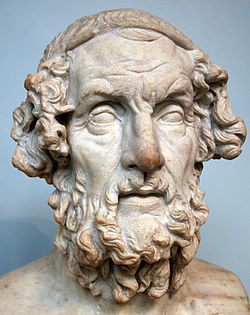
Homer: The hardest-working man in show business, 2600 years running.
Bards were essentially the world's first "touring musicians." In the days of Homer, a bard made a living travelling from town to town and singing. Bards lived off the kindness of strangers. Rather than comparing them to touring musicians, we should probably think of them more as travelling buskers. Second of all, bards didn't just play music, they also delivered news from the surrounding areas they had encountered along the way. They delivered messages and letters, when possible.

Even as recently as the 19th Century, books like The Last of the Mohicans were depicting the characters of travelling musicians as essentially poor but noble artists who live by their means and don't expect much in the way of riches to ever come their way. 

So, looking historically, not only has being a musician never really been a financially lucrative line of work, but what little money musicians were able to make wasn't solely a function of their being musicians; they offered other services, too. 

The whole concept of the "millionaire musician" is not only a modern construct, but it is seemingly a product of only the last 75 years or so. The music industry is now suffering from shrinking profits, and a logical person can probably suggest that music-sans-money is what we can more realistically suspect.

The Austrian School economist in me would suggest that modern music millionaires were probably able to generate their fortunes thanks to patent/copyright rules, record company/radio station collusion, and other such rent-seeking behavior. The music business is famously corrupt, and I think it's clear to most people that the biggest difference between the most popular artists and everyone else is often little more than the strength of the marketing campaign behind each group.

Hard Work and Musical Output
No music act in this day and age - at least none that I am aware of - works as hard as musicians used to. Consider the following excerpt of an interview with Geddy Lee of Rush.


You can plenty of other interviews with members of that band to corroborate the story told in this one. In the early days, Rush was touring 50 weeks of the year. In the Rush documentary, one of the reasons cited for replacing original drummer John Rutsey with Neil Peart is because Rutsey - a type 1 diabetic - could not possibly have kept up with the grueling tour schedule and pace of hard work that Geddy and Alex Lifeson were interested in, for health reasons. (How might music history have changed if Rutsey had had access to modern synthetic insulin at the time he was in the band!)

Of course, stories of Frank Zappa's work ethic are legendary. This is a man who, according to those who spent significant time with him, never stopped working. He was apparently "always writing," and of course he produced a catalogue of music that could only have been produced by a man who worked harder than anyone else. The number of albums he produced during his lifetime was well over 60, and on top of that he founded and ran his own record label and business to distribute his own music, produced films, became involved television and politics, and toured relentlessly.

I use the examples of Rush and Frank Zappa because they are arguably two of the last music acts that achieved their success without major record label funding. Perhaps Rush benefited from Canada's "Canadian content legislation," but no such thing can be said of Frank Zappa. Their success was gained for the most part through an unyielding tour schedule and a herculean creative output.

Compare that to the average artist today. The most ambitious of them release a few CDs, perhaps print some supporting merchandise (t-shirts and such), play a steady amount of local tours, and disband in a few years when it becomes obvious that they will not be signed to a major record label any time soon. They will film music videos for YouTube, sometimes run a small and not-so-grueling tour out of the back of a van, come home with many stories, but few new fans. But the hard work that was present in the early days of Rush or Zappa just isn't there. Sure, they think they're working hard, but measured in objective markers, there is no real comparison.

Part of this may be that music venues don't pay as much to live musicians anymore, and there are fewer such venues anyway. Without a doubt, the music market has changed, and the venues that traditionally offered live music acts can now meet the same need with a local DJ spinning the international hits over the PA system. But what have musicians done to respond to the changing musical dynamic?

This leads me to my next point...

Music Is No Longer About The Audience
Any casual glance at this year's (or last year's, or next year's) American Idol contestants will show you a group of people who want desperately to be stars. When you watch them perform, it is perfectly obvious that they are showcasing themselves, that they believe they have what it takes to be loved by everyone. They seek fame and adulation.

To some degree, music is always about fame and adulation in the sense that all musicians want the audience to love what they do. However, there is a big difference between wanting to do good work and wanting to be a star.

Today's musicians no longer think about what it takes to first draw, and second maintain, an audience. When they perform, few make direct eye contact with their fans. They are always complaining about the poor musical taste of the masses. They lament their low gig rates and poor turnout, but do nothing to address either of those problems. Aside from hanging a few posters and doing the rounds on various social networking websites, musicians don't work for their audience.

During a performance, virtually no modern musical act that I am aware of actually seeks to win the crowd over with performance antics and intra-song "routines." Frank Zappa, on the other hand, had countless ways to generate interest. He used to smash vegetables on stage, create an "audience participation segment" for every show, have "secret words" that he would use to prompt audience cheers, and so on. His band would also engage in routines - something like a short skit - between songs, often over the top of a simple, quiet musical accompaniment.

Take for example the gorilla routine that begins at 4:51 of the following video:


It's nothing major, but it is something that offers the audience a chance to see more than just a group of sweaty guys playing rock and roll. There is some care put into what the audience experiences. Even if an audience member isn't a fan of lengthy guitar solos, he or she still has something to see during that portion of the concert, even if it's just a guy in a gorilla suit acting goofy.

I repeat: such stage antics are not in the repertoire of the modern musical act. Modern musicians want simply to show up, do their thing, and receive praise. In the moment, the audience is the furthest thing from their minds. In the old days, though, musicians sought to offer entertainment that was audience-oriented.

Conclusion
These are only a few examples of how I feel that musicians themselves are bringing down the quality of modern music. There are certainly more. Does every problem with the music industry come down to the poor quality of the artists? Definitely not. Nonetheless, I feel that musicians are no longer pulling their own weight in the industry. Until they do, we can expect a continuing decline of music in general.