As time goes on, the better I appreciate the perspective of people like Thomas Sowell, who has mostly stayed out of the libertarian "scene" because he's not a joiner. For understandable reasons, he doesn't want to join a crowd of like-minded people. Instead, he prefers to use his mind to follow the facts and lead him to his own conclusions.
Of course, everyone says that this is what they do. Everyone says that they just analyze the facts and the data and make up their minds accordingly. The truth is, however, that most people filter their information through ideology. They embrace or privilege any fact that fits their preconceived notions and reject or penalize any fact that stands in opposition to what they want to be true. And, true enough, nobody's perfect.
Still, imperfection is one thing; actively fostering confirmation bias is something else entirely. Anyone who knows what confirmation bias is ought to be actively engaged in avoiding it. Sadly, many people know what it is, and work actively to promote it anyway.
For example: I recently saw a web-comic that claimed that all those who oppose allowing transsexual girls to compete with cisgendered girls in girls' competitive sports are really just bigoted against transsexuals. The exact claim was that you don't have to scratch very far beneath the surface to uncover anti-trans bias. I responded to this web-comic with some biological facts about how testosterone impacts athletic performance, and concluded my comment by saying that I didn't think everyone who is reluctant to allow such competition is automatically biased against transsexuals. The reply? "I never said that they were." No, the person to whom I addressed my comment did not - but the comic that we were all discussing sure did! How did that context get dropped?
Second example: In a discussion about how more people die from suicide by hand guns than are murdered by long guns, a friend of mine quoted someone who was arguing in favor of greater restrictions on hand guns. I emphasized a point in that quote, highlighting the fact that hand guns aren't seen to be as "spooky" as, say, AR-15s, and thus they don't get as much attention in gun control debates. Many people responded, essentially asking me what my point was. But that was my point. All of it. I didn't have a further agenda.
What these two examples highlight is a practice I've taken on recently, which I do increasingly more often. Rather than make a broad and all-encompassing argument in favor of X or Y, I like to find a simple point that every reasonable person can agree with, and highlight it. It has to be a factual point, and it has to be mostly unobjectionable. What I find is that highlighting this point also tends to highlight my interlocutors' own cognitive biases. They think I'm trying to "get them" (actual verbatim quote of one such person, by the way), when they've merely "gotten themselves."
To correct their opinions, they'll either have to come up with different reasoning for the same conclusion, or refine their reasoning to account for an undisputed fact that favors the other side. That's my agenda. Sticking to and emphasizing the bald facts and forcing people to consider them when they articulate their own points.
Today, while reading
Bryan Caplan's list
of "common sense" policies that no presidential candidates are
proposing, I had a thought about proposals for a "universal basic
income" (UBI).
Libertarians often
propose direct transfer payments as economically efficient alternatives to
traditional welfare. Thus, the so-called "libertarian case" for a
universal basic income involves scrapping all existing welfare programs and
replacing them with the equivalent per capita
universal basic income. In other words, if it costs the country, say $1000 per capita to deliver $500 in welfare benefits
to qualifying citizens, we could improve economic outcomes by delivering $500 in cash to qualifying citizens at less than $1000 per
capita. This is achieved by (1) eliminating the administrative burden of
submitting welfare applications, (2) eliminating "means testing,"
i.e. investigating welfare claims, (3) cutting the workforce at the welfare
departments, (3) passing the savings onto the taxpayers, and (4) empowering
welfare recipients to spend their money however they
think is best.
You might not agree
with the above argument -- I sure don't -- but that's how it goes.
This underlying
argument is often deployed on a much smaller scale. For example, when people
debate steel tariffs, economists are quick to point out that steel tariffs cost
American consumers hundreds of thousands of dollars per steel worker. If we really wanted to use policy to protect
the steel workers, we'd be better off scrapping steel tariffs altogther and
then paying each steel worker, say, $150,000 per year not to work at all. It sounds radical, and maybe it is, but the
point of the argument is to show how costly steel tariffs are, and how we could
lower domestic steel prices and still take care of American steel workers
without creating large market distortions that hurt everyone.
In thinking about
this, however, it struck me that the libertarian case for a universal basic income can be deployed against policies
that libertarians traditionally do not object to. One example is the armed
forces. It would be more economically efficient to eliminate the US armed
forces and use the Department of Defense's annual budget to pay all Americans
an annual self-defense stipend, which they could spend however they deemed
appropriate. Some would squander the money on non-defense spending, but others
would conscientiously invest in martial reinforcements for their homes and/or
communities, thereby eliminating market distortions and saving taxpayers money.
The reason most
people reject this proposal is because they broadly believe that the government
does a better job providing military protection than home-grown militias do
(for a wide variety of reasons). The idea that the government should just
shutter one of its essential functions and "pass the savings on to
you" suffers from the fatal flaw that it
still leaves you without essential services, such as basic military
protection against foreign military invasions.
What this reductio ad absurdum demonstrates is that
there is at least one case to which the basic libertarian argument for transfer
payments must be rejected: the case of "essential government
services," whatever that terms happens to mean to you. Obviously, if you're a left-leaning person, you will
tend to include more social welfare programs in the list of "essential
government services," and if you're a right-leaning person, you will tend
to include more national defense and infrastructure programs. In either case,
the argument simply falls flat.
And the reason is
simple. People don't care about saving money when it comes to essential care.
They'd like essential care at the lowest possible cost, of course, but they
would still rather ensure that the government spends money and provides
essential care than eliminate essential care and disseminate the savings among
the populace.
One group of people
are clear exceptions to all of the above argumentation, however: Anarchists,
especially anarcho-capitalists.
One of the things
I've learned relatively recently, say, over the past two or three years, is the
value of phrasing things carefully and not overreaching in my arguments.
I think David
Henderson is particularly good at this, and one of the reasons I think he is so
careful in what he says is that his style of persuasion is extremely modest. He
doesn't try to turn a non-libertarian into a libertarian. Instead, he focuses
in on a narrow but important point, and finds something about that point that
his interlocutor can agree to. This is almost never enough to win over someone
completely to his point of view, but it's usually enough to get someone to
think twice their own position. That alone is a very powerful thing to do, and
one shouldn't miss out on an opportunity to do this in a futile pursuit at
arguing against a person's entire ideology. Don't let the good be the enemy of
the perfect; keep your eye on the prize.
This endeavor is not
without its own set of pitfalls, though. For one thing, people can be
suspicious of my motives. If someone knows that I'm a libertarian, they can be
highly suspicious about my reasoning for making a modest point, and thus refuse
to give any ground at all. If I make a point that tax collection rates don't respond much to increases in tax rates,
for example, my interlocutor may be reluctant to admit that this is true, even
though it is a well-documented empirical fact. My interlocutor might mistakenly
believe that if he/she gives even a little bit of ground on the modest point,
I'll have a death-blow waiting right behind it. It's not as if a simple fact
about tax collection rates completely refutes any argument for higher taxes,
but some people approach debates from the standpoint that they must win every point in order to win the whole debate.
I have two responses
to this. First of all, that's an awfully Manichaean way of looking at the
world. In reality, a belief I favor is often mostly
good and always involves a few negative trade-offs I'm willing to bear.
Nothing is one hundred percent perfect, so we shouldn't expect it to be. We
ought to seek out the negative trade-offs of a strongly held belief and be
forthcoming and realistic about dealing with those trade-offs. Second, it's
childish not to be willing to give any ground or concede any point whatsoever.
Those who choose to behave that way are, ultimately, doing their position a
severe disservice by making it appear to be unrelenting. Nice people, friends
and family, who discuss and debate any sort of issue, large or small, will tend
to want to give their friends and family credit for making a reasonable point.
It's the mark of someone who doesn't care at the moment to be particularly nice
who refuses to concede any point at all.
Meanwhile, what one
discovers when one focuses on careful wording of modest claims is that most
people who passionately argue for or against something argue against the
"larger something," not the "smaller something." That is,
people who, say, favor higher tax rates argue for higher tax rates in a
"macro" sense. They will take any excuse to make these arguments, and
a carefully worded, modest claim will only serve as a springboard to get them
going on their "larger something." Again, such people aren't
interested in truth-seeking, they're interested in forming a diatribe. They're
entitled to do so, but we don't really learn new things that way.
What new things do
we learn when we make carefully worded, modest claims? Well, mostly we learn
the best reasons underpinning our beliefs. We learn to discard the bad reasons,
the poor arguments, and the false claims. We gain a little good faith with members
of the opposition, who might start to view us as being more pragmatic and less
quixotic. And we gain a great deal of confidence in our own position, since we
know exactly how far it can be taken.
When you're trying
to be persuasive, the best way to tell whether you're up against insurmountable
opposition is to analyze the points on which people disagree with you. If
people stay mainly on-topic, then there is hope of having a productive
conversation with them. If people stray from the topic at hand and instead
focus on disputing the particulars of your arguments, then you may as well stop
talking and go for a soda.
I'll call this
"the pedant's fallacy." The pedant's fallacy occurs when someone
attempts to defeat a narrower aspect of an argument in order to discredit the
larger point.
The classic example
of the pedant's fallacy is when someone harp's on another person's spelling or
grammar in an online debate. This happened in a debate I was a part of the
other day. One person made a claim; a second person said, "That makes no
since;" and a third person chimed in only to correct the second person on
his spelling of the word sense. The
third person was committing the pedant's fallacy. The second person's argument
might be right or wrong, but the veracity of his argument has nothing to do
with his accidental use of "since" in place of "sense."
Another common form
of the pedant's fallacy is to dismiss an argument if its supporting evidence is
supplied from Wikipedia.
Person A:
"Wikipedia tells me that eating mustard oil causes heart disease."
Person B:
"Well, Wikipedia isn't a reliable source of information!"
Notice that Person B
didn't address any argument about mustard oil or heart disease, he simply
started a new argument about the integrity of Wikipedia as a source of
information. If Person A allows herself to be drawn into that new argument,
she'll soon discover that if she loses on that one point, Person B will assume
that he's proven something about mustard oil
and heart disease. But he will not have done so, and this is precisely
what makes his argument fallacious.
Keep in mind,
however, that there is no point telling the pedant that he has committed the
pedant's fallacy. Most likely, he'll just argue about that, and then you'll be even further away from the topic you
began discussing in the first place. It's absolutely vital to understand this.
People who commit the pedant's fallacy are not interested in the core argument
you're making. What they're interested in is shutting you up and making you
feel wrong.
By contrast, people
who actually want to have a discussion with you will have no problem staying on
topic, because they're interested in the topic itself, even if (or possibly because) their position is opposite yours. You
never have to worry that someone who is enjoying the conversation will harp on
your spelling or the integrity of your sources until that becomes material to
the over-arching debate. Then and only then will they bother to make a big deal
of it. They'd rather just respond to your material arguments with material
countervailing arguments of their own. That's how a good discussion unfolds.
Person A: "I don't think America will build its immigration wall, because as Churchill said, 'Americans will always do the right thing, eventually.'"
Person B: "I
think America will build its immigration wall, because populism is at an
all-time high and anti-immigrationists are electing more Congressmen these
days."
Person C:
"That's not what Churchill said! You got that quote completely
wrong."
Needless to say,
only Person A and Person B are having a real conversation here. Person C is
just an asshole.
It's important to
acknowledge what drives a person to the pedant's fallacy. Mostly, it's a form
of laziness. It takes hard work and careful thinking to construct persuasive
arguments that overturn someone else's carefully constructed, persuasive
arguments. It's much easier to harp on their spelling and grammar, the
historical accuracy of one of their points, and so on. It's easy to be tempted
into the low blow when you're not really committed to the discussion in the
first place. If you don't have the time or attention to give to someone's
argument, you might be tempted to defeat them the easy way and get out clean
before you sink all your time into a protracted debate. But you'd still be
committing the pedant's fallacy.
It's also a snarky
way to appear very clever. If someone produces five different scholarly journal
articles that substantiate their point, and you find a problem with one of the
sources, you can certainly bring it to their attention. But to use that one bad
source as a refutation of the other person's entire
argument is pedantic and mean. One bad source doesn't defeat a good
argument. Furthermore, it's not enough that even all of the sources are bad if
you haven't taken the time to put forth good sources and a good argument
yourself. This kind of snarkiness enables a lot of bad arguments to persist. If
you're so clever, then you ought to be able to defeat an argument on the merits
of your own position, not on the questionable sources of the argument you're
responding to.
If someone says,
"Based on Source X, I believe that Statement Y is true," it's not
enough to say, "Source X is a bunch of crap." That doesn't respond to
the person's argument. You could instead say, "Source Z refutes Source X
for the following reasons, and these reasons support the rejection of Statement
Y." That's a material objection. Or, you could say, "Source X seems
to say the opposite of what you're saying; why do you think it supports
Statement Y?" That's a material question. But to object to Source X
without any further argument is stupid, even if Source X is ridiculous.
So, there are some
attractive reasons to resort to the pedant's fallacy, but we should still
resist the urge. If you disagree with someone's argument, you should choose to
engage them or not. What you should not do is engage them only on some narrow
act of pedantry and disregard the broader part of the argument. That's not a
nice way to talk to people.
As a long-time
blogger, I have more than my fair share of experience with frameworks. For my
purposes here, I'll use the word "framework" to apply to any
systematic conceptualization of an issue. A framework is any structured way of
looking at anything at all, any narrative that does the job of conceptualizing
the matter in a way that makes it easier to think about.
To use plainer
language, human beings have a tendency to do their thinking via the use of stories. The Big Bang Theory isn't just a set
of laws about physics, it's a narrative that tells the story of the creation of
the universe in a way that can be absorbed by ape brains. Before we had the Big
Bang Theory, we had other theories about the creation of the universe, and most
of them really were stories, written in
storybooks, which characters who said dramatic things like "Let there be
light!" Over time, as we learned more about the universe, we spent less
time on those stories, and eventually replaced them with a new one. It would not
surprise me at all if we were eventually to replace the Big Bang Theory with a
new narrative, one that does a better job of narrating the earliest moments of
the universe. Should that come to pass, it, too, will be told as a story.
Stories are useful
for what they describe, and useless for what they do not describe. This sounds
obvious, but the importance of it is not obvious at all, so I will illustrate
with an example: Comic books from the 1950s are really useful for telling cool
stories about magic superheroes; but they're really awful, completely useless,
for telling stories about how men and women should treat each other. Comic
books from the 1950s are broadly sexist, by today's standards, and possibly
even by the standards of the 1950s. People still read those old comics from the
so-called "Golden Age," but they don't read them in order to learn
about gender relations. The only reason anyone reads old comic books is to
enjoy cool stories about magic superheroes. These comic books serve that purpose very well; but we shouldn't use
them to explore civil equality unless we're looking for a What Not To Do
manual.
***
Back to my main
point: frameworks are useful for
describing what they describe, and useless otherwise. Yesterday,
I mentioned a possibly racist Scott Sumner blog post. That an example of a
framework poorly matched. The "strongman" hypothesis of Donald
Trump's political success may be a useful framework for analyzing the current
presidential administration - it's not my preferred framework, but I have seen
people use that framework to make good points. But the "strongman"
hypothesis is not a good framework for describing the results of public opinion
polls among Hispanic Americans. It's important to use your framework only for
its purpose, to avoid extending it beyond its usefulness, and to only apply it
to new subject matter experimentally. (That is, maybe it would be interesting
to apply the "strongman" framework to a physics problem or a problem
in psychology - but also maybe not; feel free to experiment, but remember that
it is only an experiment, and be ready to reject what you find as readily as
you might accept it.)
Being wrong is one
way that a mismatched framework can cause problems. Being confusing is another
way. This latter thing is arguably much worse. For example, this AOC
congressgirl recently presented a policy wish-list that attempts to apply the
Socialism framework to the Environmentalism problem. One reason this attempt is
problematic is that it is wrong: there is probably not enough taxation and
redistribution in the United States to change the course of global climate
change, especially considering that the major polluters today are in other
countries, such as China and India.
Like I said, the
mismatched framework is bad because it's wrong. But more problematically, it's
bad because it's confusing. If people come to believe that climate change can
be solved by merely passing legislation then we won't stop climate change at
all. Climate change is not a political problem, of course, but a science problem. It may also be an engineering problem, since technology must be
invented to clean our air and our oceans and to establish more environmentally
sustainable ways of housing human beings and processing our waste. It might
even be true that legislation can help direct us toward addressing the science
problem or the engineering problem - the reader knows where I stand on that,
but let's concede that it's possible. Even though it's possible, climate change is still
fundamentally a science problem that must be conceived of in a scientific
framework and solved through a story about science. Not a story about legislation. Our environmental problem is not
that too few people understand politics; it's that too few people know how to
do the kinds of science and engineering that we need to stop climate change.
We'll never get there without the right framework, and time spent on the wrong
framework is confusing us.
***
We also experience
frameworks for dealing with our every-day lives, and thus we experience the
same kinds of pitfalls as they pertain to our individual relationships.
Take your sibling,
for example. Early on, you developed a framework for understanding the
thoughts, feelings, and actions of your brother or sister. To the extent that
this framework was accurate and did a good job of explaining your relationship,
it was useful. One day, though - or, more accurately, over the course of many
years - your sibling grew up and became a new person. It would be foolish to
attempt to explain the actions of your adult sister by referring to a childhood
framework about her motivations, based on how she once played Monopoly with
you.
That's extreme, but
we don't have to rely on extremes. It would be foolish to apply the framework
you built that explained your brother's drive to be a high school varsity
football player to your 40-year-old brother's recent divorce. If you want to
apply a framework to your brother's recent experiences, then you need to learn
about what he's been through lately and
find a framework that explains those
experiences. In short, you need to accept that your adult siblings are
not exactly the same people you grew up with, that they have been shaped by the
years, and that the old frameworks never apply.
Failing to do this
will cause relationship problems. The map has to match the territory, as the
saying goes.
***
An additional
problem arises when we try to apply macro-frameworks to micro-problems.
Consider how wildly inappropriate it would be to analyze your relationship with
your sister using the framework of climate change! It sounds ridiculous,
doesn't it?
Why, though, do we
not hesitate to apply the feminist framework to the child-rearing problem? Why
do we become so entrenched in our feminist framework (or, equally, our
anti-feminist framework) that we work to make our children an incarnate
representation of our beliefs about gender equality?
Why do we attempt to
indoctrinate our children in any such ideology, forcing them to behave in
accordance with what we see as universally and morally right? Why do we pat
ourselves on the back and tell ourselves that we're good parents when our
children repeat our own nonsense back to us for approval? Why do cry out in
anguish when our children grow up to develop their own ideas about morality and
behave in accordance with that new set of morals, so different from our own?
Why do we consider that a failure? Why do some parents consider it a failure if
their children grow up to gay, or Democrat, or atheist, or a lawyer, or…?
The answer is simply
this: We've mismatched the framework and the problem. Child-rearing is not an
ideology problem, and so should not be understood using an ideology framework.
Parent-child interaction is not political, and so it should not be understood
using the framework of politics. Indeed, I'll even go this far: raising a child
is not a spiritual problem, and thus
cannot be understood using a religious
framework.
I'm not saying
ideology, politics, or religion are bad; I'm saying that those frameworks only
apply to ideological, political, or religious problems, respectively. Using
religion to understand child-rearing is as erroneous as using religion to
understand a physics problem, and the results will be similar.
Nor can you use
these macro-frameworks to solve any of your other micro-problems. You can't get
a promotion at work using an ideological framework; how would that even work?
You can't mend fences with an old friend using a religious framework; god may
have told you to forgive, but nobody told you to steal his lawnmower. You can't
pay your weekly grocery bill by thinking about red states vs blue.
***
Frameworks are
highly attractive, because narratives are the way human beings understand the
world around them. Despite all that, the application of frameworks comes with
deep pitfalls with respect to matching the correct framework to the correct
problem. Not only must we choose frameworks that accurately reflect the problem
we're trying to solve, as measured by the usefulness of the framework to
describe that problem, we must also apply the right level of framework to the
right level of problem. At best, choosing the wrong framework will result in a
wrong solution, and your problem will go unsolved. At worst, though, choosing
the wrong framework will cause persistent confusion that will render your
problem unsolvable.
Tyler
Cowen reminds us of a blog post he wrote seven years ago, “Books
which have influenced me the most.” At the end of this earlier post, Cowen
writes, “I would encourage other bloggers to offer similar lists.” It sounds
like fun, and I’d like to do just that.
First, though, I need to add a caveat. Cowen’s book lists
are interesting predominantly because Tyler Cowen is very secure in who he is.
He clearly understands his role as a blogger. He’s a cultural critic as much as
an economist, if not primarily a cultural critic. Every day we learn a little
bit more about his personal tastes in books, music, food, and ideas. On his blog,
he presents himself as the kind of person who can add interesting commentary to
virtually any topic, the kind of person who functions as the most important
guest at a party, even if not the life of the party. He’s the sort of man who
can keep conversation headed down interesting and elucidating pathways, mostly
by knowing how to ask the right questions. But if no one’s asking the right
questions, he’ll gladly answer them himself, and then put the question back to
everyone else when he’s finished.
In short, we’re interested in what books influence a man
like that because a man like that is very interesting and has diverse tastes
and thoughtful observations.
By contrast, who am I? I don’t mean to say that I’m
unimportant or a nobody or that people shouldn’t care much about me – that’s
not for me to say, anyway. I just mean to ask the question, if you happen to
come across my blog for some reason, why should you care which books influenced
me the most? It’s unlikely that you’re curious about that because you’re
curious about how I think. I’m not the life of the party and I’m only recently
learning how to ask the right questions. My observations can be controversial,
but they’re unlikely to cause anyone to think and ponder for a long time.
No, you’d more likely be interested in a list like this to either
get some random ideas for book suggestions, or to compare my list to the list
of books you like best.
I’ll present my list in that light. This changes the contents
of the list a bit, but don’t worry about that.
So here they are, in no particular order:
I. The Castle by
Franz Kafka. I was already a Kafka fan when I found my copy of this book – a 2nd
English language edition – in the back of a moldy used book store somewhere in
California. The thing I love most about this book is that, at the time I read
it, I didn’t have a lot of experience with bureaucracy and didn’t fully
understand what the book was about; yet as my life unfolded, my thoughts would
return again and again to this book each time I encountered a relevant
experience in my life. So the book and its themes and messages stuck with me
even though I didn’t come to understand them until later.
II. Epistemological
Problems of Economics by Ludwig von Mises. After Human Action, I think this is Mises’ most important work. Because
of my personal interests, I learned far more from the former than I did from
the latter. It is a wonderful book for learning “the economic way of thinking.”
It’s also quite a bit lighter reading than Human
Action, which helps its contents stick to your grey matter a little better.
I think this should be required reading for undergraduate economics students.
III. The Island of the
Day Before by Umberto Eco. It’s not his most popular book, but this one was
seemingly written just for guys like me. It’s a book about a young man who
commits himself to loving from afar. He never endeavors to win the heart of his
love so that he can continue cherishing her from afar. This decision serves to
influence everything else that happens in his life. In true Eco fashion, the
various events in the story all come together in a superb metaphor unlike
anything I’ve ever read before. And the ending is open-ended, left up to the
reader on purpose. I won’t spoil the ending for you, but Eco allows us to
finish it as we please, which is of course the whole point of the story.
IV. Atlas Shrugged
by Ayn Rand. Screw the haters. Much has been written about what a terrible book
this is. I always found the book to be a wonderful character sketch, probably
because I actually knew people in real-life who had parallel characters in the
story. The ideas in that book won me over from the more left-leaning political
traditions, kindled my interest in economics, and served as a source of
inspiration for many, many years. I’ve read this book several times and, sadly,
I now feel a pang of shame whenever I pick it up, not because of what I think,
but because of how badly people are excoriated for enjoying it. That’s not
fair. This is a good book. It’s made big waves for valid reasons. No book is
perfect. This is a good book.
V. Moby Dick by
Herman Melville. This one just might get my vote for the greatest novel in the
history of mankind. Surely it is the greatest novel in American history. I
first read this book in junior high school, heavily abridged. We’d skip whole
chapters and focus entirely on the action in the story. As a result, much of
the meaning in the story was lost on me at the time. I still enjoyed the book,
but not like I do when I read it now. To be honest, I am surprised the modern
school systems allow this book to be taught as standard curriculum. It’s
boldness in challenging sacrosanct American virtues like Christianity and
Existentialism make it the kind of book that would likely be banned if more
people understood what it was really about. But that’s the beauty of it,
really. There are easter eggs in every paragraph of this book. The prose is
directly allusive to specific works of Shakespeare, and to the Bible. Yet all
the same, Melville manages to tell the tale in a merry, witty way, in a voice
all his own, and to teach us something about “chasing the dragon” along the way.
It’s a masterpiece.
VI. A Profile of
Mathematical Logic by Howard DeLong. This is essentially a textbook of
mathematical logic. As such, there is not a lot I can say about it that will
interest blog readers, except to say that it is perhaps the clearest and most
elucidating book on mathematical reasoning I’ve ever read. I’ve always been “just
okay” at math. Reading this book helped me become “a math guy.” I’m still not a
great mathematician, but at least now I can engage in mathematical thinking
without fear. If you have the prerequisite math background, I can confidently
say that this book can do the same for you.
VII. The Illuminatus!
Trilogy, by Robert Shea and Robert Anton Wilson. I thank my sister for
introducing me to this book. It is full of sex, drug use, and fowl language, but
it is one of the best books a well-read person could possibly read. Almost
every major book is referenced somewhere in this novel, and usually lampooned.
The story is confusing and psychedelic. It’s reflective of the hippy culture
that influenced. It’s a great book for all the wrong reasons, but it still
somehow manages to present a wonderful vision of libertarian possibilities and
radical freedom. I don’t recommend it for kids, but I do recommend it.
VIII. The Count of
Monte Cristo by Alexandre Dumas. This classic and cautionary tale about
vengeance and obsession is the kind of book that every youth reads about ten years
earlier than they really should. While it’s certainly accessible to the more
youthful reader, the situations it describes simply don’t mean as much until
after one has a few more years under his belt. Unlike Dumas’ more popular The Three Musketeers, The Count of Monte Cristo’s primary
source of action is its nail-biting dialogues. I think it’s superb how, over
the course of the book, we gradually go from cheering for the hero to… possibly
cheering against him? Hoping that someone stops him and that he learns his lesson?
Again, younger readers will be dissatisfied by the fact that the hero doesn’t
remain a hero all the way through, and that we’re left with a deeply flawed human
being who could have been a hero. By adulthood, we can better appreciate ideas
as heroes, rather than people.
IX. Better Training
for Distance Runners by David Martin and Peter Coe. This is another
textbook, one on exercise physiology. The technical sections can be a little
dense, but if you don’t mind learning the basics, then the rest of the book
will reward you with an excellent primer on how to train, really train, as a
distance runner. I think a revised version of this book, with more simplified
physiology sections and more compelling prose, would make an excellent book for
high school coaches and athletes, and would make a lot people healthier and
happier with their running.
X. Son of the
Revolution by Liang Heng. This book is a personal account of what it was
like to live through the Cultural Revolution in Communist China. It is
important as a documented account of communist life, but it is perhaps even
more important as a lesson in the universality of human reactions. The Cultural
Revolution produced nation-wide witch hunts that evoke the mob mentality that
envelopes any country when a mass delusion takes hold, whether it come in the
form of “terrorists” or “drug lords” or “racists” or anything else. Liang Heng
is a wise man who lived through a terrible set of circumstances, came out on
top, and was willing to pass along his life lessons for the rest of us.
Here’s a quote from a
recent op-ed about Peter Theil and the US presidential election:
My guess, based on zero data, is that, had I mentioned Peter Thiel one year ago, only a handful of readers would have recognized his name. And, had I told you that he was one of the founders of Paypal and the first investor in Facebook (he’s even portrayed briefly in The Social Network), my guess, again based on zero data, is that your opinion of him would have instantly improved. “Tell us more about this Thiel,” you would say.
Forget about Peter Thiel and Donald Trump for a moment, and
just pay attention to the phrasing in that passage. The author uses the phrase “based
on zero data” not once, but twice. Of course, substantiating the author’s “guess”
with empirical research is a pretty silly concept. It’s not relevant to the thrust
of the article. I choose to highlight it here, however, because it reveals
something about our modern perspectives. In a bygone era, an author might have
chosen to say “I suspect,” or “I’d wager,” or “I’d venture to guess…” but
today, this author – along with many people out there – choose to stipulate
that they are saying so in spite of not
having analyzed the matter empirically.
The implication here is that analyzing the data is the conceptual
default. Welcome to the modern age. We are all data analysts now. The question
from here is how we can expect this fact to color our perspectives.
Recently, someone on my Facebook feed made a jibe at a
certain kind of person for believing a certain kind of thing about the Cold
War. The jibe was that sociologists should study why that certain kind of
person had reached a certain kind of conclusion, followed by a very
ideologically charged epithet for the Soviet Union. Because I happen to know
people were alive during the Cold War who grew up in countries that benefitted
from Soviet foreign policy, and because I happen to believe that Westerners do
not have the total story regarding Soviet foreign policy, I added a comment on
Facebook suggesting that the hypothetical sociologist should include the perspectives
of residents of the Third World.
This comment resulted in immediate demands for which people,
which country, which events, I was thinking of. Naturally, I avoided naming
specifics – not because I couldn’t give them, but because I didn’t want a
debate about the merits of a particular Cold War policy to distract from my
real point, which is that one’s perspective on the Cold War is invariably
shaped by which narrative one most identifies with. In the US, we’re accustomed
to thinking of the USSR as an “Evil Empire.” In the Third World, the question
really comes down to which major world superpower had the biggest impact on one’s
country – and was that impact positive or negative? This is why Nelson Mandela
famously chose to work with the USSR despite Western objections, because the
Soviet Union had helped Mandela’s cause when no one else would. You could argue
that Mandela was a communist and the Soviet Union helped him only for that
reason, but again this really only distracts from my point. My point is that
the USSR wasn’t a villain to everyone. Anyone interested in a complete history
of the Cold War ought to do a proper accounting of everything.
But my point fell on deaf ears because all anyone could do
was demand which country, which events – empirics, empirics, empirics. Let’s
see the data and analyze it. Hand it over. This speaks to the core cognitive problem
we face today: we approach everything as though we are data analysts. That
makes us very good at solving problems that can be solved by data analysis; it
makes us horrible at solving other kinds of problems.
Similarly, I came across a recent Facebook post (a public
one, so feel free to hunt it down if you’re so inclined) by Less Wrong religious leader Eliezer
Yudkowsky, arguing that everyone should vote for Hillary Clinton because the downside
risk of a Donald Trump presidency is World War 3. That’s not an exaggeration –
that really and truly is what Yudkowsky said. Of course, the reality is that
World War 3 may happen – or not – regardless of which candidate wins the
election. The only reason Yudkowsky counts this as a risk of a Trump
presidency, and not a Clinton presidency, is because Yudkowsky is biased. This should be perfectly clear because, as I
just said, World War 3 can happen under any set of assumptions; Yudkowsky only
includes that set of assumptions in his estimation of a Trump presidency.
But, remember, this is how Bayesian reasoning works.
Yudkowsky is willing to bet on WW3 + Trump, and unwilling to bet on WW3 +
Clinton; ergo, it is more probable until he decides to “update his priors.” He
thinks it, therefore it is. Now we can finally see that Bayesian reasoning,
when done incorrectly, is basically magical thinking.
Bayesian reasoning done
correctly, however, can be a powerful way to solve statistical and
machine-learning problems. In other words, it’s good at solving data analysis
problems, but bad at solving foreign policy problems. As you can see, the
problem runs deep.
It gets worse: A common trope among the libertarian crowd is
that voting is ineffectual on the margin, thus it doesn’t matter whether or not
you vote. But, if everyone acted on this information simultaneously, then no
one would vote and the thesis would invalidate itself. So this notion is
actually a paradox: completely meaningless, utter nonsense. Voting is
marginally ineffectual because voting itself is effectual. Similarly, profits
are maximized when the marginal profit of the next unit is zero. It would be
stupid to say that “producing gallons of milk is a waste of time” just because we’ve
reached the point of diminishing marginal benefit. But when we’re stuck
analyzing problems from a data analysis mindset, we undermine our ability to
solve problems through other means.
And that’s just politics.
Think about all the other areas of our lives that are surely suffering due to the
fact that we’re stuck in a data analysis paradigm.
I got a good laugh out of this answer on Quora about which kind of motorcycle is better, between Kawasaki and Harley-Davidson.
Woman gets attacked by a bear during a marathon in New Mexico. I had heard rumors of this happening to people, but this is the first confirmed case I know about. I used to run races that had bear disclaimers, so it must be fairly common, anyway.
I stumbled upon this long interview/jam with Richie Kotzen from the mid-2000s, and what struck me most is how much better he's gotten as a musician despite the fact that he was already awesome back then.
The Houston Chronicle provides an exhaustive list of reasons why Trump's policies-or-rhetoric (since we don't really know what the heck it is) are bad for Houston, bad for Texas, and bad for the United States.
In true Stationary Waves fashion, my latest piece at Sweet Talk Conversation touches on a little bit of everything: music, logic, philosophy, illusions, and trying to figure out how to become a better person by thinking-the-crap-out-of everything.
Well, it's way too convoluted to excerpt, so read the whole thing.
Over at a website called LearnLiberty.org, Matt Zwolinski has a piece defending recent California legislation that would revoke state funding to institutions of higher learning if those institutions did not add "affirmative consent" language to their sexual assault policies.
In his defense of "affirmative consent," Zwolinski highlights three scenarios in which "no means no" is an insufficient policy because, in some cases, victims of sexual assault cannot say no (footnote omitted for brevity - click through to view it):
Intoxicated: After consuming a significant amount of alcohol in A’s presence, B passes out on the couch. A then undresses B and has sexual intercourse with her.
Afraid: A and B meet in a bar and go back to A’s apartment. B rebuffs A’s advances. A smiles at B and says, “Look, you’re alone with someone you don’t know, who’s much bigger and stronger, and, for all you know, has beaten and raped several women. Maybe I’m not as nice as I seem.” B is very frightened by A’s remarks and does not resist A’s advances.*
Incapable: B is a 19 year-old woman suffering from a severe intellectual disability, with an IQ of 59. A is aware of B’s condition, and begins to play a “touching game” with B, involving mutual undressing and touching of genital areas. B engages in this activity without protest.
There's only one problem: All three of Zwolinski's examples are already violations of the "no means no" guideline and existing sexual assault laws. Zwolinski has argued a red herring - nobody who opposes the new California Senate Bill disputes the illegality of any of the above scenarios under current law.
So how does identifying three indisputable violations of an existing law build a case for a new law about new guidelines? It doesn't.
Zwolinski spends the bulk of his article defending the moral validity of the concept of affirmative consent, and on that I definitely do not disagree with him. But who does? As far as I can tell, no one. This amounts to a second red herring - who are all these people who don't feel that they need affirmative consent during a sexual encounter? Who is Zwolinski arguing against, exactly?
There is one final problem with this senate bill, one that Zwolinski suspiciously does not mention in his defense of it: The law holds universities responsible for enforcing affirmative consent policies, even though affirmative consent doctrine is not actually part of the legal definition of consent. Thus, universities' enforcement of this policy presents two threats to democracy.
The first is the fact that the legal definition of consent can be changed without direct legislation to that affect. The senate bill doesn't change the law about sexual assault, it changes the law about publicly funded institutions of higher learning. It requires that universities adopt a certain guideline - one that is different from the exact letter of the law, and one which both Zwolinski and the bill's proponents expect the university to enforce on its studentbody.
Which brings me to the law's second threat to democracy: It turns university administrations into quasi-judicial bodies expected to investigate, try, and enforce sexual assault cases extra-legally. The problem here isn't merely that the law turns universities into judge, jury, and executioner (although, it does). The problem is that all of this is happening without due process of LAW.
For the life of me, I cannot understand why a self-professed libertarian would think this kind of legislation would be an overall improvement to liberty. Perhaps Zwolinski will at some point clarify his thinking here. Right now, though, I just don't get it.
The following appeared here, but is now only available here.
They have failed to acknowledge the hurt and pain that such a large part of our community feel. They have again and again shown that they are committed to an ideal of free speech, not to the Silliman community.
It's difficult to know where to begin here, but let's start with this: Words are a threat to no one's community. If such a community existed that could be threatened by the mere utterance of words, then that community would simply not last very long.
Among the many things that make up a community are logic and ideas. If the free-exchange of logic and ideas must be suppressed in order to foster a community, then it is safe to say that that community is based on lies and illusions. The notion that feelings could override the importance of logical truth - arrived at by a free and robust discourse - is on the one hand infantile and on the other hand narcissistic.
But above all, it is preposterous. And, as the author of the piece, Jencey Paz, herself indicates, it is a threat to free speech.
Using Google's webcache feature, I was able to read some great comments posted beneath the op-ed. Here's an excerpt from "Tony," a self-described gay man:
Being overly sensitive is a weakness, full stop. You must be stronger than those who would do you harm. But you’re not even facing those people. You’re facing allies. When has weakness ever achieved what strength can’t?
Commentator "Patrick" leaves a comment that is damning to the author, if true:
From Yale’s “Intro To Undergrad Education”:
“Freedom of expression is especially important in an academic community, where the search for truth holds a primary value. In 1975, a committee chaired by the late C. Vann Woodward, one of Yale’s most distinguished professors, issued the Report of the Committee on Freedom of Expression at Yale, informally called the Woodward Report. This document emphasizes that the history of intellectual growth and discovery demonstrates the need to be able to ‘think the unthinkable, discuss the unmentionable, and challenge the unchallengeable.’ The report acknowledges that such freedom may sometimes make life uncomfortable in a small society such as a college. But it also asserts that ‘because no other institution combines the discovery and dissemination of basic knowledge with teaching, few need assign such high priority to it.’
Yale’s commitment to freedom of expression means that when you agree to matriculate, you join a community where ‘the provocative, the disturbing, and the unorthodox’ must be tolerated. When you encounter people who think differently than you do, you will be expected to honor their free expression, even when what they have to say seems wrong or offensive to you.”
It would be tempting to "pile-on" here and make Jencey Paz's life a living nightmare, especially since it is the so-called "call-out culture" to which she obviously belongs that tends most often to publicly shame and humiliate people until they are unemployable pariah's. The above post reflects my best attempt at resisting that urge. I do, however, believe that her name ought to be made public and that op-ed recorded in the internet for the future, as a testament to what the loss of liberty looks like as it happens.
I don't remember the quote exactly, but at some point Ayn Rand wrote that there are "sundry libertarians" who accept Objectivism's conclusions but reject either Objectivism's metaphysics or its epistemology, I forget which.
I don't want to comment on that, specifically, but the quote came to mind when I started reading this post from Robert Murphy. Reaching for a "gotcha" against open borders advocate Alex Tabarrok, he remarks that if you don't think it's okay to use guns to prevent immigration, then you must also not think it's okay to use guns to defend yourself in any other context. The gist of Bob's point is that, on some level, we all accept the use of violence as a deterrent against being attacked, so when Tabarrok claimed that doing so is morally problematic with respect to migration, Bob moved in for the "kill."
The ensuing comments made it clear that Bob's view is a common one, and that view basically boils down to, hey, if you violate the Non-Aggression Principle against me, then I will make you pay! My problem with that is that it seems to violate the spirit of the NAP. The whole point of this principle is to highlight the fact that a peaceful society requires little more than clearly defined rights coupled with a society full of broadly well-intentioned individuals.
The NAP is not, as some people seem to believe, a justification for surrounding your property with mines and hungry alligators in a moat and daring someone to trespass. That kind of attitude might be consistent with the NAP, but it is fully bereft of the kind of thoughts a non-aggressive person should probably have.
In other words, it accepts the Non-Aggression Principle, but rejects its metaphysical underpinnings.
It sometimes seems that there are a great many of us who view issues this way. That whole Civil War thing is another classic example: it's clear that, despite the rhetoric, human slavery was a major component of the Civil War. If one were to defend the Confederacy for all those technical states-rights reasons, that person might have a consistent and logical argument in his or her favor. But still: SLAVERY. You know?
If you're escaping a major moral indictment on a philosophical technicality, then you might have the better argument, but you're still immoral. Our purpose as moral agents in a society is not to push the boundaries of moral reasoning in order to get ourselves off the hook, but rather to err on the side of morality.
The following is a synopsis and expansion of a series of comments I left under a post at SlateStarCodex.com. Toward the end of the debate, a few fellow commentators remarked that I was making the case for frequentist inference, which - because I am not an academic statistician or philosopher - is something I hadn't heard of until yesterday.
Now, I'm not very fond of putting all opinions into categories, and I reiterate that I only heard of frequentist inference yesterday, so I'm not ready to declare to the world, "World, I am a frequentist inferror!" But I did a little reading up, and it does seem to reflect my approach to probability. Moreover, I'm pleased to learn that I wasn't just spouting a bunch of crazy-talk, and that intelligent people had traversed that path before I.
Enough preamble, though, let's get to it.
* * *
My core claim: I think LessWrong-ers set themselves into a pattern of thinking that is ill-suited to the majority of the human experience.
* * *
Here's a quick example of why I think so, to help initiate the discussion:
Suppose Eliezer Yudkowsky asked me to assign a probability to whether a sentient robot will murder a human being during the next, say, 20 years. Setting aside the fact that technological advances are not a probability (because they are the product of deliberate human action) and focusing solely on the question of the robot itself – assumed to exist – choosing to murder a human being, this is not a question of probability, because volitional acts don’t "just happen." It's not randomness that causes someone to murder someone else, there are deliberate thoughts and actions going on, and these things cannot be assigned "likelihoods" based on anything rational.
Now, it's possible to suggest that all things that human beings do are purely random phenomena, as some eventually claim. They say that human brain functions are subject to quantum mechanics, and there is randomness involved there. But it would be disturbing to use that fact to suggest that, at any given moment, there is an X% chance that you will murder someone (even if the chance is very small). At the risk of sounding harsh, such a belief sounds a lot like a psychotic break to me.
On the other hand, we could indeed observe that. each year, X% of people commit a murder. We can ask, “What is the probability that next year, the number will be Y% instead?” The reason we can ask that is because we're no longer asking about the probability of a particular murder involving specific people. Instead, we’re asking about the likelihood that a sample mean will differ from a historical population mean. That, my friends, is indeed a question of probability, and we can do valid statistical analysis on a question like that.
Proponents of Bayesian inference - such as the "Less Wrong community" - like to say things like, "but I know often murders occur, and I know what the demographics of a murderer are, and I can compare the prevalence of murder among certain demographics to a particular person and arrive at a forecast for how likely I think it is that the person will commit murder..." And I can see how that does become a probability problem, but it only really works for a random observation.
What I mean is, if I put a random person named Joe in front of you along with some demographic data, you can come up with a statistical model that can do a best-possible job of predicting whether that random person is going to become a murderer at some point in the future. But if I task you to predict whether someone you know is going to murder someone else you know, then we're no longer talking about randomness or probability. We're talking about a couple of people that you know, and people do things by choice, not by probability (unless you're having a psychotic break and you've convinced yourself that everything you think and do is the whim of the random forces of molecules colliding inside of you, otherwise called "Because Quantum Mechanics! Nihilism," or BQM Nihilism for short).
In short, there are two questions here:
Will Joe murder someone?
What is the probability that I can correctly guess whether someone fitting a particular demographic profile is a murderer?
My position: Only question #2 is a question of probability. Only question #2 is appropriate for statistics.
* * *
But still, suppose I had to predict whether Joe was a murderer. Then, isn't coming up with a Bayesian prior, and fitting it into a predictive model and conducting some analytics the best I can do, given the information that I have?
Here's where things get more interesting to me...
One of the marks of a truly wise person, in my opinion, is the ability to say (honestly), "Gee, I just don't know." Being comfortable with the fact that there are some things out there that are just simply unknowable is part of being a grown-up. It's a sign of emotional maturity. .We all wish we knew everything there was to know, but no matter how smart we are, no matter what kind of Bayesian games we play with ourselves, we'll never know everything. We'll never even come close! It's just not possible.
It's admirable to try to expand human knowledge, of course, and it's a wonderful character trait to have a thirst for knowledge. But it's mature to accept your limitations.
Back to Joe: If you know Joe, and you need to predict whether he will become a murderer at some point in the future, then sure you could assign a bunch of probabilities and update your priors in an ongoing "virtual Markov Chain," but fundamentally we're asking about Joe's character, and that's not subject to probability. Either you've got Joe's number, or you don't, but you didn't get to where you were by running a Bayesian model against your every interaction with him.
And if you did, then you're not human.
* * *
When I’m uncertain about something, I just say, “I don’t really know for sure.” Then I either choose to guess, or choose not to guess. If I choose to guess, I take stock of the available information, but I don’t delude myself into thinking that there is a cardinal number attached to my guess when I’m talking about situations in which cardinal numbers do not apply.
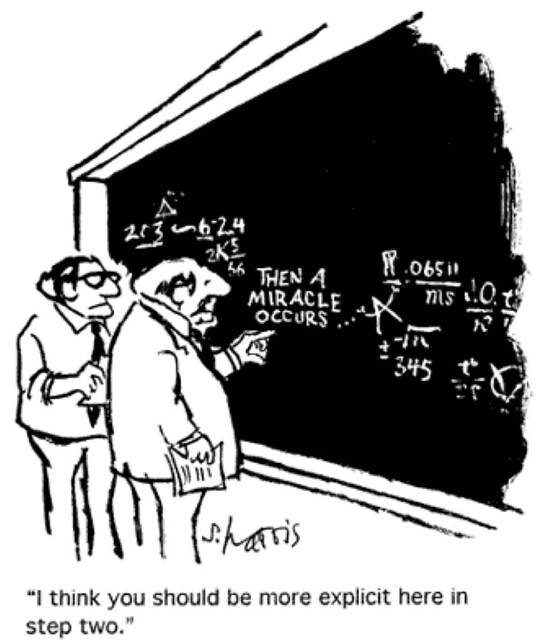
Theists use physics right up until they don’t understand the physics anymore and then say, “The rest is a miracle of god!”
Over-use of probability is a similar kind of thing. It’s just something LW-ers do to grapple with that whole “Incomplete Other” thing that fascinated Jacques Lacan so much.
I’m not going to say that it’s true in all cases, but hopefully you can see how this kind of thinking is susceptible to producing an obsessional neurosis. Obsessional neurosis occurs when someone engages in some compulsive activity in lieu of gaining real control over his or her life. Developing a giant Bayesian statistical model for life is the ultimate neurosis for a person inclined to formalized logic. Hell, somebody even made a movie about it:
You can imagine some poor schmuck trying to estimate the year of his death using a Markov Chain Monte Carlo simulation and choosing when the best time to sire a child might be…
* * *
But wait - there are even more problems with this kind of thinking.
One of them is that, when you're building a predictive model about something, you're engaged in a priori theorizing. You're implicitly saying, "This thing that I have chosen to include in my model is relevant to the question I am trying to answer." Similarly, by not including something, you are implicitly suggesting that it's not very relevant, or not statistically significant, to your question.
So, when we build a model to predict whether Joe is a murderer, we include a certain set of demographic information, but we may exclude other sets of information, and in doing so, we've biased our analysis with our opinions. We've expressed a "Bayesian prior" subconsciously, and that excluded prior is basically this: "There is a zero percent chance that the thing I have excluded from my model is relevant to the question I purport to answer."
Maybe it is irrelevant. But maybe not. More to the point, if you haven't included it in your model for the first run of the analysis, then you've biased your model unfairly - according to the rules of Bayesian inference itself! And since no one could ever hope to begin with a model that includes everything, then there is no possible way that Bayesian analysis improves on our ability to solve common, everyday problems any more than any other biased method of cognition.
Period.
* * *
This blog post is already long enough, and I've left out the important criticism that statistical modeling almost always implies some sort of linear relationship between the predictive variables and the variable being predicted. Who among us is prepared to claim that human behavior is always and everywhere a continuous function of physical inputs?
And yet, when we attempt to subject all decision-making to Bayesian inference, that is exactly what we're suggesting.
Now, the funny part there is that I often encounter people - behavioral economists, for example - who are happy to suggest that any type of human preference that doesn't behave according to a modelable continuous function is "irrational." Gleefully, they proclaim that humans are not rational animals because, look here, people smoke cigarettes even though they know cigarettes are unhealthy, and look over there, people take on more debt than they can afford, even when it's clear that the debt is unaffordable.
Something about the Less Wrong crowd makes me think that this is their view, too. I get the impression that they simply feel that they are combating their irrational tendencies with a sublime brand of rationalism.
It's that underlying sense of transcendence, the suggestion that you might be able to achieve some sort of higher state of existence by putting into practice Eliezer Yudkowsky's principles of rationalism - which he himself describes in quasi-religious language, like "The Way" - that gives people like me the heebie-jeebies.
When a community of people offer you a chance at achieving a higher state of being by becoming a little less human, it starts to look more like a religion than a science. Is this a fair criticism of the Less Wrong community? I have no idea, but I do know that I'mnottheonlyone to have made it.
* * *
What's the point? Why write all this when I don't really have any skin in the game? What do I care if people follow some Silicon Valley thirty-something with a quasi-religious fervor based on some basically sound and convincing mathematical source material?
Recall that I come from a place in the world where both religions and cults thrive. Recall that my blog has in many ways become a place to engage in self-analysis, self-criticism, and hopefully, the end of the kind of illusions we tell ourselves. Personal growth (not transcendence) requires that we always try to grow and develop.
We'll always be wrong - usually we'll be more wrong, not less. Trying to be less wrong is okay if it means gaining some new knowledge and using it to improve the results of your day-to-day action. But there is only so much knowledge you can have. It's tempting in today's world of "big data" and big processors and big Markov Chains to believe that all we need to do is model the possible outcomes of any scenario and update our priors.
But it's also vain. Growing up means accepting your limitations and working with them. In some cases, that might mean letting go of Bayesian inference and restricting your statistical analyses to problems that can actually be solved with statistics.
Oxlade writes "He declined to predict the exact trigger but said it was more likely to happen in the next five years rather than 10." However, as Henderson rightly points out, an event is always more likely to occur in a 10-year span than a 5-year span.
EconLog commentator "Radford Neal" (in scare quotes because I don't know whether or not that is his real name) defends the opposite position:
If 85 percent of Stanford grad students get it "wrong", that's pretty strong evidence that the answer is not actually wrong at all. And an explanation that they're using "system 1" (whatever that is), as most people do in the circumstances, is actually further evidence of this. The meaning of a statement/question is what most people will take it to mean. It seems most people take the statements in this example to mean something other than what the experimenter claims it means (a claim that is therefore clearly incorrect).
"Jameson" (ditto on scare quotes) criticizes the use of "mathematical precision" in language because he feels that it detracts from communication.
I was inclined to agree with both "Neal" and "Jameson" until I remembered an old Roderick T. Long blog post on a news report using the word decimated, in which he writes:
In recent years the term “decimate” has come to be widely misused to mean “devastate,” probably because the two words sound similar. But we have lots of words that mean “devastate.” We have only one word that means “decimate.” Why give it up?
As Long points out, we have words that mean things for a reason. That point also holds true for concepts. We might want to sometimes relax our rigidities to "get away with" mental shorthand, but why would we want to get away with anything at all? Likelihood is likelihood. Probability is probability.
I really do try to stay out of the climate change "debate." My core belief, for those interested, is that most of the descriptive models are accurate, but most of the predictive models are inaccurate. That's a nuanced view that doesn't tend to put me on a "side." There shouldn't be a "side." There should only be findings.
But anyway, something called The Committee for Skeptical Inquiry has challenged something called the Heartland Institute to a bet. The details of the bet are as follows:
The Committee for Skeptical Inquiry (CSI) hereby presents to the Heartland Institute a challenge as to whether the Earth’s climate will set a new record high temperature this year. The challenge will be settled using the NASA GISS mean global land surface temperatures for the conventional climate averaging period (defined by the World Meteorological Organization as 30 years) ending on December 31, 2015. If the global average temperature does not exceed the mean temperature for an equal period ending on the same date in any previous year for which complete data exist, CSI will donate $25,000 to a nonprofit to be designated by Heartland. Otherwise, Heartland will be asked to donate $25,000 to a science education nonprofit designated by CSI. It is CSI’s intent to repeat this challenge every year for the next 30 years.
My Claim: I Believe The CSI's Bet Is Disingenuous
Why? Because the only thing that will impact the outcome of the matter being bet upon are global average temperatures for the last half of the year 2015. In other words, if the next six months are hotter-than-average, globally, then CSI will win.
Assuming the Heartland Institute believes that current temperature trends are part of an essentially random walk, that means that their expected probability of winning would be 50%. (Assuming temperature is random and normal, 50% of recorded temperatures will appear above the mean, by definition, give or take. Let's leave aside the possibility that the Heartland Institute believes that global temperatures follow a non-normal distribution. Both possibilities are equally preposterous, anyway.)
Of course, no one who pays attention to global temperatures actually believes they are random. There is, for one thing, seasonality in global average temperature. There are quite certainly a different number of temperature sensors in the Southern hemisphere than the Northern hemisphere, and the urban impact on temperatures will be greater wherever there are more urban sensors. There are seasonal changes in ocean currents and temperatures, which is a fact I have no reason to believe the Heartland Institute disputes.
And finally, six or seven months of temperature readings are insufficient to draw conclusions about the accuracy of climate change models, no matter what happens to those temperatures in that period of time. Duh.
All of these reasons demonstrate that the CSI is basically trolling the Heartland Institute. I don't have a problem with that, but let's not pretend it's a real bet.
But Wait - There's More!
Suggesting that the people at the CSI are trolls is actually a charitable interpretation of this bet. I say this because their press release contains the following quote:
“If anyone really thinks that human-caused global warming is a hoax, and that the climate has stopped heating up, they must also believe that temperatures will now stabilize or drop,” said Mark Boslough, a physicist and CSI Fellow who devised the challenge. “Well, that’s a testable claim, so let’s test it.”
Boslough's "if" is a straw man fallacy. It is not at all true that anyone who disputes the theory of AGW believes "that temperatures will now stabilize or drop" within the next 7 months. For example, one might believe that global warming is occurring for non-anthropomorphic reasons.
I have no idea what the Heartland Institute's position on this matter is, and I don't much care. But Boslough's argument is a preposterous straw man, and his Institute's bet is thoroughly disingenuous.
Robin Hansen has a recent post about math-types who minimize the value of the social sciences because they don't take them seriously enough.
I have a social science background, and to a lesser extent, a mathematics background. My thoughts on the subject are probably less relevant than the thoughts of those people who are better-studied in one or both of those areas. Still, my vanity compels me to offer an opinion here.
It's Math
In my experience, hard sciences are applied logic, the most formal and generalized of which is pure mathematics. If you can understand pure mathematics, then you can understand any other field or discipline. But the reverse is not true: There are many, many more social scientists who do not understand pure mathematics than there are mathematicians who do not understand social sciences.
This isn't just a relic of the fact that academics tend toward logic, and thus tend toward mathematics. Logic is the underlying basis of all human thought processes. Philosophy in its original form (think ancient Greece) fused mathematics and ethics and astronomy and biology all into one glorious pool of reasoning. But that sort of thing can only go so far. Eventually, "philosophy" as a stand-alone discipline lost its steam under the realization that nearly all of the difficult problems were either better suited to scientific analysis (and thus, the question was one of science, not philosophy at all), or that it was really just a shortcoming of language. (See "the paradox paradox.")
When I say philosophical problems are a shortcoming of language, I mean that the problem is imaginary. For example, the color of uncooked salmon meat has no formal name in the English language. We could say that it's "pink," but it's not really pink. We could say that it's "orange," but it's not really orange. We could say that it's "red," but it's not red, either. Here a philosopher would be tempted to say that either salmon has no color or that color itself is a complex phenomenon (or an emergent one, am I right?). But both of those statements would be wrong, because the color of salmon exists and we call it "salmon-color" even though that's kind of stupid. The problem isn't with the color; the problem isn't even with the idea of color.
The problem is simply that English doesn't have a word for that color. Big deal? Call it "tau" and forget it was ever a problem. It doesn't matter.
Gradually, "philosophy" dissolved into logic, mathematics, and science. As formal logic became more rigorous, people seemed to notice that it was just math, and that's how we understand the field of "Logic" today. So then there were two: mathematics, and science.
Physicists have done the most work in revealing that science is basically just math. All of the important work in physics these days is mathematical conjecture confirmed by physical experimentation. The various other hard sciences out there - chemistry, biology, etc. - do not look much different from physics. At this point, the sub-discipline you're interested in is really just a specialization of the same thing, aka "science," aka mathematics.
Social Science
Finally we have social sciences. Social sciences started out as theories of human behavior, as observed by grouping things differently. We can look at a person's individual motives, in which case we're talking about psychology. We can look at a person's motives as he interacts with a group, in which case we're talking about sociology. We can ignore motives and focus on the quantifiable result of human behavior, in which case we're talking about economics or possibly political science.
But when we get right down to it, all this social scientific theorizing amounts to crafting paradigms, or way to view human behavior so that we can better understand it.
I don't deny that there is a psychological component to the world, as there is an economic one, and a sociological one, etc., etc. But when we engage in social science reasoning, we're not describing the profound truths of the universe, we're using paradigms to simply describe the many different ways human beings interact with each other.
That is to say, we might gain additional insight into a situation if we look at it "sociologically," but I don't think we'll ever come across a good predictive model for "quantum sociology." In other words, we can describe human behavior through the paradigm of modern sociology, but we don't derive empirical truth from this. It becomes the academic equivalent of poetry. It sounds nice because it resonates with us, but it won't teach us any secrets of the universe.
Similarly, we can describe human behavior in English or French, and our choice might connote something different in some specific way, but this is more relevant to the inadequacy of language than it is to the validity of our theory.
Conclusion
All that verbiage to say something simple: Social sciences are paradigms, useful for learning, but not otherwise relevant to the universe. Once you've learned what you need to learn from Weber's theories, you should think of them as analogies or talking points, not concrete truths of human behavior. That's the purpose of social science. But if you're looking for concrete truth, you need to learn the underlying logic and then move on to empirical science.
I mentioned a few posts back that I was going to write a forthcoming post about paradigms. I have unsuccessfully attempted to write this post a few times now, and finally realized that I need to give my thoughts a more thorough treatment. Instead of one, long post, you're going to get a few shorter ones.
My intent with these posts is to criticize strict adherence to a paradigm - any paradigm - because they can be misleading. Their use results in the sort of automatic thinking that can lead even a very careful and brilliant mind into overlooking important details, or failing to understand certain subtleties, or minimizing certain others, or explaining-away details before properly considering them.
Before I can make that case, though, I have to explain what paradigms are good for, and that shall be the topic of today's post.
What Is A Paradigm?
The word "paradigm" entered the public lexicon some time during the 1990s. I mean, it was always there, as long as it's been a word, but it wasn't an important word - it wasn't a buzzword - until the 1990s. "Paradigm" went right along with "synergy" and Palm Pilots and Franklin Day Planners. The general idea at the time was to bill big business as not just a series of steps aimed at producing and selling a good or service, but rather an idea or a mode of thinking.
Only suckers, the argument was, build laptop computers and sell them. Paradigms offer the advantage of viewing laptop production as a concept, which can then be improved and manipulated in the abstract. Paradigms offered business managers the advantage of "revolutionizing the business" without having to change real-world things like the structure of the assembly line, or the way depreciation is handled in the accounts, or the map of the supply chain.
I'm being critical of "paradigm" the buzzword, but paradigms can actually be extremely useful. For example, if you and your roommate decide to cook dinner together, you can look at it as a collaborate creative effort (Paradigm #1), or you can look at it as a food manufacturing process (Paradigm #2). Without passing judgement as to which paradigm will result in the "best meal," we can easily see that the two paradigms imply something different about how you'll do the work.
Paradigm #1 implies that the two of you will discuss, collaborate, and otherwise work on the same things at the same time. Paradigm #2 implies that you'll divvy up the work and only come together at the end of the process. It's certainly possible to look at cooking both ways, and each paradigm offers its own advantages and disadvantages. The main difference is the paradigm.
What Are Paradigms Good For?
The major advantage of paradigms, in my opinion, is that they are very instructive ways to learn about new things. In the cooking example above, if you didn't know how to cook, but had a recipe book and a roommate, you might really like the idea of treating it as a manufacturing process. You'd be able to follow the instructions, divide the labor, and manufacture your dinner. If you do that a few times, you'll quickly learn "how to cook."
Cooking is a relatively easy problem. Suppose you're trying to solve a tough scientific problem. One way to do that is to power through the scientific fundamentals and consider the implications of each fundamental separately, given what you know. That's not merely a lengthy and tiring process - it might also limit your creativity in solving the problem.
The Black-Scholes pricing model famously solved an investment problem by mathematically treating the problem as though it was a ballistics trajectory problem. In other words, Black and Scholes adopted a rocket science paradigm in order to solve an economics problem. In doing so, they learned about (and taught us) a great deal about economics.
So you can see that paradigms offer us the ability to learn a great deal about whatever it is we happen to be looking at.
Beyond Paradigms
There are certain limitations.
Imagine again the cooking example. What if you don't have a cookbook? What if your roommate is out that evening and cannot help you? What if you're missing some of the ingredients? Your paradigm might instruct you to "download additional instructions," or to "hire more line workers," or to "order a shipment of new raw materials," but obviously none of those things will help you make dinner.
But the point of the paradigm was to teach you how to complete a task. Hopefully, by the time you've fully absorbed the principles behind the paradigm, you'll know how to cook. At that point, you won't need the paradigm anymore.
Similarly, elaborate comparisons between financial instruments and rockets are weak and silly. The point of the Black-Scholes model was never to make such a comparison. The point was merely to use a mode of thinking to solve a problem.
Getting too caught-up in an elaborate analogy misses the point. In subsequent posts, I intend to argue that paradigms should be discarded as soon as we have absorbed the lessons they were designed to impart. Once we have the knowledge we need, the paradigm becomes a distraction, an urge to draw comparisons that ought not be drawn.