Showing posts with label Scientific Method. Show all posts

2019-02-08

Frameworks, And Their Problems


As a long-time blogger, I have more than my fair share of experience with frameworks. For my purposes here, I'll use the word "framework" to apply to any systematic conceptualization of an issue. A framework is any structured way of looking at anything at all, any narrative that does the job of conceptualizing the matter in a way that makes it easier to think about.

To use plainer language, human beings have a tendency to do their thinking via the use of stories. The Big Bang Theory isn't just a set of laws about physics, it's a narrative that tells the story of the creation of the universe in a way that can be absorbed by ape brains. Before we had the Big Bang Theory, we had other theories about the creation of the universe, and most of them really were stories, written in storybooks, which characters who said dramatic things like "Let there be light!" Over time, as we learned more about the universe, we spent less time on those stories, and eventually replaced them with a new one. It would not surprise me at all if we were eventually to replace the Big Bang Theory with a new narrative, one that does a better job of narrating the earliest moments of the universe. Should that come to pass, it, too, will be told as a story.

Stories are useful for what they describe, and useless for what they do not describe. This sounds obvious, but the importance of it is not obvious at all, so I will illustrate with an example: Comic books from the 1950s are really useful for telling cool stories about magic superheroes; but they're really awful, completely useless, for telling stories about how men and women should treat each other. Comic books from the 1950s are broadly sexist, by today's standards, and possibly even by the standards of the 1950s. People still read those old comics from the so-called "Golden Age," but they don't read them in order to learn about gender relations. The only reason anyone reads old comic books is to enjoy cool stories about magic superheroes. These comic books serve that purpose very well; but we shouldn't use them to explore civil equality unless we're looking for a What Not To Do manual.

*        *        *

Back to my main point: frameworks are useful for describing what they describe, and useless otherwise. Yesterday, I mentioned a possibly racist Scott Sumner blog post. That an example of a framework poorly matched. The "strongman" hypothesis of Donald Trump's political success may be a useful framework for analyzing the current presidential administration - it's not my preferred framework, but I have seen people use that framework to make good points. But the "strongman" hypothesis is not a good framework for describing the results of public opinion polls among Hispanic Americans. It's important to use your framework only for its purpose, to avoid extending it beyond its usefulness, and to only apply it to new subject matter experimentally. (That is, maybe it would be interesting to apply the "strongman" framework to a physics problem or a problem in psychology - but also maybe not; feel free to experiment, but remember that it is only an experiment, and be ready to reject what you find as readily as you might accept it.)

Being wrong is one way that a mismatched framework can cause problems. Being confusing is another way. This latter thing is arguably much worse. For example, this AOC congressgirl recently presented a policy wish-list that attempts to apply the Socialism framework to the Environmentalism problem. One reason this attempt is problematic is that it is wrong: there is probably not enough taxation and redistribution in the United States to change the course of global climate change, especially considering that the major polluters today are in other countries, such as China and India.

Like I said, the mismatched framework is bad because it's wrong. But more problematically, it's bad because it's confusing. If people come to believe that climate change can be solved by merely passing legislation then we won't stop climate change at all. Climate change is not a political problem, of course, but a science problem. It may also be an engineering problem, since technology must be invented to clean our air and our oceans and to establish more environmentally sustainable ways of housing human beings and processing our waste. It might even be true that legislation can help direct us toward addressing the science problem or the engineering problem - the reader knows where I stand on that, but let's concede that it's possible. Even though it's possible, climate change is still fundamentally a science problem that must be conceived of in a scientific framework and solved through a story about science. Not a story about legislation. Our environmental problem is not that too few people understand politics; it's that too few people know how to do the kinds of science and engineering that we need to stop climate change. We'll never get there without the right framework, and time spent on the wrong framework is confusing us.

*        *        *

We also experience frameworks for dealing with our every-day lives, and thus we experience the same kinds of pitfalls as they pertain to our individual relationships.

Take your sibling, for example. Early on, you developed a framework for understanding the thoughts, feelings, and actions of your brother or sister. To the extent that this framework was accurate and did a good job of explaining your relationship, it was useful. One day, though - or, more accurately, over the course of many years - your sibling grew up and became a new person. It would be foolish to attempt to explain the actions of your adult sister by referring to a childhood framework about her motivations, based on how she once played Monopoly with you.

That's extreme, but we don't have to rely on extremes. It would be foolish to apply the framework you built that explained your brother's drive to be a high school varsity football player to your 40-year-old brother's recent divorce. If you want to apply a framework to your brother's recent experiences, then you need to learn about what he's been through lately and find a framework that explains those experiences. In short, you need to accept that your adult siblings are not exactly the same people you grew up with, that they have been shaped by the years, and that the old frameworks never apply.

Failing to do this will cause relationship problems. The map has to match the territory, as the saying goes.

*        *        *

An additional problem arises when we try to apply macro-frameworks to micro-problems. Consider how wildly inappropriate it would be to analyze your relationship with your sister using the framework of climate change! It sounds ridiculous, doesn't it?

Why, though, do we not hesitate to apply the feminist framework to the child-rearing problem? Why do we become so entrenched in our feminist framework (or, equally, our anti-feminist framework) that we work to make our children an incarnate representation of our beliefs about gender equality?

Why do we attempt to indoctrinate our children in any such ideology, forcing them to behave in accordance with what we see as universally and morally right? Why do we pat ourselves on the back and tell ourselves that we're good parents when our children repeat our own nonsense back to us for approval? Why do cry out in anguish when our children grow up to develop their own ideas about morality and behave in accordance with that new set of morals, so different from our own? Why do we consider that a failure? Why do some parents consider it a failure if their children grow up to gay, or Democrat, or atheist, or a lawyer, or…?

The answer is simply this: We've mismatched the framework and the problem. Child-rearing is not an ideology problem, and so should not be understood using an ideology framework. Parent-child interaction is not political, and so it should not be understood using the framework of politics. Indeed, I'll even go this far: raising a child is not a spiritual problem, and thus cannot be understood using a religious framework.

I'm not saying ideology, politics, or religion are bad; I'm saying that those frameworks only apply to ideological, political, or religious problems, respectively. Using religion to understand child-rearing is as erroneous as using religion to understand a physics problem, and the results will be similar.

Nor can you use these macro-frameworks to solve any of your other micro-problems. You can't get a promotion at work using an ideological framework; how would that even work? You can't mend fences with an old friend using a religious framework; god may have told you to forgive, but nobody told you to steal his lawnmower. You can't pay your weekly grocery bill by thinking about red states vs blue.

*        *        *

Frameworks are highly attractive, because narratives are the way human beings understand the world around them. Despite all that, the application of frameworks comes with deep pitfalls with respect to matching the correct framework to the correct problem. Not only must we choose frameworks that accurately reflect the problem we're trying to solve, as measured by the usefulness of the framework to describe that problem, we must also apply the right level of framework to the right level of problem. At best, choosing the wrong framework will result in a wrong solution, and your problem will go unsolved. At worst, though, choosing the wrong framework will cause persistent confusion that will render your problem unsolvable.

2018-12-07

Data Is No Substitute For Real-World Knowledge


Here’s an interesting post at the FRED blog, highlighting the fact that Canadian manufacturers work fewer hours per week than their American counterparts. To the people at FRED, this is a mystery:
Sadly, we don’t have an answer, but we can list some potential answers. First, economic integration across countries doesn’t necessarily make countries more similar. Indeed, integration provides opportunities for specialization, thanks to comparative advantage. It could be that Canada has specialized in manufacturing sectors where the standards for work hours are lower. Second, labor market legislation may have changed. Indeed, current laws may give workers more bargaining power in Canada than in the U.S. In particular, unions currently have more say in Canada, and their goal is typically to improve the situation of their members (for example, by reducing work hours). Third, the labor practices of these countries that relate to the use of overtime or undertime may have become more different over the years. If employers prefer to use overtime instead of hiring new people, then average hours increase. The opposite happens when workers are given fewer hours instead of being laid off.
It’s always interesting to me to see researchers attempt to explain phenomena with data when they have no essential familiarity with the situation they’re trying to explain. In this case, researchers at FRED have no insight into what it’s like working at a manufacturing plant, neither in the United States, nor in Canada. They’re simply speculating about what might be.

Having spent a little time in Canada, though, the real answer comes very easy to me. You’ll notice that the Canadian value of average work hours per week ends up at about 37.5 hours per week. It just so happens that 37.5 hours is the standard full-time work week for Canadian public service employees. If you have a government job, you work 37.5 hours per week. Since the public service is the largest employer in the country of Canada, and particularly in the province of Ontario, and since the vast majority of Canadian manufacturing occurs in Ontario, it stands to reason that the standard work week there is 37.5 hours. Indeed, I can confirm this firsthand: I lived in Ontario and worked 37.5-hour work weeks. There really is no mystery at all.

Keep this in mind if you’re someone who analyzes data. It’s interesting to pull artifacts out of data sets and speculate about possible explanations, but that is simply no substitute for just asking people what the heck is going on. In fact, if you’re not familiar with the situation you’re analyzing, you’re better off asking first, and analyzing data second, rather than the other way around.

This is one of those big weaknesses demonstrated by today’s world of “big data.” Quite often, large data analysis companies like Amazon and Google are speculating based on zero familiarity with on-the-ground situations. AI and deep learning can teach us a lot, but it’s no substitute for real-world knowledge.

2017-06-19

I Have Two Things To Say

The first is, yes, I'm still here.

The second is, check out this awesome comment from a recent EconLog post:
I wish economists/sociologists would stop running a linear regression on ordinal outcome variables. A 0.56 decrease on a 4 point-scale doesn't mean anything because the scale is ordinal and saying such-and-such leads to a 0.56 decrease is treating it as cardinal. The reason why you can't do that is because a trust level of 2 does not reflect twice as much trust as a trust level of 1.
This comment demonstrates advanced understanding of statistics, the kind that wards off mistaken conclusions, the kind that I wish were more common among numerate people. 

2015-08-26

Good Explanation, Poor Prediction

Let's say you're overweight, have a bad diet, and never exercise. Let's say you go to the doctor for an annual checkup, and - for years - he tells you, "You've got to lose some weight, change your diet, and increase your activity level, or else you're going to acquire type 2 diabetes."

But, for years, you choose not to change your lifestyle and, for years, you fail to acquire type 2 diabetes. From time to time, some of your friends say, "Doctors like yours don't know anything about diabetes. They've been predicting that you'd become a type 2 diabetic, and yet it still hasn't happened yet!"

Then, one day, it happens. You're devastated. In a moment of weakness, your doctor says, "For years, I've been warning you that your poor health habits would result in type 2 diabetes - you should have listened to me."

Suppose you were to respond to your doctor as follows:

"True, for years you warned me and for years it never happened. So how useful was your warning? Not very. Clearly I have now acquired type 2 diabetes, but that doesn't mean your theory about weight, diet, and exercise is correct. What, if anything, would cause you to second-guess your beliefs?"

The moral of this story is: Sometimes ideas - even ideas we think are completely uncontroversial - have strong explanatory power but poor predictive power.

2015-08-25

(Traffic) Signal Versus Noise

I have a fairly long daily commute, and accordingly, I've spent a lot of time observing traffic patterns and behavior. Every city that I've ever driven in has its own unique "driving personality," i.e. sets of behaviors that are more common within that city than outside of it. I'm sure you've noticed the same thing, and maybe you've also noticed that if you spend some time acquainting yourself with a city's "driving personality," you can often guess what a fellow motorist will do long before they do it - maybe even before they know they'll do it. This isn't a special or unique skill, it's just part of being an attentive driver.

I often get a kick out of motorists on a busy freeway who dart between lanes in an attempt to travel as quickly as possible. Many of them will change lanes as soon as they see a spot in traffic that might enable them to pass a small subset of cars. They change lanes, pass a few cars, and then wait for their next opening to pass the next subset.

This is funny to me because a lot of these vehicles must be well accustomed to driving these routes at that time of day on a regular basis. They're responding to the "noise," i.e. the momentary traffic patterns that might enable them to pass a few other cars, but they're ignoring the "signal."

In this case, the "signal" is the long-term trend. I drive more or less the same route every day. I don't need to dart between lanes and pass a few cars at a time because I'm already familiar with which lanes are, on average, faster than the others at which point on the road.

I've occasionally surprised people by how quickly I commute on the route I choose to drive. People assume I'm speeding most of the time, but I'm not. I simply pay attention to which point on the road is usually the best time to change lanes. On average, I easily cruise past the drivers who are constantly changing lanes because they make a wrong move that holds them back. Meanwhile, while I seldom make a "winning move," I never choose wrong.

On any given day, another motorist driving the same route might make it faster to my destination than I do. But, on average, I always save time compared to others, and especially compared to hastier drivers who are always trying to pass the next car ahead of them.

What's your favorite traffic trick?

2015-08-05

More Wrong

The following is a synopsis and expansion of a series of comments I left under a post at SlateStarCodex.com. Toward the end of the debate, a few fellow commentators remarked that I was making the case for frequentist inference, which - because I am not an academic statistician or philosopher - is something I hadn't heard of until yesterday.

Now, I'm not very fond of putting all opinions into categories, and I reiterate that I only heard of frequentist inference yesterday, so I'm not ready to declare to the world, "World, I am a frequentist inferror!" But I did a little reading up, and it does seem to reflect my approach to probability. Moreover, I'm pleased to learn that I wasn't just spouting a bunch of crazy-talk, and that intelligent people had traversed that path before I.

Enough preamble, though, let's get to it.

*          *          *

My core claim: I think LessWrong-ers set themselves into a pattern of thinking that is ill-suited to the majority of the human experience.

*          *          *

Here's a quick example of why I think so, to help initiate the discussion:

Suppose Eliezer Yudkowsky asked me to assign a probability to whether a sentient robot will murder a human being during the next, say, 20 years. Setting aside the fact that technological advances are not a probability (because they are the product of deliberate human action) and focusing solely on the question of the robot itself – assumed to exist – choosing to murder a human being, this is not a question of probability, because volitional acts don’t "just happen." It's not randomness that causes someone to murder someone else, there are deliberate thoughts and actions going on, and these things cannot be assigned "likelihoods" based on anything rational.

Now, it's possible to suggest that all things that human beings do are purely random phenomena, as some eventually claim. They say that human brain functions are subject to quantum mechanics, and there is randomness involved there. But it would be disturbing to use that fact to suggest that, at any given moment, there is an X% chance that you will murder someone (even if the chance is very small). At the risk of sounding harsh, such a belief sounds a lot like a psychotic break to me.

On the other hand, we could indeed observe that. each year, X% of people commit a murder. We can ask, “What is the probability that next year, the number will be Y% instead?” The reason we can ask that is because we're no longer asking about the probability of a particular murder involving specific people. Instead, we’re asking about the likelihood that a sample mean will differ from a historical population mean. That, my friends, is indeed a question of probability, and we can do valid statistical analysis on a question like that.

Proponents of Bayesian inference - such as the "Less Wrong community" - like to say things like, "but I know often murders occur, and I know what the demographics of a murderer are, and I can compare the prevalence of murder among certain demographics to a particular person and arrive at a forecast for how likely I think it is that the person will commit murder..." And I can see how that does become a probability problem, but it only really works for a random observation.

What I mean is, if I put a random person named Joe in front of you along with some demographic data, you can come up with a statistical model that can do a best-possible job of predicting whether that random person is going to become a murderer at some point in the future. But if I task you to predict whether someone you know is going to murder someone else you know, then we're no longer talking about randomness or probability. We're talking about a couple of people that you know, and people do things by choice, not by probability (unless you're having a psychotic break and you've convinced yourself that everything you think and do is the whim of the random forces of molecules colliding inside of you, otherwise called "Because Quantum Mechanics! Nihilism," or BQM Nihilism for short).

In short, there are two questions here:
  1. Will Joe murder someone?
  2. What is the probability that I can correctly guess whether someone fitting a particular demographic profile is a murderer?
My position: Only question #2 is a question of probability. Only question #2 is appropriate for statistics.

*          *          *

But still, suppose I had to predict whether Joe was a murderer. Then, isn't coming up with a Bayesian prior, and fitting it into a predictive model and conducting some analytics the best I can do, given the information that I have?

Here's where things get more interesting to me...

One of the marks of a truly wise person, in my opinion, is the ability to say (honestly), "Gee, I just don't know." Being comfortable with the fact that there are some things out there that are just simply unknowable is part of being a grown-up. It's a sign of emotional maturity. .We all wish we knew everything there was to know, but no matter how smart we are, no matter what kind of Bayesian games we play with ourselves, we'll never know everything. We'll never even come close! It's just not possible.

It's admirable to try to expand human knowledge, of course, and it's a wonderful character trait to have a thirst for knowledge. But it's mature to accept your limitations.

Back to Joe: If you know Joe, and you need to predict whether he will become a murderer at some point in the future, then sure you could assign a bunch of probabilities and update your priors in an ongoing "virtual Markov Chain," but fundamentally we're asking about Joe's character, and that's not subject to probability. Either you've got Joe's number, or you don't, but you didn't get to where you were by running a Bayesian model against your every interaction with him. 

And if you did, then you're not human.

*          *          *

When I’m uncertain about something, I just say, “I don’t really know for sure.” Then I either choose to guess, or choose not to guess. If I choose to guess, I take stock of the available information, but I don’t delude myself into thinking that there is a cardinal number attached to my guess when I’m talking about situations in which cardinal numbers do not apply.

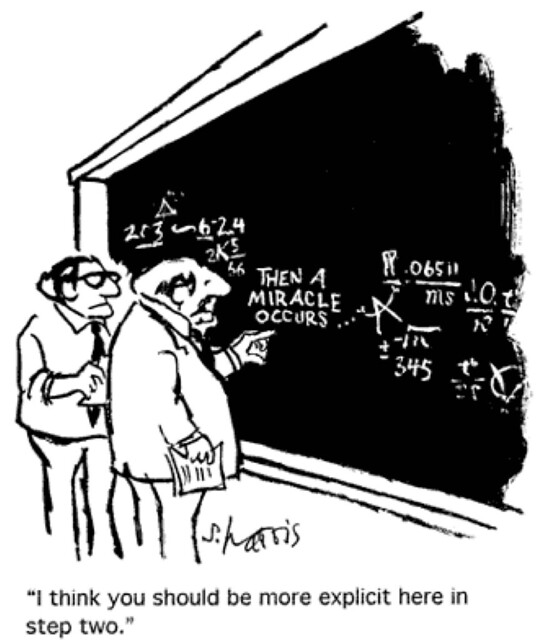
Theists use physics right up until they don’t understand the physics anymore and then say, “The rest is a miracle of god!” 


Over-use of probability is a similar kind of thing. It’s just something LW-ers do to grapple with that whole “Incomplete Other” thing that fascinated Jacques Lacan so much.

I’m not going to say that it’s true in all cases, but hopefully you can see how this kind of thinking is susceptible to producing an obsessional neurosis. Obsessional neurosis occurs when someone engages in some compulsive activity in lieu of gaining real control over his or her life. Developing a giant Bayesian statistical model for life is the ultimate neurosis for a person inclined to formalized logic. Hell, somebody even made a movie about it:


You can imagine some poor schmuck trying to estimate the year of his death using a Markov Chain Monte Carlo simulation and choosing when the best time to sire a child might be…

*          *          *

But wait - there are even more problems with this kind of thinking.

One of them is that, when you're building a predictive model about something, you're engaged in a priori theorizing. You're implicitly saying, "This thing that I have chosen to include in my model is relevant to the question I am trying to answer." Similarly, by not including something, you are implicitly suggesting that it's not very relevant, or not statistically significant, to your question.

So, when we build a model to predict whether Joe is a murderer, we include a certain set of demographic information, but we may exclude other sets of information, and in doing so, we've biased our analysis with our opinions. We've expressed a "Bayesian prior" subconsciously, and that excluded prior is basically this: "There is a zero percent chance that the thing I have excluded from my model is relevant to the question I purport to answer." 

Maybe it is irrelevant. But maybe not. More to the point, if you haven't included it in your model for the first run of the analysis, then you've biased your model unfairly - according to the rules of Bayesian inference itself! And since no one could ever hope to begin with a model that includes everything, then there is no possible way that Bayesian analysis improves on our ability to solve common, everyday problems any more than any other biased method of cognition.

Period.

*          *          *

This blog post is already long enough, and I've left out the important criticism that statistical modeling almost always implies some sort of linear relationship between the predictive variables and the variable being predicted. Who among us is prepared to claim that human behavior is always and everywhere a continuous function of physical inputs?

And yet, when we attempt to subject all decision-making to Bayesian inference, that is exactly what we're suggesting.

Now, the funny part there is that I often encounter people - behavioral economists, for example - who are happy to suggest that any type of human preference that doesn't behave according to a modelable continuous function is "irrational." Gleefully, they proclaim that humans are not rational animals because, look here, people smoke cigarettes even though they know cigarettes are unhealthy, and look over there, people take on more debt than they can afford, even when it's clear that the debt is unaffordable.

Something about the Less Wrong crowd makes me think that this is their view, too. I get the impression that they simply feel that they are combating their irrational tendencies with a sublime brand of rationalism.

It's that underlying sense of transcendence, the suggestion that you might be able to achieve some sort of higher state of existence by putting into practice Eliezer Yudkowsky's principles of rationalism - which he himself describes in quasi-religious language, like "The Way" - that gives people like me the heebie-jeebies.

When a community of people offer you a chance at achieving a higher state of being by becoming a little less human, it starts to look more like a religion than a science. Is this a fair criticism of the Less Wrong community? I have no idea, but I do know that I'm not the only one to have made it.

*          *          *

What's the point? Why write all this when I don't really have any skin in the game? What do I care if people follow some Silicon Valley thirty-something with a quasi-religious fervor based on some basically sound and convincing mathematical source material?

Recall that I come from a place in the world where both religions and cults thrive. Recall that my blog has in many ways become a place to engage in self-analysis, self-criticism, and hopefully, the end of the kind of illusions we tell ourselves. Personal growth (not transcendence) requires that we always try to grow and develop.

We'll always be wrong - usually we'll be more wrong, not less. Trying to be less wrong is okay if it means gaining some new knowledge and using it to improve the results of your day-to-day action. But there is only so much knowledge you can have. It's tempting in today's world of "big data" and big processors and big Markov Chains to believe that all we need to do is model the possible outcomes of any scenario and update our priors.

But it's also vain. Growing up means accepting your limitations and working with them. In some cases, that might mean letting go of Bayesian inference and restricting your statistical analyses to problems that can actually be solved with statistics.

2014-05-14

Paradigms - A Key Message

To recap a key message from my blog: Paradigmatic thinking is useful when trying to understand something new, but it becomes an obstacle to understanding when we are no longer capable of thinking about things WITHOUT the paradigm.

You could say that paradigms have high explanatory power, but low predictive value, or you could just accept that no one way of looking at things is perfect enough to tell you everything you need to know. This is why theories of social science go in and out of vogue without producing more insight than those that came before them.

2014-04-23

Paradigms, Part III - Okay, Fine! I'll Talk About Piketty!

Everyone is talking about Thomas Piketty's new book, Capital. Some on the left have lauded it as a great argument for why the government's welfare safety net system should be expanded. Some on the right think otherwise. I haven't read the book, but I'm deeply skeptical that anything like that book could be used to substantiate a political opinion. This skepticism leads me to conclude two things:

  1. Piketty's most vociferous fans probably think that Piketty has "proven" something that he has not, i.e. they think his work is more revolutionary than it actually is.
  2. The principle benefit of the theory outlined in Piketty's book is that it provides a scientific veneer for an existing set of political priors.
If this doesn't remind us of the perils of paradigms, I don't know what does.

We learn from Piketty that large rates of return on capital imply financial gains for business owners and some displaced employees. This is a good lesson, but not a revolutionary one. Most of us know this without needing to be told. Holding on to this paradigm too long leads us to conclude unlikely things about the world economy; at that point, we're better off letting go of his model, relaxing the constraints, and living in the beautiful, un-model-able nuances of the real world.


Familiarize Yourself
Before you formulate an opinion on Piketty's main idea, you owe it to yourself to find out what he's actually saying. I'm not a reliable source of economic summaries, so do your due diligence. Jonathan Finegold Catalan has already located a free version of the appendix in which Piketty articulates his underlying idea. (Read it, understand it, then come back and finish this blog post of mine. Start on page 36.)

In particular, I think Finegold Catalan does an excellent job of summarizing the key idea when he writes:
The heuristic the book sells to the reader is r > g. That is, if the return on capital is greater than the rate of economic growth, inequality will increase. The concept, explained like that, is somewhat cryptic. It’s an easy heuristic for those who don’t want to get bogged down in the theoretical argument. The theoretical argument is actually not that complicated (theory makes up a very, very small minority of the book). Piketty makes it near the end of the sixth chapter of his book. His argument is that if the elasticity of substitution between capital and labor is > 1, the share of income accruing to capital will grow relative to that of labor.
My Reaction
I'll start with the positive:
Piketty's idea is prima facie correct. If you make more money investing in new machinery than you do by doing "business-as-usual," then this will tend to produce situation-specific income inequality.

Imagine Peter owns a sandwich shop. Peter wants to open a new restaurant: Peter can either choose to hire Roy to make sandwiches in the new shop, or invest in a sandwich-making robot. If Peter makes more money investing in robots than in employees, then Peter - who is wealthy enough to own more than one sandwich shop, unlike Roy - will make an increasing proportion of his income from machines. Roy, who never gets hired, loses in this scenario. You can see how "inequality increases" here because people like Peter earn more money while people like Roy earn less.

Now the so-so:
One objection here is that somebody has to build the robots. Roy may lose out on sandwich-making employment opportunities, but he wins big at the robot-making factory. So there is no reason to merely assume that inequality increases when Peter buys more robots. It might, or it might not. It depends on the particulars of the case.

Piketty makes clear that when he's talking about r and g he means for the whole economy. So he's not just talking about Peter and Roy, he's talking about everyone in the whole world. The claim becomes this: If investing in robots makes more sense for all the people in the economy who make the most money than "business-as-usual," then inequality will increase.

This is a stronger claim, and a more easily disputed one. Suppose we live in a two-good economy where people either make sandwiches or build robots. As sandwich-makers seek to replace employees with robots, robot-builders will need to hire more people to build those robots. The more robots we need, the more we need people to build robots! This will be true, unless the robot-builders also replace robot-builders with robot-building robots...

But doesn't this just kick the can down the road? Who designs and builds the robot-building robots? Somebody has to. The production process has to begin somewhere, and that's where the people will be, if for no other reason than to build the robots that will perform all the other tasks.

Now the negative:
Thus we come to the Achilles' Heel of Piketty's ideas about capital. If capital were a giant, amorphous blob of electrodes produced en masse and then formed like clay into whatever shape required to perform whatever task, then Piketty's claims would be a lot stronger. But capital - especially modern machinery used to produce modern goods and services - is highly diverse and highly specialized.

For example, insulin cannot simply be cranked out by a machine. Recombinant RNA must first be grown in a laboratory (by some combination of humans and machines), and then shipped to a manufacturing facility (by some combination of humans and machines) before the machines at the factory can produce insulin in vats. Synthetic insulin is among the most complicated products in a modern economy, and it requires people to produce it.

On the other hand, assembling automobiles is an almost fully roboticized process.

Modern vehicles and modern medicine are both incredibly important and lucrative and technologically advanced fields. The same macroeconomy that produces the modern automobile produces synthetic insulin.

In short, we can say many superficial things about "manufacturing," but we cannot make specific claims about the "capital" involved in both industries that accurately describe both industries. Different parts of the economy behave differently.

In economic jargon, r and g aggregate up to the macroeconomy, but that includes the summation of a lot of positive and negative numbers, numbers greater than 1 and numbers between 0 and 1. Just like the price of iPads can decrease while the price of gasoline increases, so the price of insulin-making robots and car-making robots can go in opposite directions. Just because the aggregate number is X doesn't mean it's X for every industry in the world.

We can assume-away all the variation in an economy if we want to, but it doesn't provide us with the kind of insight needed to arrive at important policy conclusions.

Conclusion
Piketty's ideas will resonate with leftists who are hungry for a technical justification for implementing leftist policies, such as steep taxation on the rich or on capital itself, and large welfare payments to people who do not own large amounts of capital. It's equally likely that rightists and libertarians will scoff at Piketty's claims and seek to explain why they just cannot be true.

The truth doesn't lie in the middle. The truth lies in the strength of expressing ideas only vaguely, and steering clear of specifics. That is, the truth is that Piketty's ideas are accurate as a shotgun theory and inaccurate otherwise.

Piketty's theory isn't wrong, but it doesn't provide a good justification for leftist social policy, either. Those two facts are bound to disappoint leftists and non-leftists alike, and this is why it's important to take paradigms as learning tools, absorb the knowledge, and then cast the paradigm aside again.

UPDATE: Arnold Kling's view is similar to mine when he says:
The way I see it, Piketty and Solow work with models that incorporate homogeneous workers (with no differences in human capital) and homogeneous capital (with no differences in ex ante risk or ex post returns). The real world is so far removed from those models that I simply cannot buy into the undertaking.
Solow's take, as referenced by Kling, is here

2014-04-21

Bias Bias (Meta-Bias?)

From Bryan Caplan:
Why is the psychologists' approach so superior to the economists'? Simple. Economists reject all-pervasive testimony on lame methodological grounds. Psychologists, in contrast, aggressively cross-examine this all-pervasive testimony, and empirically expose its all-pervasive perjury. Despite what they say, people really are selfish, businesses really are greedy, students really are lazy, and workers really are materialistic. Econo-cynicism has a firm basis in psychological fact.
Of course, a "firm basis in fact" is hardly the same as "unvarnished truth." Some deviations from narrow self-interest handily survive cross-examination. Voting really is largely unselfish, workers really do obsess about nominal pay, and managers sincerely hate firing anyone. The point, though, is that the economic way of thinking is on much stronger empirical ground than economists themselves have managed to demonstrate. Though we've often belittled psychology, it's ably served us for decades. Perhaps if economists give psychologists some much-deserved credit for Social Desirability Bias, they'll be more eager to vouch for the value of what we do.
Does social desirability bias apply to discussions of social desirability bias? Will people be more likely to detect social desirability bias if they believe signalling acceptance of social desirability bias theories are socially desirable?

It sounds like I'm trying to be funny, but I'm not. Whenever we start talking about systemic biases, we raise implicit epistemological questions. How do we know that the bias exists without priming for it? But how can we prime for it without compromising the results?

In some ways I think the means-end approach of e.g. Ludwig von Mises neatly and effectively sidesteps this problem, but then again I have never been very warm to behavioral econ.

2014-04-11

Order From Accidents

I shouldn't speak in generalities without empirical justification to back me up on my generalizing. So, I won't say that intellectuals have a tendency to assume order from accidents. Instead, I'll say that a certain kind of intellectual often falls into this sort of trap.

Two major examples come to mind: evolution and free markets.

Regarding evolution, we often here people reasoning back from what they see in current organisms (especially humans). This is such a prevalent error that I often wonder whether most people really do think that evolution has "motives." The way this works is that someone will take a physical feature - say, the comparatively smaller physical features of a woman versus a man - and construct an evolutionary theory for it.

Now, as a matter of pure fact, women are generally smaller than men. As a matter of pure science, is must be evolution that is "responsible" for this fact. But that's as much as we can say. Anyone who ventures any sort of theory about "evolutionary advantage" or human sexual behavior based on height, or any other such nonsense is just making stuff up.

We simply can't say that evolution happened the way it did "because _________." We can see what happened, but explaining the motives of nature is absurd. Genetic mutation is an accident. It doesn't happen for a reason. Once a mutation becomes prevalent, there may be some reason why it spreads more rapidly than other genetic varations, or there might not be. Not every genetic mutation need present any kind of evolutionary advantage, and there's no reason to assume that it does.

The stories we tell ourselves about evolution are mostly false. Evolution just happens over time. There are no "motives." Thousands of years after the fact, we honestly have no idea whether or how a particular mutation is/was "advantageous." It could have been an impotent accident that just spread. We don't know.

Some free market types also make a similar mistake regarding economics. This is especially prevalent among people who lean toward Hayek. There is a certain confirmation bias involved in assuming that an "institution" that has developed over time has reached its current state by virtue of the fact that the "institution" has an inherent value. It might, or it might not, but the mere fact that it exists and evolved over time tells us nothing about its merit as an institution. Nor does it tell us that the particular "institution" in question is the best way to solve a given problem, or that people couldn't design a better version of it themselves just by sitting down with a pencil and a piece of paper.

Of course, the Hayek types recoil at the mere suggest that "emergent institutions" might well be inferior to one that was designed. In particular, libertarian types hate the idea that a central authority of some sort could ever design an effective institution. I will let these folks hum and haw a bit at what I'm saying, if they so choose. However, the burden rests with them to demonstrate that every "emergent institution" is superior to what someone might deliberately design and mandate. That's a tall order, and everyone knows it. Using the aetherous language of an "old Whig" won't change that fact.

In a way, I think both categories of thinkers are anthropomorphizing change. That's a bad idea. Change just happens, sometimes for the better and sometimes for the worse. There is no God Hand. There is no motive.

2014-03-20

Paradigms, Part I

I mentioned a few posts back that I was going to write a forthcoming post about paradigms. I have unsuccessfully attempted to write this post a few times now, and finally realized that I need to give my thoughts a more thorough treatment. Instead of one, long post, you're going to get a few shorter ones.

My intent with these posts is to criticize strict adherence to a paradigm - any paradigm - because they can be misleading. Their use results in the sort of automatic thinking that can lead even a very careful and brilliant mind into overlooking important details, or failing to understand certain subtleties, or minimizing certain others, or explaining-away details before properly considering them.

Before I can make that case, though, I have to explain what paradigms are good for, and that shall be the topic of today's post.

What Is A Paradigm?
The word "paradigm" entered the public lexicon some time during the 1990s. I mean, it was always there, as long as it's been a word, but it wasn't an important word - it wasn't a buzzword - until the 1990s. "Paradigm" went right along with "synergy" and Palm Pilots and Franklin Day Planners. The general idea at the time was to bill big business as not just a series of steps aimed at producing and selling a good or service, but rather an idea or a mode of thinking.

Only suckers, the argument was, build laptop computers and sell them. Paradigms offer the advantage of viewing laptop production as a concept, which can then be improved and manipulated in the abstract. Paradigms offered business managers the advantage of "revolutionizing the business" without having to change real-world things like the structure of the assembly line, or the way depreciation is handled in the accounts, or the map of the supply chain.

I'm being critical of "paradigm" the buzzword, but paradigms can actually be extremely useful. For example, if you and your roommate decide to cook dinner together, you can look at it as a collaborate creative effort (Paradigm #1), or you can look at it as a food manufacturing process (Paradigm #2). Without passing judgement as to which paradigm will result in the "best meal," we can easily see that the two paradigms imply something different about how you'll do the work.

Paradigm #1 implies that the two of you will discuss, collaborate, and otherwise work on the same things at the same time. Paradigm #2 implies that you'll divvy up the work and only come together at the end of the process. It's certainly possible to look at cooking both ways, and each paradigm offers its own advantages and disadvantages. The main difference is the paradigm.

What Are Paradigms Good For?
The major advantage of paradigms, in my opinion, is that they are very instructive ways to learn about new things. In the cooking example above, if you didn't know how to cook, but had a recipe book and a roommate, you might really like the idea of treating it as a manufacturing process. You'd be able to follow the instructions, divide the labor, and manufacture your dinner. If you do that a few times, you'll quickly learn "how to cook."

Cooking is a relatively easy problem. Suppose you're trying to solve a tough scientific problem. One way to do that is to power through the scientific fundamentals and consider the implications of each fundamental separately, given what you know. That's not merely a lengthy and tiring process - it might also limit your creativity in solving the problem.

The Black-Scholes pricing model famously solved an investment problem by mathematically treating the problem as though it was a ballistics trajectory problem. In other words, Black and Scholes adopted a rocket science paradigm in order to solve an economics problem. In doing so, they learned about (and taught us) a great deal about economics.

So you can see that paradigms offer us the ability to learn a great deal about whatever it is we happen to be looking at.

Beyond Paradigms
There are certain limitations.

Imagine again the cooking example. What if you don't have a cookbook? What if your roommate is out that evening and cannot help you? What if you're missing some of the ingredients? Your paradigm might instruct you to "download additional instructions," or to "hire more line workers," or to "order a shipment of new raw materials," but obviously none of those things will help you make dinner.

But the point of the paradigm was to teach you how to complete a task. Hopefully, by the time you've fully absorbed the principles behind the paradigm, you'll know how to cook. At that point, you won't need the paradigm anymore.

Similarly, elaborate comparisons between financial instruments and rockets are weak and silly. The point of the Black-Scholes model was never to make such a comparison. The point was merely to use a mode of thinking to solve a problem.

Getting too caught-up in an elaborate analogy misses the point. In subsequent posts, I intend to argue that paradigms should be discarded as soon as we have absorbed the lessons they were designed to impart. Once we have the knowledge we need, the paradigm becomes a distraction, an urge to draw comparisons that ought not be drawn.

For now, though, I shall leave it at that.

2014-02-13

George Selgin Is Too Good A Writer

He's so good at composing his prose that it probably gets in the way of people who would much rather have "just the facts, ma'am." At least, that is the lesson I've drawn from his most recent post at Free Banking. (Hot off the presses! I'm blogging about it here because I can't be bothered to register at Free Banking in order to comment - which I am sure they are ultimately happy about, as my blog comments tend to get annoying sometimes. Just ask Daniel Kuehn.)

For all its colorful and delightful language, Selgin's post can perhaps be condensed into a single sentence:
Indeed, the only sort of thinking that I insist is unhelpful to doing good economics is thinking about, so as to better obey, the particular methodological credos of some school.
I am reminded of that old Frank Zappa quote, "Without deviation from the norm, progress is not possible."

It's possible that every valid method for conducting economic analysis was outlined by Ludwig von Mises - or anyone else, for that matter - a hundred years ago, but I doubt it. Science, social or otherwise, should always seek to discover new ideas about how to discover new ideas. Otherwise, it risks becoming an internally consistent but logically false circularity. See also: "Begging The Question Or Brainwashing Yourself."

2014-02-06

Minimum Wage And The Gnome Hypothesis

Some months back, I introduced what I call "The Gnome Hypothesis," and added the term to my dubious little Lexicon, defining it as any chain of logic that is valid, but derived from imaginary assumptions.

Jonathan Finegold Catalan pushes the case for the monopsony theory of labor markets when discussing the minimum wage (bold added, italics in the original):
The case for a minimum wage. Many people believe that all people deserve a minimum standard of living, and that one method of pursuing this is by paying minimum wage workers an hourly income above the market value of their labor. The classic economic argument against the minimum wage is that it creates unemployment, by pricing many workers out of the market. However, much of the recent evidence fails to reveal disemployment costs, meaning that firms raise their minimum wage without having to let workers go. In fact, some studies show that the minimum wage increases employment, as the monopsony theory of markets predicts. The implication is that the most cited cost to minimum wage may actually not be a cost at all.
Instead of testing for monopsony, Jonathan imports it by conjecture. Whether the observed market is a monopsony is a determinable fact, but absent that determination, this is all merely a thought experiment.

A minimum wage increase that translates into an employment increase is consistent with a monopsony labor market theory, but it is also consistent with other stories. As I wrote recently, we might rather be looking at one contiguous county's gain at the expense of another. Or perhaps some other explanation is the right one.

But it's all just a Gnome Hypotheses until we investigate.

Unfortunately, a large body of economic research comes down to the following (highly flawed) analytical reasoning:

  • If X then Y.
  • If W then Z
  • Test for either Y or Z.
  • Therefore, conclude either X or W.

It feels scientific, because there are hypotheses, tests, and conclusions. But look what's missing: Every other conceivable explanation for Y and Z!  "If X then Y" is not even a hypothesis worth testing until we've ruled-out the alternative hypothesis, "If not-X then Y." We have to prove a causal link between X and Y before we can test for one.

We call this affirming the consequent, and minimum wage discussions are rife with this fallacy. If monoposony (P) then minimum wage increases will increase employment (Q); we test for Q, observe it, and conclude P. This is only a valid test if we first establish that Q is a necessary and sufficient condition for P, and not for any other theories, R, S, T, etc.

So, Jonathan Finegold Catalan is affirming the consequent when he says that observing Q is "reasonably" consistent with P. That's fallacious, but what makes it a Gnome Hypothesis is the fact that P is pure speculation. We can all imagine a monopsony scenario, but that doesn't mean that our imagination has established that the scenario applies to the real world.

In other words, we don't need a test for Q; we need a test for P.

2014-01-16

Some Links

Okay, I probably should have just included that Jimmy Kimmel video in this post. But the truth is, I had no idea I was going to write this post until the minute I clicked on the "New Post" button. Sue me.

Science reveals that there is no such thing as ESP. Thanks, science. I had no idea. What's the word on leprechauns?

The biggest surprise is that yoga and supposedly lighter forms of exercise also counted. The researchers don't know why, but they speculate that they help prevent the loss of lean muscle mass or affect how the body uses glucose.
What, you mean giving a hoot is statistically significant? Amazing.

Once again, Kevin Erdmann excoriates the arguments in favor of raising the minimum wage with real-world data. He sums up as follows:
Is there any other issue where the data conforms so strongly to basic economic intuition, and yet is widely written off as a coincidence?
Speaking of minimum wage, Russ Roberts is scratching his head over Paul Krugman's many contradictory assertions. Yes, I get it: "Things are different in a liquidity trap." But just how different are they? Different enough to justify making fun of anyone who wasn't completely sold on the liquidity trap arguments?

In an extremely interesting post, Lubos Motl discusses the limits of scientific falsifiability, i.e. the idea that scientific theories need only be theoretically falsifiable. Example: Suppose I were to assert that there exists a colony of meerkats living on the dark side of the moon. This claim need not actually be falsified in order to be discarded. IQ fans, immigration restrictionists, and people in love with spurious statistical correlations, please take note.

2014-01-02

Differences Important And Unimportant

Explaining any phenomenon is a four-step process:

  1. Differentiate
  2. Hypothesize
  3. Text
  4. Explain
The first step is very different from the last step, and we shouldn't conflate the two. That is, if you bounce a ball twice, and observe that the ball bounces in a different direction both times, you haven't explained anything about motion. Even if all red balls are observed to bounce in one direction and all green balls are observed bounce in another direction, you're still at Step #1.

"Balls of different colors bounce in different directions" sounds like a nice story, but it's only Step #2. Even verifying this story through observation takes you only to Step #3.

"The color is what determines which direction the ball bounces" is an explanation. That's Step #4. How reliable ought we consider that explanation?

Part One:
It is said that people are not fungible resources. Or rather, it is not merely said that labor is not fungible. It is an argument that has been deployed for and against all manner of claims about law, society, economics, and government. Like any other shotgun theory, this claim is superficially true and specifically vacuous. It cannot support any particular claim because it is not specific enough to count as evidence for anything. That differences merely exist among people tells us nothing. If we would like to draw any conclusions at all, then we must be more specific about the differences we have in mind. This, however, is a bad idea.

Part Two:
Forty years ago, Laszlo Polgar, a Hungarian psychologist, conducted an epistolary courtship with a Ukrainian foreign language teacher named Klara. His letters to her weren't filled with reflections on her cherubic beauty or vows of eternal love. Instead, they detailed a pedagogical experiment he was bent on carrying out with his future progeny. After studying the biographies of hundreds of great intellectuals, he had identified a common theme—early and intensive specialization in a particular subject. Laszlo thought the public school system could be relied upon to produce mediocre minds. In contrast, he believed he could turn any healthy child into a prodigy. He had already published a book on the subject, Bring Up Genius!, and he needed a wife willing to jump on board.
Laszlo's grandiose plan impressed Klara, and the two were soon married. In 1973, when she was barely 4 years old, Susan, their rather hyperactive firstborn, found a chess set while rummaging through a cabinet. Klara, who didn't know a single rule of the ancient game, was delighted to find Susan quietly absorbed in the strange figurines and promised that Laszlo would teach her the game that evening. 
Chess, the Polgars decided, was the perfect activity for their protogenius: It was an art, a science, and like competitive athletics, yielded objective results that could be measured over time. Never mind that less than 1 percent of top chess players were women. If innate talent was irrelevant to Laszlo's theory, so, then, was a child's gender. "My father is a visionary," Susan says. "He always thinks big, and he thinks people can do a lot more than they actually do."
 - Carlin Flora, The Grandmaster Experiment

Part Three:
Oh, we can argue with Laszlo Polgar, if we want to. Perhaps Polgar gave his daughters two gifts: excellent training in chess and an excellent set genes. Surely it is no strike against the heritability hypothesis that a leading European intellectual would sire three female chess champions. Even the article itself questions the validity of Polgar's experiment.

This is one situation in which contradiction simply will not do. Those who contend that intelligence is genetic must ultimately explain why so many geniuses come from more modest parents, and ultimately raise less-genius children of their own. Anyone who chooses to assert that men are better-suited to becoming chess grandmasters must reconcile that belief with a satisfactory explanation of the Polgar sisters.

Thus, we can accept at face-value the claim that there are "differences" between men and women, but the existence of ill-defined "differences" does not help us explain why we should expect to see (or not to see) three female chess masters raised by a reasonably intelligent man who was not himself a chess grandmaster. If the answer is that men are better inclined to formal logic than women, then why was Laszlo Polgar able to train three women to rival any male chess player? If the answer is that intelligence is genetic, then the question goes from being "Why are all three Polgar sisters so good at chess?" to being, "Why did the genes of two average-intelligence parents combine to form, not one, but three female chess masters?"

"Differences" offer no insight here. Women were once barred from participating in marathons under the belief that their bodies could not handle it. Had that belief endured, no man would have had the honor of losing a race to Deena Kastor.

Nor is it sufficient to use statistical variation as an explanation here. If it is true that women tend to be inferior when it comes to chess and marathons, then that only begs the question, Why? "Genes!" is not an answer, it is a hypothesis, one that a Hungarian man once decided to test and found the opposite.

Part Four:
One might suggest that it is banal and risk-free to assert, here and now, in the year 2014, that men and women are not so different, that race is not a good predictor of intelligence, and so forth. And one would be correct to make that suggestion. However, if we don't take the time to clearly state the context in which the discussion is being had, the discussion itself becomes meaningless.

To reiterate the point, then. There are fewer female chess grandmasters than there are men. That's a factual difference between men and women. If the hypothesis is that women tend to be unable to compete at the same level as men, then the existence of the Polgar sisters is a problem for the hypothesis. If, on the other hand, the hypothesis is that girls tend to lack sufficient encouragement to pursue excellence in chess, then the Polgar sisters offer confirmation. It would be incumbent upon the opposition to show reasonable counter-evidence in the form of a sample of girls who were trained in chess but failed to rise to any level of excellence. The matter doesn't end here, of course. As much evidence can be collected as we deem sufficient.

But the bald fact, the mere existence, of "differences" offers absolutely no insight into the matter whatsoever. Worse, mere facts have a tendency to mislead. That I am holding an empty water glass and standing in a puddle looks like I am clumsy. Add to it the fact that it has recently rained, and I just appear to be eccentric. Either way, we still don't know why I am holding a glass and standing in the rain.

Part Five:
Suppose we were to stage a chess tournament among a representative subset of the human population. Then, we would expect that the inclusion of females in that tournament would, as a matter of pure statistics, lower the average level of chess playing. This much, at least, should be understood to be true and uncontroversial.

But before the feminists have my head, consider this: We would expect the competition in a chess tournament to be much tougher if anyone on Earth can participate than it would be if only males could do so. How can the competition be stiffer despite the fact that the average level of playing is worse? Is it because all the grandmasters in our sub-population stoop to the level of the reduced average? Of course not! The best players will quickly rise through the ranks, only now there will be more of them, because the population now contains both Bobby Fischers and Judit Polgars. And it's more difficult for Bobby Fischer to beat Benjamin Finegold and Judit Polgar than it is for Bobby Fischer to beat Benjamin Finegold only.

Once again, we arrive at a theme so often-discussed at Stationary Waves: that context matters, that we cannot just rattle off a list of facts and expect the secrets of the universe to present themselves to us. Had we relied on that approach, we would never have conquered the neanderthals. Facts without hypotheses are meaningless.

All that is to say that "differences" between human beings are neither any sort of an explanation, nor any reason to fret.

Part Six:
I'll leave you with one final point, this time in the other direction. It's not as though all differences are unimportant, but rather that differences are only important if they are shown to be so. In other words, there is a right way to do differences.

Here's a picture that you may have seen before. It turns up on social media websites every now and then.
The point of the graphic is to highlight that a woman wearing a hijab is no more "oppressed" than a Catholic nun.

But, of course, there are important differences between the woman on the left and the woman on the right. The first and foremost difference is that a nun's habit serves and entirely different purpose than a Muslim woman's hijab. To see this, all one need do is Google the question, "Why do ______ wear _____?" while filling in the blanks with the appropriate nouns. I took the first link that came up for both questions, and each website looked reputable and friendly to each faith, in my opinion. Here is what they said:

Why do nuns wear a habit (emphasis mine)?
A "habit" tells who the nuns are. Nuns are women of prayer who have dedicated themselves to a life of prayer, penance and sacrifice. They do not keep to themselves the fruit of their contemplation, but share it with others. The nuns accept with gratitude people who come to them for prayers for through them they are fulfilling their mission of bringing to God the needs of the suffering world. So a "religious habit" is a visible manifestation for people to know and see that nuns are giving and sharing their lives for others for the salvation of the world and for God's glory.
Compare that to the answer for why Muslim women wear the hijab:
There are a myriad of reasons why, but the easy, one sentence answer is, because they believe God has made it an obligation for believing women. In the Quran God tells the believing men and women to lower their gaze and to dress modestly. He (God) specifically addresses women when He asks them not to show off their adornment, except that which is apparent, and draw their veils over their bodies.
So a nun's habit is a uniform, to help you know whether or not you are talking to a nun, while a Muslim woman's hijab is an act of modesty that is a prerequisite for eternal salvation. The former is a voluntary article of clothing to increase the visibility of nuns, to help non-nuns seek out the services of nuns; nuns may remove the habit at any time (provided they are wearing something underneath - heh). The latter is an obligatory rule applied to women, whether or not they are religious servants, not to help identify them to others, but to actually do the opposite - to hide their bodies and restrict visibility.

That is a fairly significant difference.

Another important difference is that, while it is quite commonplace to find a Muslim woman wearing a hijab like the one in the picture, nuns haven't dressed like that for decades. Consider this picture of a modern-day nun, which I found in the Denver Post:
Hence, another important difference between the nun's habit and the Muslim hijab as pictured in social media is that nuns don't actually wear anything like the hijab anymore.

What these differences mean depends entirely on the question. The graphic I pulled from social media asks why there is a double-standard between nun habits and hijabs. To that, I would respond that nuns are not committing a sin when they walk out into public in plain clothes, whereas Muslim women who do so are said to be immodest. If the hijab really is no different than a nun's habit, then there should be no problem going out in public without it. Thus, the real question is why do Muslims commit a double-standard here?

None of that, of course, says anything about which religion is "better" or "truer," nor does it lend any legitimacy to religious discrimination.

It does, however, serve to illustrate how we can explore differences in meaningful ways. That religious Muslim women tend to wear hijabs is not itself indicative of the kind of "oppression" to which the picture above refers. But that a hijab is obligatory, and a habit voluntary, may offer a small window into that matter.

Conclusion
There are differences between people. Of course they are. Parse any population and the resulting subsets will display different statistical means. Highlighting differences is not particularly informative unless those differences are paired with a theory. And, importantly, the theory itself is not an argument for anything, either. It is merely the second step in a four-step process:

  1. Differentiate
  2. Hypothesize
  3. Test
  4. Explain
So the next time someone tells you that differences exist, keep in mind that they are at Step #1. Too often, people believe that the existence of a difference is Step #4.

2013-12-03

Framing

Exact sciences come with the benefit of pure empirical validation. We test, we measure, we assess, and our theories live or die by what we observe. This kind of purity, rooted in the concept of duality or difference, ensures that our compass is always pointing in the clearest direction we can see subject to our current understanding. If something doesn't make sense, we revise our understanding with further testing and observation, which feeds our theories, which are subsequently re-tested and re-evaluated, and so forth.

This is why everyone (okay, almost everyone) loves science. It's precise. It gives us knowledge, and with knowledge comes control over the future.

Social sciences, however, behave a little differently. While the likes of Ludwig von Mises might argue that social sciences generally consist of a priori and axiomatic logical descriptions, I don't really like to look at it that way. The reason I don't is because that description carries with it the implication that truth in social sciences is actually knowable. I'm not so sure it is.

Easy there, big fella, I haven't gone all wishy-washy, post-modernism on you. I still believe in an objective truth, just as I always have. The thing about social sciences is that there is no real truth there to determine, objectively or otherwise. Let me explain.

Psychology, For Example
Freud may want to interpret your dreams using a framework of psychoanalysis. He might even listen to you, hear you, understand you, and give you information that helps you heal. But still, there is no one, correct way to interpret a dream. Sometimes a cigar is something, and sometimes it's just a cigar. It's not as if a more well-honed theory will tell you when a cigar is or is not a cigar. Rather, it's a question of what the psychoanalyst's intellectual framework is, and how well it fits the needs of the listener. There's a bit of a matching-model involved. Maybe Dr. Jones and his analytical framework can help you. Or, maybe what you really need is Dr. Smith's model. And even if you do need Dr. Smith's model, it doesn't mean someone else wouldn't be better off going to see Dr. Jones rather than Dr. Smith, dig? This is why many therapists encourage patients to shop around a bit; they know that their approach works for some patients and not for others.

And that's okay, because there isn't a single psychological truth to discover. It's really about finding the theory that frames your situation in a way that provides clarity and comfort. Here, have a cigar...

Economics, For Example
Considering what I just said about psychology, it should come as no surprise that I am starting to lose interest in the various economic-theory disputes out there. It's ludicrous to argue about whether or not we're in a liquidity trap. It's pointless to banter about Keynes-versus-Hayek. And those New Classicals don't have it all straight, either.

The reason everyone's wrong isn't because economics is worthless or that I have another preferred theory that I think is true. Rather, there is no one, great economic truth to know, thus the objective truth itself is unknowable in this situation, too.

Economic theories are still incredibly useful - all of them. The Keynesian models, old and new, both provide an interesting intellectual lens through which to interpret some of the economic events that occur during our lifetimes. So does the Austrian "model," and all the others. But no one theory or approach is going to explain everything about the economy, that would be pretty stupid. No one expects that "science" will eventually discover an econometric model so precise that it can predict tomorrow's economy within a few standard deviations.

Instead, we experience life, and economic events along with it. We can make sense of many such events by applying the various intellectual frameworks, the economic theories and macro models, and paying attention to what clarifies and what does not. Your favorite model may apply perfectly today; it may not apply at all tomorrow, and it may not have yesterday.

The key seems to be matching things up. We must match the economic theory and the situation based on what provides clarity and good predictions. When something outlives its usefulness, we can set it aside. At all times, though, we should be working to match the circumstances to the model that best describes it.

Conclusion
When we don't have the benefit of applying an exact science to our quest for knowledge, we have to make due with weaker theories. That's fine, they can still shed light on our situation. But remember: they also might not be useful at all. Weber's explanation for today's sociological trends might make no sense to you whatsoever, and if not, there's no sense forcing a square peg into a round hole, so to speak. Apply the theory that fits, then revise as you go. When a theory outlives its usefulness, find a new one.

Hard science provides empirically validated theories. Social sciences provide framing, intellectual models that can help make sense of a situation. The model is not the truth; it's not even close to the truth. It doesn't even function as a source of knowledge. It's just there to help you see things clearly. And if it's not helping you see things clearly, you should find a new one, because it's not the law, it's just a framework.

2013-11-22

Certainty, Duality, And Nonsense

We'll never be able to perceive everything. Nor does every sensory perception constitute an exact indication of what reality is actually like. But perception is the only data we have to make our way through life. Anything else is nonsense.

In Alan Greenspan's memoirs, The Age of Turbulence, he recounts a funny story about logical positivism and his time with Ayn Rand. Unfortunately, I lost my copy of this book in an airport years ago, but I managed to find a citation for the story in question in this LRC post by Roderick Long:
After listening for a few evenings, I showed my logical-positivist colors. I don’t recall the topic being discussed, but something prompted me to postulate that there are no moral absolutes.
Ayn Rand pounced. “How can that be?” 
“Because to be truly rational, you can’t hold a conviction without significant empirical evidence,” 
“How can that be?” she asked again. “Don’t you exist?” 
“I … can’t be sure,” I admitted. 
“Would you be willing to say you don’t exist?” 
“I might….” 
“And by the way, who is making that argument?” 
Maybe you had to be there — or, more to the point, maybe you had to be a twenty-six-year-old math junkie — but this exchange really shook me. I saw she was quite effectively demonstrating the self-contradictory nature of my position. … It dawned on me that a lot of what I’d decided was true was probably just plain wrong. Of course, I was too stubborn and embarrassed to concede immediately; instead, I clammed up.
And the punchline of the story:
Rand came away from that evening with a nickname for me. She dubbed me “the Undertaker,” partly because my manner was so serious and partly because I always wore a dark suit and tie. Over the next few weeks, I later learned, she would ask people, “Well, has the Undertaker decided he exists yet?”
While this exchange seems like so much hoity-toity New York high society mumbo-jumbo to some, nearly everyone is familiar with a simpler version of the same problem, accurately conveyed by this item I found on Quora today:
How can you know for sure that your body is real and not just an avatar?Let's assume that our consciousness has no direct contact to the outer world. And that all what we perceive is "just" a our mental model of the world. 
Is there anything at all what can be said then about our real "us"?
We might otherwise call this "The Matrix Problem," or the "How Do We Know It Isn't All A Dream?" problem, or maybe even The Simon Grey Problem. (I kid! I kid!)

Well, I think I've figured out what I don't like about these problems: There is no duality between the opposing viewpoints. Allow me to explain.

What Is Duality?
First let me stipulate that when I refer to "duality," I'm referring to the kind of logical duality that pertains to category theory. It's possible to make this concept extremely formal and complicated, but for my purposes here, it should suffice to say simply: Things can be categorized.

This seems like a banality, but it's important. Without intuitively understanding duality, you wouldn't know where your fingertips end and the rest of the world begins. Infants, for example, are said to have to learn that they are a separate and distinct person from their mother. To an infant mind, because mother and child are often inseparable, it is not immediately obvious that the mother is a unique being, not a part of the child's own consciousness.

So another way of describing this kind of duality is simply to say Things that are different are not the same thing. Again, this sounds obvious, but it's important.

Reality As Reality, Vs. Reality As A Dream
Let's return to that Quora question I linked to above. What is the real problem with describing reality as being nothing more than a dream? The problem is that there is no discernible difference between dream-reality and reality-reality.

How would your life change if you found out that your consciousness is nothing more than a dream being had by a turtle riding in the back of a giant, cosmic, pickup truck, and that the turtle will never wake up until long after the dream ends, and your conscious along with it? The answer is: It wouldn't. Your consciousness is unaffected by the hypothetical prospect that its nature is fundamentally different than it seems in a mystical, magical way that you will never be able to detect.

For you, the existence a magic turtle does not fundamentally alter anything about your actual consciousness. Thus, there is no essential, defining, important difference between dream-reality and reality-reality. It's all just reality, regardless of which homunculus is the true entity experiencing it. It's the hand you actually perceive that feels heat when you hold it near a flame; whether that perceived hand is just a turtle's dream is irrelevant to you, and always will be, so long as that dream is defined to be something you will never be able to verify or falsify.

In other words, there is no meaningful duality between the two concepts. In short, the question posed at Quora is nonsense.

How do we know whether we are experiencing X or Y, where X is defined to be everything that we perceive, and Y is defined to be everything we perceive, plus any number of things that will never, ever be perceived by anyone, anywhere? This question cannot be answered be we cannot differentiate between X and Y. X and Y are exactly the same state of affairs. There is no duality between X and Y, only unity.

Faith, Knowledge, And So On
Here's an even less abstract example: Christians believe in the Holy Trinity. In very crude terms, the Trinity consists of god, who can do whatever he wants to do; Jesus, who is god in the physical flesh; and the holy spirit, which is basically all the heebie-jeebies that we get that make us insist that we have proof of the supernatural. So the question is this: What is the difference between a trinity of characters who make up an all-powerful god on the one hand, and just an all-powerful god on the other hand?

The answer is: nothing. There is no difference between an omnipotent god and an omnipotent god that assumes various names and shapes. Part of being omnipotent is having the power to - among other things - assume any name and shape one pleases. Thus the ability to assume names and shapes confers no additional power that omnipotence didn't already afford.

The Holy Trinity is exactly as meaningless as saying, "Kobe Bryant is a major league professional basketball player who is also a member of an NBA team." Any statement that confers no new information is meaningless, at least insofar as duality is concerned.

And, in fact, the existence of god is precisely the same phenomenon. The physical universe is the sum total of all perceptible time, space, matter, and energy. God's universe is the physical universe as I have just described it, plus a bunch of stuff that will never, ever be perceived by anyone, anywhere, at any point within the physical universe.

As such, "god" is a magic, sleeping turtle in the back of a pickup truck. Including "god" in any description of reality conveys exactly as much additional information as stipulating that Kobe Bryant is both a major league professional basketball player and a member of an NBA team. There is no duality between a universe that was created by a god and one that was not created by a god. There is just "the universe." There is no point adding extra, invisible features that can't be perceived. By definition, they are not part of the universe, so what are they doing in a conversation about the universe?

Conclusion
It's interesting to note the parity between those who deny reality, like young Alan Greenspan, and those for whom reality isn't enough, who must add a wide array of imaginary things to reality that cannot be perceived. It is fascinating that while the former category of people seem to think they are being skeptical of something, the latter category think they are asserting a belief. In both cases, though, the claim amounts to absolutely nothing.

It's important to keep this in mind when people assert either that our perceptions are unreliable indicators of reality or that reality consists of a great many imperceptible things. It's not that either of these is an objectively false claim, it is simply that our understanding of reality is completely unaffected by the truth or falsehood of either.

We will never be able to perceive every aspect of reality. Nor is every perception we have an accurate depiction of reality (think about phantom pains, for example). But the key point here is that data matter. Perceptions genuinely inform our understanding of reality; that which can never be perceived, simply does not.

Understanding this concept is the key to keeping things straight when it comes to science, philosophy, and indeed your immortal soul (cue spooky music). 

2013-11-21

Some Links

George Selgin is brilliant, as usual, on monetary policy. (UPDATE: Man, Selgin is absolutely on fire!)

Research reveals that children are less physically fit than their parents were at the same age.

Steven Landsburg demonstrates that virtually every argument for welfare-increases-via-tax-increases relies on a magic genie. (There's no such thing as a free lunch.) Well, Landsburg takes this as an opportunity for a teachable moment; Donald Boudreaux is a bit more caustic (but equally funny).

Mmm... delicious cock ale...

You may have read today's news that eating nuts extends longevity. When has Harvard research ever gotten anything wrong? Before you start equivocating every glass of beer with a bowl of nuts, though, you might want to read what Lubos Motl has to say about it.

Speaking of health "studies" that serve no other purpose than to reaffirm society's unrelated-to-health preferences for foodstuffs, here's yet another claim that coffee is a health food. (For the record: No, it's not. Sure is tasty, though!)