2013-05-27

Diabetes And Exercise: Part IV

Recently, I have been exploring the some personal hypotheses related to human growth hormone (HGH), cortisol, and insulin and glucose levels in the blood stream. What began as a bit of a crackpot theory quickly grew into a relatively deep dive into some aspects of the endocrine system that are not directly involved in the insulin-glucagon-food-sugar cycle that so preoccupies us diabetics. I am still not fully comfortable discussing the information from any standpoint of expertise, and it should always be remembered that I am not any sort of an endocrinologist, not even an amateur one. Nevertheless, I do feel that I have sufficient knowledge of some of these concepts to merit a new installment of my Diabetes and Exercise series.

Anabolism And Catabolism
Metabolism consists of two separate processes that have fancy names, but which are fully intuitive. Anabolism is that part of metabolism that produces growth and generation. Catabolism is that part of metabolism that results in the breaking down of larger things.

A simplistic view of the process would cause a conceptual error. We would like to believe that anything that builds is good, while anything that deconstructs is bad. This is obviously not the case: fuel must be burned in order to produce energy, timber must be cut in order to build a house, and so on. In all cases, building something new involves breaking something else down to some extent or another. So long as we are not dealing with annihilation, we intuitively understand this concept.

So it is with the human metabolism: Catabolism breaks down larger molecules so that energy can be released into the body, anabolism combines energy, hormones, and proteins to produce muscle and tissue growth.

Recall from my "Hunting for Clues" post that HGH, which is primarily responsible for muscle growth, lipolysis, protein synthesis, etc., is produced as a response to strenuous exercise and/or hypoglycemia. Insulin levels therefore also impact the extent to which HGH production occurs.

The way this at least appears to me to work is that blood sugar levels have a tendency to fall when we fast (of course) and when we engage in activities that make use of the sugar in the bloodstream. Once the insulin/glucose ratio tilts to a certain point, HGH production kicks-in. The most immediate reason for this is to stimulate gluconeogenesis in the liver. That is, to keep us alive, HGH sends a signal to the liver to start cranking out the glucose. In a healthy body, this would continue up to the point where more reasonable blood-insulin and -glucose levels are established, at which time catabolic hormones (mostly glucocorticoids, I believe) would be released to send a signal to halt or slow gluconeogenesis and/or metabolize blood sugar.

It is a two-step process, and neither step is more important than the other. It is akin to taking a step with your right leg, followed by a step with your left leg, and thus, walking.

Diabetic Conditions (I Think)
Diabetic bodies being what they are, we are always warding-off conditions of hyperglycemia. Left without insulin injections, our blood glucose would rise and we would ultimately die because of it. This suggests (again, I must reiterate that I am hypothesizing based on my limited understanding of the situation) that diabetics with under-controlled blood sugar levels will also experience lower HGH production (since we will rarely be in hypoglycemic conditions, or even conditions of high blood-insulin levels regardless of blood glucose levels).

Combine this knowledge with the fact that exercise produces cortisol, a glucocorticoid. This means that a diabetic who exercises regularly will experience increased cortisol levels (as a direct stress response to the exercise itself) and increased hyperglycemia as a result of both being a diabetic in general and the fact that exercise also stimulates gluconeogenesis as the natural result of exercise-induced increased respiration.

What we are left with is a picture of a diabetic body under the conditions of strenuous exercise: heightened levels of blood glucose and glucocorticoids combined with inhibited levels of human growth hormone. The body is catabolizing, but not anabolizing. That is, the diabetic body breaks down, but does not build up. If you are a diabetic who exercises regularly, you have probably experienced the feeling that you are wearing yourself down: your muscles burn and feel fatigue for days on end, you're tired all the time, and so on.

The quirk here is that, as we all know, exercise also reduces blood sugar levels and can result in hypoglycemia if we're not careful. Our balance is therefore thrown out-of-whack. We get the worst of all worlds: increased blood sugar and cortisol, but no corresponding regulatory influx of HGH. Whatever hypoglycemia we experience is a result of our injected insulin. Because the body isn't producing that insulin itself [hypothesis alert], it appears that the normal anabolic signals fail to trigger the right way.

Making Use Of This Knowledge
Over the past few weeks, I have been experimenting with my new-found knowledge. There are a few simple things we diabetics can do improve our anabolic profile. Doing so will reduce our blood sugar, reduce the amount of daily insulin required, and hopefully help us all better-regulate our bodies.

First, it has been shown that eating a small amount of protein after every workout results in a slight inhibition of the production of cortisol. I have spent almost a year drinking very-low-carbohydrate (~3mg or so) protein shakes after every workout. The low levels of carbohydrate prevent me from going hypoglycemic before I can get to a safe a place with necessary snacks, while the protein serves to reduce the body's post-workout stress response. I feel much better having had a protein shake after a workout than I do otherwise. It does at least appear to work.

Second, it is extremely helpful to use one's workouts to foster the production of HGH. As I have noted, strenuous exercise stimulates HGH production. The operable word is strenuous. If you are like me, then you have grown accustomed to working out a particular way. For example, I spent whole years of my life going for a daily 10-mile run. Before I was diabetic, this worked okay (although it wasn't ideal). When I became diabetic, however, the daily 10-mile run created conditions in my body in which I was producing copious amounts of cortisol due to the stress of the workout, but the workout was never so stressful as to result in much HGH production. My blood sugar would gradually increase, until I would eventually have to take significant time off running.

In contrast, these days I have taken to dedicating about three days per week to a very strenuous strength-and-plyometrics workout that completely exhausts me, after which I will often go for a modest run on top of that. Such workouts are so strenuous that my body cannot help but crank out the HGH. Yet, because I only do this three times per week, my body never gets so worn-down from exercise that I hurt my muscles, bones, or ligaments. The remainder of the days of the week are spent doing a more traditional cardio workout, like a daily run. This seems to produce the right balance of HGH versus cortisol.

Third, it is very important that an exercising diabetic reaches a state of deep sleep on a regular basis, because it is during this deep sleep that the majority of a person's HGH is produced. Every diabetic who has ever had to stay up at night has feel the awful burning sensation of lacking sleep. That burning sensation is cortisol pumping through the human body: losing sleep is stressful. But the foregone HGH production serves up a double-whammy for the exercising diabetic, further worsening our blood sugar profile.

Conclusion
Considering the above discussion, there are a few important take-aways to be had:

  • Diabetics risk diminished anabolism
  • There are proven activities that promote anabolism in the body
  • Hyperglycemia and cortisol production worsen a diabetic's blood sugar profile, but this is a condition that can be alleviated by engaging in activities that promote anabolism
  • Dedicate three days per week to highly strenuous exercise, such as plyometrics
  • Get plenty of sleep
To put it succinctly, if you're not gasping for breath, then you're not engaging in strenuous activity. You should be gasping for breath for a good thirty minutes solid. Doing so will promote HGH production and improve your blood glucose control.

It should be noted that much of what I have just written applies equally to diabetics and non-diabetics. For diabetics, it is uniquely important, but all of the above principles apply to people who simply wish to enjoy the anti-aging, immunity-boosting effects of natural HGH production.

2013-05-26

Authenticity, Part II

In my last post, I discussed what I perceive to be a growing thirst in society for authenticity. This thirst is everywhere, and it may be beneficial to consider an example before proceeding further.

Consider, for example, the recent case of an Ecuadorian who kidnapped a New York businessman:
Businessman Pedro Portugal was found this week. 
Police say he'd been held in a warehouse for more than a month. They say he was bound and burned with acid as captors demanded a $3 million ransom from his family in Quito, Ecuador.
That's a pretty authentic crime. The suspect is also alleged to have impersonated a police officer. But what does he have to say for himself?
A man charged in the brazen abduction and brutal captivity of a New York City businessman says he "made a mistake" but he's "not a criminal."
So a kidnapper would have us believe that he simply made an honest mistake. Hey, anyone could accidentally kidnap a rich businessman, burn him with acid, and hold him for ransom. It doesn't make you a criminal...

Set aside the banality of stipulating that the one and only necessary and sufficient condition for "being a criminal" is breaking a law, and instead focus on what the criminal himself is getting at. What he means to suggest is that criminals are bad people, but that he's not a bad person. Criminals are knaves who are engaged in unethical behavior, presumably from dastardly motives. The suspect in this case wants people to understand that he made a bad choice (to kidnap, torture, and ransom a rich businessman for money), but that he doesn't want people to see him as bad.

This criminal has a lot to thirst for. I don't doubt that he is destitute and struggling through dire circumstances, so for one thing he thirsts for a better economic well-being. He is also clearly suffering from a dearth of moral integrity, for - even if it were true that he is not an altogether bad man - kidnapping and burning an innocent man with acid is a fairly hefty mistake, as far as moral shortcomings go. He thirsts for money, he thirsts for a better sense of morals...

...and, puzzlingly, he thirsts for authenticity, i.e. the authenticity of humanity. He doesn't want his true moral character revealed, and now that it is, he wants people to simply understand that something other than his moral character propelled him toward a terrible mistake.

The game he's playing here is a little semantic doozy that relates to what "criminal" means, and what kind of person qualifies for that description. If he's a "criminal," he has to admit to being a bad person. If he's not a fundamentally bad person, then how can he be a "criminal?"

So it goes. We want the authenticity that comes with the meaningfulness of lables; but we don't want the labels to be applied in a way that makes us feel bad. Rather change ourselves, and achieve authenticity, we would rather change the labels, and achieve... something else.

The escape from all of this nonsense is surprisingly simple: To enjoy authenticity, you have to actually be authentic. This is horrendously, terrifyingly foreign to a society that has grown so extremely comfortable with always putting their best foot forward. In the old days, that consisted of putting on nice clothes and walking with your head held high whenever one was in public. In today's world, it consists of choosing deceptive camera angles for your Facebook profile photo.

Every step of the way, we are seemingly lobbying for ourselves. I'm not just the guy paid to do the work; I'm not just the guy who derives personal satisfaction from a job well done. No, I'm the guy you need to give a shot at project manager. I'm the guy who needs an elevator pitch. I'm the guy who was seen having lunch with the SVP, the guy who has a killer photo of himself playing guitar on stage, the guy who has a whole Facebook album devoted to pictures of myself on a sunny, exotic beach. I am pure awesome, pure interesting, 100% cool, all the time. I never pass gas. I never cry. I never feel bad. I never strike out when I make a pass at someone. I'm perfect.

...but not too perfect, because then I'd be vain.

If you want authenticity, you have to be able to sacrifice your public image a little bit. I'm not saying you have to own up to the fact that the only reason your profile picture looks awesome is that there was really good lighting in the club that night. But would it kill you to acknowledge that your life can be pretty messed up sometimes?

Here's a story: Everyone thinks I'm an amazing runner; but I've suffered a lot of humiliation as a result of running. It's not just the cat calls, I've come in dead last in really important races before. Not just last place, but humiliatingly, excruciatingly last place. You know, the kind of last place where even your parents start to get bored and stare off into space, wondering when you'll be finished so that they can go back to doing something less cold and more interesting. I've been stranded in winter weather wearing only a pair of neon shorts and the terrifying realization that I need to find a bathroom, and fast. Even worse, I've used running as a way to escape my real problems.

The thing about an authentically good story is that it typically involves a good, healthy dose of humiliation. You can't triumph without adversity, and let's face it: you're just not that awesome. The number of true geniuses, Olympic gold medalists, Nobel laureates, etc. is excruciatingly small, and even those guys have some serious demons.

We're people. It's not that "nobody's perfect," it's that "perfect" is an intellectual construct we developed to help ourselves remember what to aspire to. It doesn't exist, not because we have failed to achieve it, but because it is unattainable by design.

In our unyielding pursuit of perfection, however, we have all happened up on a horrible mistake: We have discovered that we can pilfer some of the benefits of real achievement if we manage to convince other people that we've achieved a lot more than we really have. It goes alright for a while, but eventually you have to pay the piper. We're borrowing against our authenticity. That kind of debt can be ruinous.

First things first, allow yourself to be imperfect... Not to yourself, although, yes, that would help. Allow other people to know that you're imperfect. Smile about it. Laugh about it. It's funny. It's part of being human.

The irony is that authenticity is easy to achieve.

2013-05-24

Authenticity, Part I

Sometimes circumstances align such that concepts that never would have otherwise occurred to us present themselves in stunning clarity.

If someone had asked me last week what I had to say about "authenticity," I would have struggled for an answer. It's not that I don't have a take on authenticity, it's that my take would likely never have been brought into focus, were it not for the events of the past week.

One such event was the minor controversy stirred up at the Bleeding Heart Libertarians blog involving the if-by-whisky shotgun theories David Friedman calls mush. I'm not tempting fate by mentioning this controversy after already declaring that I wouldn't be discussing it any further. I won't be. I mention it only because it informed what has become a budding interest in the notion of a person's authenticity. In this case, the idea I'm expressing is that Bleeding Heart Libertarianism lacks authenticity as an ideological movement so long as it isn't fully capable of defining itself. It seems to consist of a diverse group of like-minded thinkers, but when that same group is called upon to delineate their differences from out-group libertarians, they routinely fail. As such, it is difficult to consider them much more than a marketing campaign. Insofar as I share the majority of their policy goals, I hope they are a successful one.

Yet, it is precisely their resemblance to a marketing campaign that gets me thinking about authenticity. When it comes to adhering to a set of ideological principles, all authenticity really means is that a person genuinely does believe what he or she says. BHLs are certainly authentic in that regard. Where they fall short is identity. In Stationary Waves language, they're engaging in a social - and therefore moral - fulfillment at the expense of individualist - and therefore existential - concerns. "Bleeding heart" libertarianism is an in-group, and like all other in-groups is it ill-defined.

We leave fuzzy boundaries at the edges of our in-groups precisely so that in-groups can serve their moral function of expelling outsiders. Seen from the standpoint of a self-policing community, what good is it to adhere to principle if it puts you face-to-face with all the people you consider morally reprehensible? A concrete moral structure prevents us from having the flexibility to exclude bad guys on-the-fly. Creeps who specialize in pushing the boundaries of acceptable behavior have been wreaking havoc on rule-based communities for ages. A dedication to principle leaves us paralyzed to oust the trouble-makers. If the rules are malleable enough, or sufficiently subject to personal interpretation, "a good argument to be made" for excluding a trouble-maker becomes all the argument needed at all.

This preserves the social order and buttresses our moral sensibilities, but it has a side-effect. In our desire to provide exceptions for our principles to punish the guilty, we lose whatever piece of our identity that required a definition to keep it in place.

Families who remain close despite the fact that one or more family members is a clear outsider know this all-too-well. The adopted child always feels that piece is missing, and so embarks on a long journey to learn about his or her absentee parents. The step-parent loves his or her spouse's children dearly, but always feels funny about words like "mom" and "dad" until he or she conceives a shared child. However willing we all are to bend the rules to redefine the word "family" to include all of our loved ones, the loss of the definite corresponds to absence of something we are supposed to know about ourselves.

Or, as The Last Psychiatrist puts it (all spelling, typographical, and grammatical errors in the original):
[O]n the one hand, they don't want to have to conform to society's impossible standards, but on the other hand they don't want the existential terror of NOT conforming to some kind of standard.  They want an objective bar to be changed to fit them-- they want "some other omnipotent entity" to change it so that it remains both entirely valid yet still true for them, so that others have to accept it, and if you have no idea what I'm talking about look at your GPA: you know, and I know, that if college graded you based on the actual number of correct answers you generated, no curve, then you would have gotten an R.  Somehow that R became an A.  The question is, why bother?  Why not either make grades rigorous and valid so we know exactly what they mean, or else do away with them entirely?  Because in either case society and your head would implode from the existential vacuum.  Instead, everyone has to get As AND the As have to be "valid" so you feel good enough to pay next year's tuition, unfortunately leaving employers with no other choice but to look for other more reliable proxies of learning like race, gender, and physical appearance.  Oh.   Did you assume employers would be more influenced by the fixed grades than their own personal prejudices?   "Wait a second, I graduated 4.0 from State, and the guy you hired had a 3.2 from State-- the only reason you didn't hire me is because I'm a woman!"  Ok, this is going to sound really, really weird:  yeah.  The part that's going to really have you scratching your head is why did either of you need college when the job only requires a 9th grade education?
And later in the same article:
Self esteem is sold to you as an inalienable right, not something to be earned; and if you don't have self-esteem it's because fake society made you feel bad about yourself.  But fake society also made you feel good about yourself, it propped you up.  The reason you got an A and not an R and believed it is because you actually believe you are an A kind of guy, Math, English, History, Science, PE, and Lunch notwithstanding.  A, not R.  But if everyone deserves it, it has no value.  Which is why getting  it is unsatisfying. 
This describes our predicament perfectly: On the one hand, we want things to be exactly the way we wish they were, all the way up to the point where we are willing to redefine the rules so that they validate the reality we wish to see. On the other hand, a part of us walks away knowing that it's not real, that we had to change the rules in order to create a game we could win.

As we continue to make our way through a life riddled by doubts, needs, fears, and unrequited desires, we cook up endlessly many ways to bend the rules. The women discussed in The Last Psychiatrist article want to redefine beauty such that they can qualify for it. The non-nuclear families want to redefine the family unit to include all the important people in their lives. The BHLs want to redefine libertarianism so that their ideas are the ones that receive headline attention.

It should be clear from all of these examples that the motivation for this sort of behavior is seldom bad. A happy family is a good family, however they choose to define it. A woman who feels beautiful is a happy woman regardless of how her physical features stand up to the voters at "Hot Or Not?" A libertarian thinker who manages to advance the cause of essential liberty has done society a good turn regardless of whether more obtuse or quixotic libertarians feel they have compromised the philosophical roots.

When it comes to human happiness, good is good. Sometimes even (although clearly not all the time) the end does justify the means. As this smart guy says, Harvard is more about the brand than it is about the quality of its education. But (as he unfortunately omitted), if your Harvard education results in your drawing a six-figure salary, that's a slice of happiness you can literally take to the bank. It's hard to argue against that kind of illusion, isn't it?

There's a secret to all this, a little magic ingredient that keeps the whole system afloat: Authenticity.

With the non-nuclear family, it's extremely easy to see. If a man provides for a child, teaches that child, nurtures that child's creativity and morality, provides mentorship, resources, love, and support, through thick-and-thin, for his entire life, then that man has authentically demonstrated that he his a father. The biological conception of the child becomes beside the point. The man ears a level of authenticity that not even a zygote can supply.

There are many other obvious cases in which authenticity manages to overcome the challenge of a rule or definition, and I won't bother to inundate you with an exhaustive list.

What I'm really getting at is that lack of authenticity means that, however we choose to bend the rules, we leave in our minds and our hearts the gaping hole that can only be filled with the truth. If you tell yourself that you can overcome a physical imperfection by having an extremely beautiful personality, and you win the heart of a great mate, then you have earned your authenticity. But if you fill a friend or loved one with a lot of false praise and hope by telling her that she is a princess when she is in fact more of a duchess then we all walk away with a pit in our stomach. The pit is the result of a lie. You can borrow against your authenticity for a little while, but it always leaves a scar somewhere in your mind.

In today's world, we are inundated with gurus, marketing campaigns, media lies, and government propaganda. We regurgitate the spin we hear in our private conversations. We buy into the quick-fixes and the grading-on-a-curve and the false demonization of innocent scapegoats. All the while, we leave ourselves hungry for authenticity.

So the next time you're watching The Voice and telling yourself that the best of these contestants is every bit as good a singer as the Dellphonics or whatever, keep in mind that you're borrowing against your own authenticity, and that one day you're going to turn around and discover that you can't buy a Dellphonics record anymore, and that the only thing left on the store shelves is the new Justin Bieber CD.

And as a final note, let me say that those of you who are saying that you like Justin Bieber and who am I to say anything about it are also borrowing against your authenticity. You might win that argument with me, but you will never out-run the hole left in your stomach, put there by the illusions you chose to suffer to make things look a little better.

Philosopher

Long ago, when human knowledge was comparatively sparse and there were no vast armies of academics endlessly pursuing scientific minutiae ultra licitum, smart people could become experts in virtually everything just by reading the key texts. This is one of the reasons there were a disproportionately high number of "renaissance men" during the actual Renaissance than there are today. (Think about it, who was the last genuine renaissance man in human history? Benjamin Franklin, perhaps?) It's not as though human genius is exceedingly rare these days (although, sometimes it's hard to completely discount that possibility when reading the news). The reality is that every course of discipline has expanded to the point where even experts in a particular branch of physics cannot possibly hope to be experts in physics, in general.

This is astounding, when you think about it. The geniuses of yore could be expert mathematicians simply by learning math up to trigonometry or calculus, the equivalent of a senior at a good high school. In the 1700s, if a person understood Newtonian geometry and calculus, one had all the tools required to be a physicist. A couple of additional years spent practicing a musical instrument and acquainting oneself with Aristotle meant that one was a bona fide renaissance man.

Take stock of this. Such men not only had knowledge of important subject matter, but they had deep knowledge of science, literature, art, and philosophy. Today, that knowledge amounts to the totality of what youth learn by about the age of twenty. True, not all of us remember all this information, but most college-educated people must at least demonstrate a temporary understanding of everything that Rene Descartes knew. Many of us must even demonstrate knowledge of even more.

The reason I bring this up is because I have been wondering what I would have to read in order to become a veritable expert in Philosophy. I've been assembling reading lists and trying to identify core concepts that should be understood if one wanted to become, not just a casual reader of philosophical ideas, but an actual philosopher incarnate. The list as it is currently assembled actually appears like a fully reasonable undertaking for anyone with an adult level of reading comprehension and sufficient time on his hands. I leave it to you, the reader, to guess which person might be disposed to such an undertaking.

Naturally, there is more to being a philosopher than reading all the important books and being able to define the important terms from rote memory. A real philosopher must also advance human knowledge of philosophy somehow, or develop new philosophical concepts not previously known.

But one has to start somewhere.

Excellent Commentary

I have no idea who "Handle" is, but here is his/her website.

Here is an excerpt from a comment Handle posted on David Friedman's blog:
The response I get then is basically sentimental or a kind of sympathetic simulation of what they would want or think "fair" in similar circumstances. The moral instinct of many bleeding hearts is to imagine that they'd fallen on hard times are somehow couldn't escape the circumstances that led them to become poor, or a prisoner (they never imagine themselves as Soldiers, revealingly), and to imagine how nice they'd have to be treated to not feel awfully deprived given the affluent lifestyle to which they've become accustomed. 
The extra (unaddressed) paradox for Rawlsian thinking is that the disagreeableness of prison, or poverty, provides the incentive for work and deterrence of crime. The nicer you make it, the more the incentive is undermined. Pure "involuntariness" is required to avoid this problem, and that is highly unrealistic. With any degree of voluntary control over one's circumstances, Maximin delivers a society of corroded incentives. In the short-term transition depleting a large stock-pile of social capital built up over previous eras, one is not likely to notice much change. But over time you'd see the emergence of a vast underclass with endemic and multi-generationally transmitted crime and dependency. That's just crazy speculation though. 
At any rate, what is the point of all this? The point is that I (we?) suspect that what Bleeding Hearts really want is something like a social tithe - society pays a reasonable fraction - 10-20% of GDP perhaps (but certainly no less than 10%!), to accomplish various redistributions from the relatively more productive to the relatively less productive. That's what "minimally nice" means - bread and roses and certain fuzzy psychological "ego" and "dignity" effects too. 
Dr. Friedman's inquiries are met with evasions precisely for this reason. Because it's embarrassing for someone purporting to be purely rational to admit that, at bottom, they're policy preferences are based in subjective sentiment or opinion or taste or something quasi-religious in character. Worse than that, sentiments with no clear limiting principles or constraints, and which lead, and which actually led historically, to hard left conclusions.

2013-05-23

Cat Calls

Some women have occasionally and indignantly told me that I will never know how it feels to experience cat calls while walking down the street. Au contraire. I have been subjected to cat calls for almost as long as I have been running.

Cat Calls As A Young Runner
I started running at about the age of seven or eight. There is some ambiguity here, because some of the memories I have of considering myself a runner pre-date the memory I have of committing myself to the idea of becoming a runner. I suppose I was running informally, and developing an interest in running, for a short while before finally accepting it as a personal challenge to myself. Whatever the case may be, on the day I really embraced the idea of being a runner I was eight years old and a classmate of mine had just finished a race with a highly impressive time and place in the competition. Inspired by that, I decided that when that same competition was held the next year, I would try to achieve similar success. And I did.

What that required of me was practice, so I would run approximately one mile to school every day, with a book bag thrown over my shoulder, and another mile back home again after school. You can imagine what sort of impact this had on my classmates. Not only were they not impressed, they were incredibly bemused. On at least one occasion, I was chased down the street, being kicked. I wasn't afraid; I calmly out-ran them. Such experiences set the stage for what would become an ongoing inside-joke I had with myself: Bullies would chase me, and I would enjoy out-running them. This made me look ridiculous, but who cares? It's not as if any victim of bullying can ever come out looking good.

As a part of these early experiences, I received my first cat calls. Generally, they were made by bullies who would voice threats to chase me and kick me. It is what it is. Kids bully each other. Such life experiences don't last forever, and I certainly didn't spend the majority of my life as a nerd. We all out-grew this stuff, and many of the bullies would later become friends of mine. (There's a lesson here for you anti-bullying advocates.)

The bullying eventually stopped, but the cat calls didn't. Most of the cat calls I received later on consisted of a loud, derisive "Woooo!" I guess the idea here is that the cat callers wanted to let me know that they were not impressed by the fact that I was running. I wasn't trying to impress them, but maybe they thought I was. Or maybe a young boy barreling down the street in neon running clothes just makes for an easy target.

For The Record, No, You Were Not The First To Say It
In 1994, Paramount Pictures released an Oscar-winning blockbuster that would forever change the course of the cat calls I received: Forrest Gump.

I have never seen this movie. I presume from whatever I can recall about the movie's trailers that it is about a simple man who experiences the most life has to offer by somehow being true to himself and his own simple nature. I honestly have no idea how correct I am about that, however, because - I reiterate - I have never seen the movie, nor have I ever wanted to. It's just not my bag.

I am aware of the fact that the movie contains a scene in which a young girl urges a young Forrest Gump to "Run, Forrest! Run!" I have been hearing those three words several times a week, every week, since about July 6th, 1994.

Today, "Run, Forrest! Run!" makes up about half of the cat calls I receive during the course of any given run.

Charged Cat Calls
Far be it from me to equate an annoying movie quote to the offensive cat calls that some women have to endure when they walk down the street. Again, about half of the cat calls I get while running are not anywhere near the kinds of things that women tell me they have to hear from men.

The other half of the cat calls I get, however, are overt examples of overtly sexualized outcries. These come in various forms, but all refer specifically to their appraisal of my physical appearance. Some examples:

Yesterday, a twenty-something man poked his head out the window of his car as he drove past me in the parking lot of a public park and shouted, "Looking hot, gorgeous!" This strikes me as being along the same lines as the "Wooo!" I used to get in the pre-Forrest Gump days. The idea seems to be that, by running, I am supposedly calling attention to my body, which the young man would like to inform me is not as attractive as he assumes I believe it to be.

Another typical one is for a car full of youth slow down long enough to make a lengthy series of "Ow!!" noises. Sometimes this is accompanied by honking, but not always. In nearly every case I can remember, the car accelerates quickly away from me once the noises have been made to the passengers' satisfaction. A lot of this is just teenage horseplay, but they also seem to be riffing on the idea that, because I am running down the street, I am attempting to display my body in a flirtatious manner.

Many times I have encountered fellow pedestrians on residential streets who, upon laying eyes on the horrors of a fit human being outfitted in normal running, take the opportunity to call out, "Eww! Gross!!" This is a near-identical cat call concept to the previous two, with the added variation being that the caller chooses a presumably honest appraisal rather than a sarcastic one.

Of course, all of the above cat calls have also been delivered with favorable ratings, too. I've received some genuinely impressed "Wooo!"s. I've had cars full of young girls stop to give me high-fives or even to chat with me. I've had admiring cat callers make a wide variety of noises that can only be described as the exact opposite of "Gross!"

Discussion
Like cat calls and advances outside the running world, those I have received while running have evoked a wide variety of emotional responses.

No one feels anything less that outrage when some kind of slimy creep takes one's workout as an opportunity to make loud, derogatory, and offensive statements about one's physical appearance. There is something extremely uncomfortable about engaging in an innocuous activity like exercise and having some jerk call attention to you in a sexual way.

The perpetrators of this sort of behavior can be - and are - male or female. Anyone who would suggest that men like these sorts of cat calls from women in any circumstance is sadly mistaken. If there is one thing I would like to convey to women who believe "men don't know what it's like," it's this: some of your fellow females are as big or bigger creeps than the most offensive males.

On the other end of the spectrum, few people can help but feel flattered after receiving the however improbable respectful cat call, especially during a moment when we might feel we are performing at our best. This sort of thing does occur with a given regularity, and while it isn't nearly as potent as it was when I was single, it's still an encouraging thing to hear.

Finally, as my last paragraph implies, all of these cat calls occur on a spectrum across which a mix of good and bad emotions bubble up. Like the bullying experiences I underwent in my early years of running, enduring cat callers is part-and-parcel to being a runner. Feeding the bullies and cat callers has the effect of making things worse for the victim; ignoring them is frustratingly unsatisfying; learning how to handle the compliments without feeling ridiculous is a challenge of its own.

In the end, the best course of action is to grow comfortable within your own skin and embrace the world's imperfections however they may be.

As In Running, So In Life
There is no doubt that learning to run in spite of the bullying, derision, and ridicule shaped my perspective on all other issues.

I had the good fortune to receive a sizable athletic scholarship for running during my university years, which is something that had become a driving force for the running I had done earlier. Somehow I had developed the belief that getting a heavily discounted college education while "everyone else" was stuck flipping burgers to afford their degrees would make all the ridicule worthwhile. There was some truth to that. It was satisfying to be able to channel my energies into something that put me at a distinct advantage to the very peers who had teased me for simply being who I am.

Of course, that scholarship came with its own share of burdens, ones that ultimately proved to detract from the achievement itself. Having my emotional release owned and paid for by a public institution, redeemed at their discretion, robbed me of the kind of internal triumph I often experienced when I had previously left the world behind to challenge myself to an excruciating run through the mountains. These kinds of runs were off-limits. I was being paid to work out in the gym and on the track, not to go for pleasure-hikes in nearby national parks.

This loss of freedom has been known to toy with the mental fortitude of many runners who may not have had to hone their sense of individualism along with their running ability. For me, though, I was able to quickly identify the problem, find the solution, and continue my life-long love affair with the sport of running. Ultimately, this is running's primary benefit.

Yes, we all look ridiculous in our spandex and/or neon clothing. We hear all the time about how "crazy" it is, and how anyone else "would never do that, unless chased, haw haw haw." It's not a fraction as glamorous as a major team sport, and it makes many people feel like hapless clowns.

What it offers in exchange, though, is an opportunity to embrace individualism despite criticism, self-respect despite pervasive mockery, grace under pressure, pride under attack, and an unwavering appreciation for the introspection that develops in response to a kind of solitude that can only be experienced by people who have the courage to put themselves asunder of society by wearing gawky clothing and entering the public domain as a vulnerable object of veneration.

In short, running builds character. 

2013-05-22

What Is Wrong-Doing?

The Miami Herald's report on Lois Lerner's testimony to Congress contains this rather insightful excerpt.

"I have done nothing wrong," said a stern-looking Lerner, sitting next to three other witnesses and reading from a written statement. "I have not broken any laws. I have not violated any IRS rules or regulations and I have not provided false information to this or any other committee."
Lerner reasons that, because she has not broken any laws, violated IRS rules or regulations, or provided false information to "this or any other committee," then she has therefore done nothing wrong.

I do not know what extent Lerner committed any actual wrongdoing, but I will remark that ethical determinations do not end at the question of whether or not one has broken any governmental rules or regulations. It is not at all illegal for me to tease a young child, for example, to the point of tears, but no one would argue that I would "have done nothing wrong," were I to do so.

Such faulty reasoning is one of the core features of statism. If right and wrong is determined by what the rules are, then whoever makes the rules gets to determine what is right and what is wrong. There is no room for personal virtue in this equation. There are no separate concepts of "personal responsibility" versus "social responsibility."

Conflating laws with ethics has been central to the statist ethos since the time of Marx. I don't expect it to change any time soon. However, sometimes we get such a clear window into the minds of our regulators that it merits emphasizing.


Read more here: http://www.miamiherald.com/2013/05/21/3409314/irs-official-to-take-the-5th-at.html#storylink=cpy

My Last Post On Bleeding Heart Libertarians

One of the reasons this issue is of such interest to me is the fact that it is so emblematic of many of the things I frequently discuss here. I have already indicated that much of the problem with so-called "Bleeding Heart Libertarianism" is that it is only accessible at the vaguest level, and is thus a shotgun theory.

To that end, David Friedman's many prescient critiques of BHLism are exactly on the money. Indeed, one of the great strengths of Friedman as a thinker is his ability to accept nuance as nuance, and to accept the shortcomings of an otherwise good theory as shortcomings, acknowledge them, and attempt to solve them as best you can. That, too, with the understanding that perhaps we cannot ever satisfactorily solve them within our lifetimes.

Epistemological Problems Of Bleeding Heart Libertarianism
Attentive readers will note that I am praising Friedman for displaying one of the great characteristics I have attributed to Classical Antiquity. The reason it is important to mention here relates to a couple of comments I made recently at the BHL blog. As I said there:
It is quite clear in The Republic that the participants of the discussion are attempting to arrive at a satisfactory definition of the word justice by exploring various conceptions of it. They do not succeed in defining it, but it is nonetheless the goal of the discussion. The very reason I brought it up here is that [Jason Brennan's] objective seems to be the exact opposite: to avoid giving definitions and specifics in hopes of facilitating a discussion about the conceptions of social justice, moral knowledge, etc.
That is, it seems to me that, when confronted with difficult questions about what exactly they stand for, BHLers would rather put the cart before the horse: The appear to want to skip the difficult part of defining what they are talking about so that they can instead focus on the implications of their beliefs.

This is not at all uncommon. In fact, my experience has been that, during political conversations of any kind, it is most often the case that people prefer to simply state their opinions and discuss the ratification of their chosen policies than to spend their time establishing the philosophical validity of their positions. The principle difference here being that it is not typically academic thinkers who do this sort of thing. Academics do not usually avoid the responsibility of justifying their particulars before moving on to exploring the implications. So, at the risk of offending some, I have to say that BHLism occasionally feels amateurish to me. (That observation, too, coming from an amateur. Yes, I fully recognize this.)

Getting back to Classical Antiquity, Plato's The Republic is an excellent example of how philosophical issues were explored back then. The usual course of action was to agree on a set of logical assumptions, and trace their implications if those assumptions hold true. As in The Republic, sometimes the assumptions must be readdressed, modified, and so on. But for any given set of assumptions, the discourse reveals a set of valid logical conditions. We may agree or disagree with the underlying assumptions, but the logic must remain valid at all times. (Note that valid logic need not necessarily be true.)

This is the way philosophical discourse typically proceeds, and this is the way it should proceed, in my opinion. BHLers, on the other hand, appear to prefer skipping the task of (clearly) defining their assumptions entirely, favoring instead to let their logic proceed however it may.

The problem here is that the audience must then take on the responsibility of defining the assumptions (whether or not they are conscious of this step) in order to make sense of their claims. Some do so automatically, and either write the BHLers off as "statists" or vehemently agree with their rationale under the belief that the BHLers and their audience do in fact share the same assumptions. (Note that until those assumptions are articulated, this is not a foregone conclusion.)

But others, like David Friedman, choose to clarify the assumptions before deciding whether or not they will agree with the BHLers. Confronted by requests for greater specificity, the BHLers have proven highly evasive. Brennan has even gone so far as to claim that knowledge need not be articulable in order to be knowledge!

Thus, the BHLers have exposed a highly problematic epistemological shortcoming: They have started with their conclusions, and have sought to articulate a logical system that justifies it. The result of this is that, when their beliefs are questioned, they either re-define their beliefs, or they re-define their assumptions. Their core conclusions are the only things that never seem to change.

Or, Do Their Conclusions Change?
David Friedman notes that Jason Brennan and Matt Zwolinski, both of whom are Bleeding Heart Libertarians, have extremely different definitions for the term "social justice." Today, fellow BHLer Kevin Vallier offers yet other definition for that term, one that appears to be at odds with the previous two.

It borders on being comical. What all Bleeding Heart Libertarians share in common is a special concern for social justice. What they do not share in common is a unanimous understanding of what the term "social justice" even means. The more of them that attempt to define it, the more unique definitions that appear.

It is worth remembering at this point that the current discussion of what BHLers actually think "social justice" is originated with Jason Brennan's criticism of those he deemed "cartoon libertarians." As I wrote right off the bat, Brennan's attack on other libertarians was little more than conceited dismissal of those who disagree with him. The great irony is that Brennan likely does not even share the beliefs of his fellow BHLers on many of the issues he dealt with in that initial post. But while he may call non-BHLers "cartoons," those who profess to be BHLers are apparently not.

Excepting, of course, the fact that the complete inability of Bleeding Heart Libertarians to agree on the definition of one of their core, unifying beliefs is itself reaching the point of being cartoonish.

Conclusion
I leave it to the BHLers to address anything I have said here. While I was initially interested in figuring out exactly what the BHLers think and stand for, as the days, weeks, and months press on I am left only with the impression that they don't know. It is not really my place or my interest to help others determine what it is that they think. I have a hard enough time figuring out what I myself think! Stationary Waves is my forum for doing so. I now leave the BHLers their forum for figuring out their own beliefs.

As for me, I'm on to other topics for the next little while.

Quote Of The Day

I don't really do "quotes of the day," so I guess this is technically just "Quote." But at any rate, today's quote comes from the great David Friedman:
One consequence of using a term with very unclear meaning is that you can attribute it to practically anything you want to. I don't think that's a virtue.
See also: shotgun theory.

2013-05-21

A Matter Of Perspective

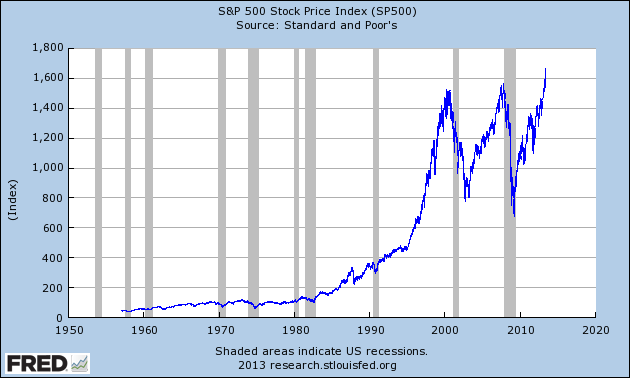
Here's a chart that Robert Murphy posted on his blog:
What kills me about this is the third recession from the right, the recession that began in 1991 or '92. I remember this recession vividly. In fact, it is the first recession I was ever really conscious of a person who thinks about the economy. I remember the news reports and the way people were so jaded and disgusted by "Reaganomics" and the GWH Bush administration. I remember the stories about the many unemployed people, and the many people living hand-to-mouth.

But just look at the size of it. It was tiny. By modern standards, it was hardly a blip.

Stunning.

2013-05-20

Who Said That?

Here's a blast from the past:

"That is the true genius of America, a faith... a faith in simple dreams, an insistence on small miracles; that we can tuck in our children at night and know that they are fed and clothed and safe from harm; that we can say what we think, write what we think, without hearing a sudden knock on the door; that we can have an idea and start our own business without paying a bribe; that we can participate in the political process without fear of retribution; and that our votes will be counted -- or at least, most of the time."

Weirdly apropos. Read the whole thing.

Some Links

I love economics news like this, because it is economic and yet completely unrelated to policy. What a fascinating discovery!

Hat tip to my mother, of all people: In what could be astounding news, researchers claim to have discovered an immune protein that could cure type 1 diabetes. Over the years, I have learned to be highly skeptical of the many annual claims that a cure has been found; but this one seems promising.

Daniel Kuehn proves that agreeing with me makes you a good economist... unless you actually are me, in which case it makes you "weak." Sigh.

For the record, I do not actually know whether the Mises Institute guys have this one wrong. Thomas Sowell might be criticizing the persistence of false ideas, or he might simply be criticizing the so-called intellectual elite. All I know is that the first thing that popped into my mind was the name Billy Ray Valentine. Plus ca change, plus c'est la meme chose.

It is always kind of sad when the music industry starts to discard its puppet, and the puppet does not yet understand that it is happening.

I didn't actually need another reason to drink coffee, but here you go.

In Defense Of Cartoons

The following started out as a comment on David Friedman's blog post, but the further along I got, the more I realized that (a) posting my thoughts there would detract from the otherwise civil discourse Friedman manages to attract, and (b) it's grown so lengthy that it is effectively a blog post of its own. So here it goes:


I think the most astounding aspect of this whole "cartoon libertarians" fiasco is that the BHLers are willing to defend what is obviously character malignment.

It's the same with the phrase "internet Austrians." It's a term cooked up to denigrate people who agree with Austrian-School economists, but who lack sufficient academic background to do so with full academic rigor. Likewise, what are "cartoon libertarians," if not people who share the BHLers' policy objectives but lack sufficient scholastic achievement to argue the BHLers' case flawlessly?

My question is, Why on Earth would BHLers want to do this? Is obliterating libertarianism actually what they have in mind? Because I'm not sure there is any other benefit to taking aim at the people who are attempting to learn from the Brennans of the world, but who also have things like day jobs and family responsibilities that keep us from engaging in academic research to the point of having an airtight argument.

It's hard not to take offense, frankly, and I'm not even sure I qualify as a "cartoon libertarian." But what Brennan wrote makes me want to qualify, just so that I can disagree with him.

Let me accept the label "cartoon libertarian." Heck, I'll be the Speedy Gonzales of libertarianism!


(For those of you a bit slow on the uptake, I'm choosing Speedy Gonzales in order to deliberately offend the sensibilities of people like Brennan, who I can only assume recognize the racist undertones of Speedy but fail to recognize that his many positive character traits actually imply something positive, not negative, about Mexican culture. In other words, Speedy Gonzales is exactly the kind of character that would offend the BHLers for being insufficiently touchy-feely while remaining adequately heroic to the rest of us.... Okay, having said that, I can now proceed to: Get it? Get it? Speedy Gonzales? Get it?)

Having accepted by assumption the fact that I am probably one of those horrible internet Austrians or bleeding heart austerians or crew-members of Battlestar Catallaxica or cartoon libertarian or whatever, I will now proceed in silence as Jason Brennan and all the real libertarians go ahead and engage in civil debate without me. I'll let them decide what I'm supposed to think. Go ahead, guys. The mic's all yours...

2013-05-17

Music As Art

For most people, the name Jennifer Batten doesn't ring any bells. That's unfortunate.

For most of the balance of us, the name Jennifer Batten is associated with the spiked hair and gawdy outfits of a "no-name" female guitarist seen on stage with Michael Jackson, a gig she maintained for about ten years, between 1987 and 1997. We may have seen her play the "Beat It" solo on various live Michael Jackson, but other than that, let's face it: Michael Jackson was never known for writing great guitar music.

Still, he was an artist with the kind of stature that can demand only the best in terms of side musicians, and Batten's on-stage persona was so captivating that curious guitarists growing up at the time, like me, couldn't help but look her up on a then-budding internet. The information we found was sparse, but with the help of some well-placed print ads in the back of guitar magazines, I was able to gather that Jennifer Batten had an interesting solo album out called Momentum, which was only available via mail order, and that she had appeared on a few of those "great guitar player" compilation CDs.

When I finally did hear the recording that made her reputation among guitar players - not the Momentum album, but rather a rock-guitar version of "Flight of the Bumblebee" - I was less than impressed. For one thing, did anyone really need to hear another rock guitar version of "Flight of the Bumblebee?" (I found out later that Batten's version was among the first.) For another thing, I was already knee-deep in the flat-picked stylings of Steve Vai and John Petrucci. Some chick playing gimmicky two-hand tapping stuff just didn't do it for a young musical idiot like myself. So, for years, I figured she was just some woman who managed to get the Michael Jackson gig because female rock guitar players were rare.

Looking back on all this today, I feel stupid, ignorant, and immature.

My favorite guitar player at that time was another 80s rock icon, one who had also recorded a "Bumblebee" song: Nuno Bettencourt. I was fairly obsessed with him, to the point that I dreamed of one day owning his signature guitar: a Washburn N4. Boy, did I ever want one of those.

One day, I went to the local music store and saw that they were selling a rare padauk N4 for a little more than $700. The salesman made a great pitch, and I almost bought it. (To this day, I kick myself for not having done so.) But I was extremely budget conscious and decided to go with something more in my price range. Looking around the showroom, my eyes honed in on another Washburn guitar, the BT-10 Maverick. It had a carved, flamed maple cap on an alder body with a maple neck and a rosewood fretboard. It had dot inlays, but they were off-centered on the fretboard, making them look extra cool. The guitar also featured a Floyd Rose whammy bar and cream binding. What a beauty! And at $400, it was exactly what I was looking for. I bought it in a cherry finish.

The BT-10 would serve as my next exposure to the world of Jennifer Batten. When I got home, I discovered that it was her signature axe. My chauvinistic pride took a hit (I bought a girl's guitar!), but after a while it didn't matter. The guitar was eye-catching and played really well. I took to it quickly, and it served me faithfully as my main guitar for the next five years. I still own it today, and it serves its purpose as my only tremolo-equipped instrument.

So, how could a mere girl, one whose only claims to fame were a gig with Michael Jackson and a two-hand-tapping version of "Flight of the Bumblebee", have her own signature guitar? Worse, how could she have one that I really liked? It didn't make sense to me. From time to time, I'd scan the internet for more information, only to once again discover little more than a link to her Momentum album.

One day, I came across a video of a live performance by guitar legend Jeff Beck playing a cover of "A Day in the Life." In the background was a woman with long blonde hair playing a guitar that looked familiar. Hey, I thought, she's playing a Washburn BT! That's my guitar! Then I realized that I was looking at Jennifer Batten. How did the Michael Jackson guitarist land a gig with one of the greatest musicians of the 20th Century?

I quickly opened up a new browser window and searched for all the information I could find about Jennifer Batten: two-hand-tapping wizard, acclaimed guitarist for the Michael Jackson band, with a successful solo career, currently touring with Jeff Beck. It was right about then that I got over my stupid "girls can't play the guitar" mentality and started letting my ears be the final arbiter.

What I soon discovered was a musician with such a stunning level of expressiveness on the instrument, such remarkable virtuosity, but more. Her notes sang, laughed, cried, while each song undulated with a funky mix of jazz, rock, world beat, and clever experimentation. Jennifer Batten's musical world proved to be one marked with an artistry that, frankly, few of even the best players can match.

Suddenly it no longer seemed surprising that this was the artist who had been hand-picked by Jeff Beck for his touring band. Suddenly it was no longer surprising that this was the guitar player who supported the most successful recording artist of all time. Suddenly, it was all obvious. Not to mention the fact that my guitar was suddenly one hundred times cooler than it was mere moments ago.

Batten's music features the kind of maturity to which we all aspire. What I mean by that is that her note choice is impeccable: it's surprising, provocative, powerful, and emotional. Like Jeff Beck, Batten prefers injecting each and every note with an overdose of emotional power to flooding the eardrums with a flurry of shredding. Also like Beck, Batten can produce a flurry of shredding that will blow your head off. If you're looking for an artist who is equally at ease playing fast and slow, one for whom every note is meaningful and important, one who can make every bend and every arpeggio tell a story of its own, look no further than Jennifer Batten.

Stylistically, Batten brings a lot to the table. Casual listeners will immediately notice the heavy dose of modern rock/fusion that serves as the backbone to her material. Comparisons to Greg Howe or Brett Garsed could easily be made. But where those artists tend to draw neatly (and brilliantly) inside the lines, Batten likes to slip and slide along the fretboard, bending and yanking the whammy bar. Because of this, a more attentive listener may draw parallels to Steve Vai, and that influence is certainly palpable on her first record, Above & Beyond. But the truth is that there is more Jeff Beck there than Steve Vai, and this was obvious long before she landed the Beck touring gig. Her subsequent albums are replete with that crying, diving, whammy bar emotion that Beck first made popular. Batten takes it to a whole new level.

For most artists, this would be more than enough ingredients to build a strong body of musical art. Jennifer Batten pushes things further still. Here, the comparisons depart from the masters of instrumental music to the more cutting edge and avante garde guitarists that so seldom make the top of the "best guitarists" lists. Throughout her solo albums, Jennifer Batten peppers her material with sound samples from movies, world music, sample libraries, hip hop beats, and so on. The millennial generation will be inclined to compare that aspect of her music to Buckethead, but the influence actually works in the reverse. Batten's use of samples and guitar special effects draws closer comparisons to Reeves Gabrels, Vernon Reid, Adrian Belew, and Warren Cuccurullo.

As strong as that list of innovators is, the thing that sets Jennifer Batten apart from them is her emphasis on the pure beauty of music. She stops short of cramming too many samples or foreign sounds into her work, favoring masterful clean-toned rhythm guitar tracks that can at times sound like keyboards or organs. Where the others might hover too long on a foreign sound (I once saw Adrian Belew play a guitar synthesizer configured to produce piano sounds, improvising for a good 20 minutes), Batten hints at strangeness just long enough to make the listener fall in love with sound before it gently fades away, only to be replaced by her signature tone and a flurry of virtuosic lead guitar.

The electric guitar was invented in 1931. Since then, it has become the primary musical instrument of the modern world. For better or for worse, the instrument has been so thoroughly explored that it is nearly impossible for anyone in this day and age to sound unique. Despite the odds, a few players have managed to do it through the strength of their imagination, creativity, and virtuosity. There is absolutely no question that Jennifer Batten is one of those players.

Kindly do yourselves the favor of familiarizing yourself with her music. I have selected a YouTube video at random to get you started.