2014-02-06

Minimum Wage And The Gnome Hypothesis

Some months back, I introduced what I call "The Gnome Hypothesis," and added the term to my dubious little Lexicon, defining it as any chain of logic that is valid, but derived from imaginary assumptions.

Jonathan Finegold Catalan pushes the case for the monopsony theory of labor markets when discussing the minimum wage (bold added, italics in the original):
The case for a minimum wage. Many people believe that all people deserve a minimum standard of living, and that one method of pursuing this is by paying minimum wage workers an hourly income above the market value of their labor. The classic economic argument against the minimum wage is that it creates unemployment, by pricing many workers out of the market. However, much of the recent evidence fails to reveal disemployment costs, meaning that firms raise their minimum wage without having to let workers go. In fact, some studies show that the minimum wage increases employment, as the monopsony theory of markets predicts. The implication is that the most cited cost to minimum wage may actually not be a cost at all.
Instead of testing for monopsony, Jonathan imports it by conjecture. Whether the observed market is a monopsony is a determinable fact, but absent that determination, this is all merely a thought experiment.

A minimum wage increase that translates into an employment increase is consistent with a monopsony labor market theory, but it is also consistent with other stories. As I wrote recently, we might rather be looking at one contiguous county's gain at the expense of another. Or perhaps some other explanation is the right one.

But it's all just a Gnome Hypotheses until we investigate.

Unfortunately, a large body of economic research comes down to the following (highly flawed) analytical reasoning:

  • If X then Y.
  • If W then Z. 
  • Test for either Y or Z.
  • Therefore, conclude either X or W.

It feels scientific, because there are hypotheses, tests, and conclusions. But look what's missing: Every other conceivable explanation for Y and Z!  "If X then Y" is not even a hypothesis worth testing until we've ruled-out the alternative hypothesis, "If not-X then Y." We have to prove a causal link between X and Y before we can test for one.

We call this affirming the consequent, and minimum wage discussions are rife with this fallacy. If monoposony (P) then minimum wage increases will increase employment (Q); we test for Q, observe it, and conclude P. This is only a valid test if we first establish that Q is a necessary and sufficient condition for P, and not for any other theories, R, S, T, etc.

So, Jonathan Finegold Catalan is affirming the consequent when he says that observing Q is "reasonably" consistent with P. That's fallacious, but what makes it a Gnome Hypothesis is the fact that P is pure speculation. We can all imagine a monopsony scenario, but that doesn't mean that our imagination has established that the scenario applies to the real world.

In other words, we don't need a test for Q; we need a test for P.

2014-02-05

Contact Stationary Waves

As you may have noticed, there is now a contact widget on the right-hand side panel of this website. You can use this widget to get in touch with me for any reason:
  • Maybe you'd like to leave a comment, but do not wish to do so publicly or via Google+ connectivity.
  • Perhaps you'd like to initiate a more in-depth conversation the likes of which prove difficult in the typical comments-thread configuration.
  • You might want to suggest a topic for a future post, or ask me how I feel about something specific.
I don't want to encourage solicitations, and I reserve the right to refuse any. But I am more than happy to discuss serious inquiries along the following lines:
  • Will I write a press article, research article, or blog post for you? (Typically yes, subject to my personal integrity.)
  • Will I design a workout plan for you and/or provide coaching via correspondence? (Typically yes, for free.)
  • Will I provide consulting analysis or similar professional services? (Case-dependent, for a fee.)
  • Am I available for music composition, recording sessions, or live performances? (Typically yes, so long as I am credited; there may be a fee, depending on the circumstance.)
  • Will I give you the inside scoop on specific people I know? (Typically no.)
  • Will I advertise for you? (Almost certainly not, but I'd be happy to review your book, movie, or music free of charge.)
And so forth. Please make liberal use of the new-and-fabulous contact widget.

Some Awesome Links

So many awesome links out there today. Here's what I found.

Riffing on his compelling theory that science made philosophy obsolete, Lubos Motl deals a few serious blows to Aristotelian teleology. (Pretty awesome.)

Steven Landsburg criticizes Paul Krugman on style-over-substance. (Soooo awesome.)

Bryan Caplan points out that diasporas are destroyers of nationalism, and he couldn't be more pleased. (I think he's awesome for saying so.)

He may refuse to read me anymore, but I still read him: The Anonymous Charmer points out that, no, those are not good headlines.

Rebecca Gebhardt Brizi concisely expounds on a simple truth.

2014-02-04

Not Just Commentary, But Good Commentary

Recently someone encouraged me to go above and beyond my inclinations. Don't just tell me what you're thinking, she (essentially) said, tell me something substantive. Don't just say it, say why. Say how. Say anything, so long as there is more substance to your comment than the comment itself.

It was a welcome reminder that, especially in public, we might be better-served by saying something useful, or saying nothing at all. If what you say doesn't leave your audience better off having heard it, maybe it would be better if you just kept it to yourself.

Naturally, this doesn't mean that we should refrain from speaking unless we can be certain that what we say will leave others better off. That would be a bit extreme. But we should at least have a good reason to believe that others can benefit from our comments; absent that good reason, it might be better if we just kept it to ourselves.

I made this point rather ineffectively in a previous post, and commenter "Alex Kostko" rightly called me out. The catch-22 for any blogger is that a blog lives and dies on writing something and posting it. The less we do that, the less interesting our blogs are. So here I am, trying to think of enough topics to keep up a pace of two or three blog posts per weekday. That's a substantial output, but is it a substantive one? Perhaps not.

I don't really know where I'm going with this, except to say that perhaps it pays to keep quality over quantity. Or, perhaps even when quantity is important, a focus on quality becomes all the more crucial. Or perhaps I just need to remind myself that it can be displeasing when people - such as myself - talk for the sake of talking.

Maybe nobody needs to hear about how much I agree with X about Y. They might care if I explain why I feel that way, but just knowing that the Stationary Waves blog agrees with some thing, somewhere does not really enhance anyone's life.

Perhaps the reader would feel better if I kept in mind that nobody just wants to read verbiage for its own sake.

Minimum Wage Analyses

Robert Murphy has a good article at EconLib discussing the competing academic analyses of minimum wage effects. Daniel Kuehn is convinced in some respects and unconvinced in others. Something that stood out to me in Kuehn's blog post was this:
What's nice is that Bob's piece brings up Neumark and Salas, which I haven't discussed here. They show that alternative time trend specifications reverse some of these results (although I don't know if this is with a contiguous counties sample - Bob, do you know?). I don't know the paper well - my one questions is whether there is an overfitting issue - basically the Meer and West critique could very conceivably apply to Neumark and Salas.
I don't want to put words in Kuehn's mouth - I know he is very sensitive to that sort of thing. So I will only speak to my impression of what he's saying. It seems slightly funny to me because I think many of the points he has been making recently on minimum wage analyses could likewise be criticized from an over-fitting angle. I raised this point in the comments section of Kuehn's blog, and he remained skeptical. Fair enough.

But in the comments sections of various blogs, Kuehn has pressed me to explain why I prefer the simpler analyses of minimum wage legislation to these newer studies, the ones that Murphy calls "revisionist."

To me, the question is context-specific. Identifying regional variation in the context of a discussion about the usefulness of raising the federal minimum wage makes very little sense to me. What matters regarding the federal minimum wage are the national employment effects. If there is evidence for raising certain regional living wages, then that is a much different question. So before we choose our model, we should know which question we are attempting to answer.

This morning, I asked Kuehn in a comment why he felt that contiguous counties were good comparators in this sort of analysis. Kuehn replied that Tarrant County (for example) might not be a perfect comparator for Dallas County, but it's better than Arlington (Virginia) County.

But this is only true if a raise in the living wage in Dallas County has no direct effect on Tarrant County's labor market, which is obviously false. In the short run, the labor market in Dallas can expand at the expense of the Tarrant County labor market by using the living wage to induce Tarrant County workers to work in Dallas. If the transition to a new equilibrium isn't fully accounted for by the time-series data, then we would expect to see the living wage increase look very good for Dallas County; but we'd be drawing the wrong conclusion.

In the long run, we would expect to see more low-skill jobs migrate out of Dallas County and into Tarrant County - but only those low-skill jobs that have the ability to migrate. Food service jobs will obviouly not migrate because people in Dallas and people in Fort Worth both enjoy eating at Whataburger, and Whataburger wants a presence in both markets. So, again, if our studies focus on Whataburger jobs (and the like), then we will expect to see the Dallas County workforce grow at the expense of the Tarrant County workforce.

The important thing is that it is happening at the expense of the contiguous county.

To account for this kind of detail, I would prefer to see a study of Dallas County and all its contiguous counties (amalgamated) as Group #1, compared to Arlington County, Virgina and all its contiguous counties (amalgamated) as Group #2. Then we'd be able to see how a given policy impacts the expanded labor market defined by Group #1, and compare it to a comparable labor market (Group #2) that did not raise its minimum wage.

[MINOR UPDATE] --- What I mean in the preceding paragraph is that we need to account for job substitution away from contiguous-but-affected markets toward the county that makes the living wage increase. Then, having thus accounted for substitution, we can compare that to a valid control group that did not raise its living wage and the surrounding contiguous labor markets that would have been affected, if it were not a "control" group. (It sounds confusing because I'm bad at describing it.) --- [END OF UPDATE]

Do the contiguous county studies behave this way? I don't know - I'm not an academic, and I don't have much time to read the work. But my follow-up questions to others have not answered my question. Perhaps one of my readers knows.

2014-02-03

Who Is "We?"

Part One:
A few days ago, I alluded to a forthcoming post on use of the word "we." It's time to deliver the goods, but before I do, let's quickly recap what said about "we" in that post:
[A]ttaching negative consequences to unacceptable childhood behavior is called discipline. It is concrete, specific, and enforceable. But simply declaring something to be "not okay" and frowning furtively at a child (or an adult, please note) is synonymous with the act of declaring an action to be socially frowned-upon. The point is that those children (or adults) who engage in that behavior should be ashamed of themselves. It's shamey. But there isn't any specificreason why people who say "not okay" are saying what they're saying. The best you'll ever get from them is "we don't do that." It's an act of shaming someone by attaching social unanimity to whatever the speaker has deemed to be "not okay."
Part Two:
A friend of mine once invited several friends on vacation, myself being one of them. I knew many, but not everyone, who went. Among the attendees was a sizable group of young people, an insular group of friends who spent a lot of time together. We all got a good deal on accommodations as a result of a group rate, which was the logic in my friend's inviting so many people. Best of all, no one was "on the hook" to spend a lot of time together, so there were many small off-shoot groups that hung out as desired.

One morning, many of us met in the hotel lobby to discuss plans for the rest of the day. As I was waiting for the member of my own off-shoot group to arrive, I watched the people in the insular group discuss their plans. One young woman, Renee (all names changed to protect the innocent), had a strong desire to do something specific. I don't remember what it was exactly, but let's say it was hiking.

She made her first attempt at suggesting the hike by saying to Steve and Michelle, "I think we should go hiking!" Her friends seemed unsure. They answered, "Well... let's wait for Jane to get here before we decide."

When Jane arrived, Renee made her second attempt. She walked up to Jane and said, "We're going to go hiking. Do you want to come with us?"

Jane wasn't sure, either. She replied, "Hmm... Well, who is 'we'?"

To this, Renee responded, "Steve, Michelle, and I."

Still, Jane wasn't convinced. She said, "I'll go if Ursula is going."

So, Renee waited for Ursula to arrive, then walked up to her and made her third attempt at suggesting the hike: "We're all going hiking. Do you want to come hiking with us?"

Ursula was surprised. "We are? Is that what Jane said?" Renee confirmed, so Ursula said, uneasily, "Well, okay... if everyone else is going hiking, I'll go hiking, too."

Part Three:
Notice how self-aware Renee was as she deceived the others. She didn't begin by saying that she wanted to hiking, she began by suggesting that they should all go hiking. When she was unable to convince the others, rather than comply with their wishes that they all discuss it as a group, Renee waited for the next group member to arrive and then announced that she and the others were definitely going hiking, and did Jane want to come, too? Jane only wanted to go if Ursula also wanted to go, but Renee told Ursula that Jane had already confirmed. Thus, as far as Ursula knew, everyone had already decided to go hiking.

The group went hiking, despite the fact that Renee hadn't managed to convince anyone to go hiking. Only Renee wanted to hike. But she deceived the others into thinking that a group decision had been reached, and thus manipulated a rather large group of friends into doing what really only Renee wanted to do.

Interesting, right?

Part Four:
It happened again, not to long ago. This time, I was the purported victim; but of course these sorts of strategies have no effect on strong individualists like myself.

I found myself among a small group of friends, on our way to have some fun. As we walked, one of us decided that he would rather do X than our intended Y. After fruitlessly suggesting to the group that we all do Y instead of X, he tried a different approach. He approached me and said, "We're going to do X."

I said, "We are? Who is 'we'?"

He didn't reply, he just smiled. Another member of the group confirmed that "we" was really "he," so I made a point of acknowledging that fact: "Oh, you would rather do X than Y. Okay, that's fine with me. We don't have to do Y, if you don't want to."

This caused a mini-group melt-down because the matter had been re-framed as a group discussion rather than a group conclusion. We spent the next ten minutes discussing what to do next. In the end, we decided to do neither X nor Y, but rather Z, and everyone seemed satisfied with that decision.

Part Five:
Absent the word "we," the English language would have severe limitations. But in the wrong hands, "we" can be highly manipulative. It's okay to act on behalf of a group, if you so choose. It's okay to want to make a group of friends happy. But it's important to keep in mind that many of the people who inform you as to what "we" want to do are really just talking about their own personal desires.

Watch closely, and you will soon see that many people have a knack for using the language of collectivism to bend individuals to their own ambitions. When people talk about the horrors of collectivism, this is what they're really talking about. It's not as if Ayn Rand truly believed that it was always evil whenever human beings acted collectively. Rather, Rand recognized the important insight that much of what people talk about when they say "we" is really nothing more than using the word "we" deceptively, in order to shame people into submission or appeal to their sense of altruism to extract benefits that would not be worth doling out if the truth were otherwise known.

It's not that collectivism is bad, it's that deception is bad, and particularly pernicious when some of us choose to abuse the word "we."

Matt Yglesias On The West Bank

I don't always comment on Matt Yglesias' posts. In fact, I may never have done it before. His recent Slate article arguing for the closure of SodaStream, however,warrants an exception.

Yglesias' point amounts to a comparison of the West Bank to South African apartheid:
Think about South Africa under apartheid. Living conditions for black South Africans were bad. At the same time, black South Africans were still impacted by the larger South African economy. The various sanctions and boycotts to which South Africa was being subjected didn't microtarget white South Africans. Black South Africans shared the pain too. And so black people in South Africa in 1987 had slightly worse lives than they would have had absent boycotts and sanctions. But the point of the boycotts and sanctions wasn't to maximize the welfare of black South Africans under conditions of apartheid, it was to end apartheid. And it worked!
The question of whether economic sanctions succeeded in overturning apartheid is a highly contentious position. We might disagree about whether economic sanctions against South Africa were morally justified, just as we might disagree about whether a boycott of SodaStream is morally justified, but Yglesias doesn't argue that point. Instead, he argues that economic sanctions are the cause and end to apartheid was the effect; thus, boycotting Israeli products will result in better economic welfare for Palestinians in the long run, short-run pain notwithstanding.

Here it is in Yglesias' own words (bold added, italics in the original):
What you have there is a situation where millions of people are governed by Israel's elected government. And a minority of those people are Jewish citizens of Israel who get to vote for the government of Israel. But a majority of the West Bank's population are Palestinian Arabs who don't get to vote for the government of Israel. That is not a context that is promising for the long-term economic welfare of the Palestinian inhabitants of the area. Any time you have a mixed population area where some of the people can vote and the others can't, you have a recipe for the interests of the nonvoters to be systematically degraded in terms of building permits, access to natural resources, law enforcement, transportation infrastructure, and everything else. It's absolutely true that if you take the persistence of the situation in which Israel governs the West Bank and most of its residents can't vote as a given, that it's good for Palestinians to have Israeli factories opening up in the area and creating jobs. 
But why should we take it as a given? [...]
Maybe Yglesias is right that a boycott will translate into long-run benefits to Palestinian residents of the West Bank. Even if so, we'd need a cost-benefit analysis to establish that the short-run costs incurred by Palestinians as a result of the boycott out-weigh the long-run benefits.

Consider the case of a hypothetical Palestinian child who requires expensive, ongoing medical treatment that can only be paid for by her father's SodaStream paycheck. If the boycott results in a loss of income, that child may die. Is it good for that child to endure this kind of hardship for the sake of someone else's long-run welfare?

I concede that this may be a personal value judgement, but it's one that Palestinians ought to make for themselves. There is no moral tenet by which Yglesias can incur hardships on strangers for the sake of what he deems to be their long-run interests. That's a clear overreach - he has no right.

But wait - has Yglesias managed to demonstrate that economic sanctions indeed caused the end of apartheid? No. Are boycotts and economic sanctions the only means by which to affect change in a policy comparable to apartheid? Absolutely not, as evidenced by the many other political activities that contributed to the end of apartheid. Are economic boycotts and sanctions the best means by which to end this sort of policy? If so, the burden of proof is on Yglesias.

In short, Yglesias is making a moral case the boycott, not an economic one. If he were interested in weighing the economic pros and cons, he would do it. If he were interested in arguing that boycotts are the best tool to use to end apartheid, he would argue as such. But he merely assume that Cause X produces Effect Y and makes an emotional appeal with comparisons to apartheid. Color me unconvinced.

None of this means that the Israeli policy is justified or that it is not justified. I leave that question to those with a better familiarity of Israeli politics than I possess. But the fact of the matter is that markets make people better off, and if we're going to deprive people their human right to freely associate, we need a strongly justifiable reason to do it. To that end, Yglesias has not succeeded.

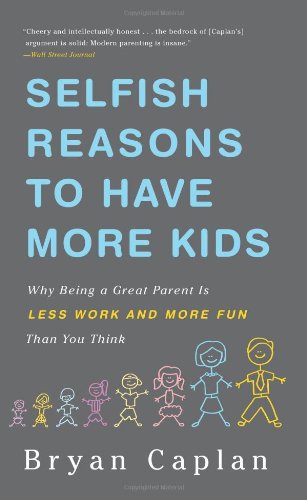
Book Review: Selfish Reasons To Have More Kids

Photo courtesy Amazon.com
Among all the libertarian writers I read regularly, Bryan Caplan is the one whose writing style I respect the most. Whatever the topic, Caplan manages to tackle it with a conciseness and rhetorical efficacy few other writers possess. Somehow Caplan always succeeds at both brevity and nuance, giving him an expository edge on the competition.

This trait is on full display in his 2012 book Selfish Reasons to Have More Kids: Why Being a Great Parent is Less Work and More Fun Than You Think. In it, Caplan makes the case that, since child rearing is not as troublesome as we all might think, each of us should have marginally more children than we otherwise might choose to do so. Caplan's arguments range from the convincing to the unpersuasive. Below, I'll discuss each one of them briefly.

The Good
Let's start with Caplan's most persuasive arguments.

By far the best of Caplan's arguments is the fact that the modern world is a safer and more pleasant place for children than it has ever been in human history. Caplan challenges our biases in favor of "the good old days" by extensively citing mortality and crime statistics, new technologies, and progress in general. No matter the metric, the case is pretty open-and-shut: the world is a better place for children than it used to be. If anyone holds the belief that it would be irresponsible to raise a child in such a terrible world, Caplan's rebuttal is that, however bad it might be, it's better now that it ever was - so don't let that keep you away from having kids.

Caplan is equally ready to cite data in favor of the case that more kids are better for the world than fewer kids. Here he leans heavily on the theory of natalism. You don't have to be a natalist to appreciate Caplan's arguments here, though. From environmental concerns to primitive economic "fixed-pie" fallacies, he makes a strong case for the fact that any additional children you choose to have will more likely make the world a better place than a worse one.

Another compelling argument in the book is that parents have a big impact on how well their children like them, even if parents don't have such a large impact on where their children end up in life. To be sure, it's an encouraging message that encourages parents to worry less, and instead focus their attention on fostering a good, loving relationship with their children. Here, though, Caplan's case isn't as strong as I'd prefer. Let's take a closer look at the less convincing arguments he makes.

The Bad
Caplan invests the bulk of the first part of the book citing twin and adoption studies in behavioral genetics to make the case that parents have almost no influence on how their children end up in the long run, in terms of crime, income, family composition, divorce rates, and so on. It's true that nearly all of the cases Caplan cites buttress the theory of nature over nurture, but nothing in the book is substantial enough to change anyone's mind about nature versus nurture. He too-readily dismisses nurture-based arguments by resting his entire case on a set of twin and adoption studies that all draw from the same few databases. A few days ago, I pointed out that if Caplan really believed that our genes determine the outcome of our lives, there would be no point to his writing the book in the first place.

A major hole in Caplan's behavioral genetics argument is that absolutely no one disputes the fact that parents have the power to completely screw their kids up. Caplan acknowledges this fact in his book, and even makes light of it. But if he accepts this assumption, then how in the world can he dispute that parents can also greatly improve their lives. There is a vast logical inconsistency here. Why does Caplan accept that parents can have a large negative impact on children, but reject the idea that they can have a large positive impact?

In answer to this, Caplan recedes into a much weaker claim: that as long as you don't thoroughly screw your kids up, they'll probably turn out fine. I have no qualms with this argument, and it is indeed convincing. But one need not take a hard-line stance in favor of behavioral genetics in order to make that point; indeed, it would probably be more convincing if he didn't. 

This fact is further underscored by Caplan's own experience with twins. He acknowledges that his own twins are very different people, and he attributes that difference to "free will." Yet by the very definition of "environment" he gives earlier in the book, "free will" counts as nurture.

But the least-convincing of Caplan's arguments come in Chapter 9, in which he has a series of imaginary conversations with himself. In them, he plays the role of various critics and systematically refutes what he imagines to be their best claims. While I can appreciate this as a useful exercise in strengthening his case, I found the scripts to be a little weird. The idea that Bryan Caplan can defeat the arguments of imaginary people by scripting their case to fall short of his own is not very compelling evidence in favor of his claims. In fact, it captures the whole spirit of a "straw-man argument," even if it doesn't quite encapsulate a straw-man fallacy. Caplan literally imagines people who make the kind of arguments he can refute, fails to lay out their strongest arguments, and fictitiously designs the conversation such that they give up too easily. As I said, it may be a useful thought experiment for anyone hoping to improve his argument, but it is not particularly convincing for the reader, and especially not for a skeptical one.

Conclusion
I very much enjoyed reading Selfish Reasons to Have More Kids, but if I'm being honest with myself, I must say that if I didn't already accept the conclusions of the book, I likely would not have found it interesting. 

This leaves me a little nonplussed. While I'd like to recommend the book on grounds that it is truly enjoyable, I likewise have to acknowledge that it won't change any minds. I'd even go so far as to say that if you already know you disagree with Bryan Caplan about having more kids, you probably won't like the book at all. So how do I finish a book review in light of these conclusions?

Caplan has an easy writing style that entertains as it advocates. The conclusions he reaches in this book are, furthermore, perfectly inoffensive. How steeply can one object to babies, anyway? In that sense, it's safe to say that he's written a thoroughly entertaining book that is worth the read, so here I'll take a cue from Caplan and advocate for marginalism: If you're on the fence about reading this book, give it a shot. You'll finish it quickly and probably enjoy the prose. 

On the other hand, if you're skeptical of having more children and want to know the best case in favor of it, you might be better off talking to a few proud parents within your circle of friend and find out why they think kids are so great. As much as I liked Selfish Reasons to Have More Kids, it won't sway any opinions.

Every Preventable Death Is A Tragedy

I was not as much a fan of his acting as many others were, but I am moved by news of the death of Philip Seymour Hoffman. Every preventable death is a tragedy.

I respectfully remind my readers that the uptick in heroin use has been building for some time now. See my posts here and here. My critics have suggested that heroin never really went away, and that is fair enough. But these things do appear to occur in "trends." Frank Zappa once said that, like music, drugs go "on and off the charts."

I've posted at length on the tragedy of drug abuse, and I won't disrespect a man's death by belaboring the point here.

2014-01-31

Much Easier

It would be great if guys like me could easily sculpt our muscles to the point that we look like Arnold Schwarzenegger (back in the day) and have the ability to run great distances. In the real world, though, it's a trade-off: The more upper body mass, the harder it is to be a distance runner. No two ways about it.

Still, I sometimes surprise myself by how much easier it is to run when you're not carrying around a lot of upper body mass. After struggling for more than a year at paces far below my comfort zone, and distances far shorter than I'd prefer, a bout of food poisoning resulted in my quickly shedding major muscle mass. And the result is that I've become my old self again! Mile pace times under 6:30? No problem. Long runs? Bring 'em on!

There's no doubt that the shedding extraneous muscle mass has been the source of my rediscovered running prowess, but still, it's important not to draw too many of the wrong lessons here. Looking back over the course of the blog, it's a fairly consistent case that any time I make a major change to my fitness regimen, I make a lot of significant gains in a short period of time, before ultimately reaching a point of diminishing returns and stagnating again. This was as true of my body-building experience as it is of my recent running revival.

What should we make of it all?

Well, one important lesson to keep in mind is that if you're starting to feel like your workouts are getting stagnant, it's time to make a change so that you can recapture the good feelings.

A second lesson is that making continued progress is more difficult the more progress you've made. You might want to modify future expectations accordingly. Aim for smaller benchmarks. There are only so many 30-second PRs you can reasonably expect to have.

A third lesson is not to over-estimate early progress. You might just be getting a taste of the lowest-hanging fruit. The real challenges may yet be ahead.

It's Friday. That's all I got.

Open Borders: Deport All Troublemakers

My latest offering at Open Borders concludes as follows:
Many critics of immigration base their case against open borders on the differences between groups of human beings. I have attempted to show why this problem is not unique to immigrants, that we are in fact different from other natives, too. Eliminating differences in a community of peaceful people presents prejudicial, empirical, and practical problems that most would find unsettling. Those critics who point to “differences” as a justification for restricting immigration thus have a steep burden of proof assigned to them. Until they meet it, I remain unconvinced.
Read the whooooole thing. 

2014-01-30

More Or Less

The best psychological advice I ever received was: Do more of the things that make you happy and less of the things that don't. On the surface, the suggestion is simple to the point of being unhelpful. "I know that already - my problem is that so many things are making me feel bad!" Dig a little deeper, though, and I'm certain you'll find it to be as profound as I do.

Exercise And Depression
What if I were to tell you that there was a medical therapy that was proven to elevate your mood for hours at a time by activating the brain's dopamine and seratonin responses, increasing adrenaline levels, lowering blood pressure, increasing the amount of oxygen in the brain, and providing a mega-dose of vitamins D and K? What if I told you that this therapy was available free of charge and came with small risks and almost no negative side effects? You'd be silly not to take that deal, right?

It sounds too good to be true until you know what therapy I'm talking about: exercise. Pessimists are quick to point out "that going for a run or picking up a guitar does not always solve the problem," but it is nearly impossible to maintain the strong form of that argument in light of all the research that has been done on the topic. As Harvard Medical School summarizes,
A review of studies stretching back to 1981 concluded that regular exercise can improve mood in people with mild to moderate depression. It also may play a supporting role in treating severe depression.
The science of the matter, at least, is clear. Exercise won't cure depression, but it almost always alleviates your symptoms.

More Of The Things That Make You Happy
I mention exercise not to propose it as a cure-all, but rather to demonstrate that certain things make you happy no matter what. The clinical evidence is inarguable: Exercise makes you happier than you would be without it. It's true that you can't always control all the negative things that happen to you in life, but you can always control the things that make you happy.

So, the crude example is: No matter what lousy stuff happens today, you can always go home and do some push-ups or sit-ups or some other appropriate form of exercise. Not everyone can run, but everyone can engage in a body-appropriate form of exercise. You know it will make you feel better because it is a clinically proven fact. No matter how bad things might have gotten today, at least you can squeeze in a workout. It won't solve your problems, but the fact that it will make you feel better is, I repeat, a fact.

Exercise isn't the only thing that makes you happy. Music might. Or art. Or cat pictures on the internet. Or meditation. Or a phone call to a friend or relative. None of these things has the magic power to solve all your problems, but if any of them make you feel better, then guess what: You have some control over how you feel. So use it.

Last point here: Some of "the things that make you happy" are shockingly simple. If you have to work with a difficult coworker, for example, you probably can't just pick up and go for a run every time he irritates you. But you can take the time to applaud yourself for being able to keep your composure and interact gracefully with someone whose personality tries your patience. Something that simple can be a great source of happiness when things are going wrong. And if your problem is more severe - a chronic medical condition like diabetes, for example - you don't need to force yourself to accomplish something every day to feel better about yourself. You can set your mind at ease by simply patting yourself on the back for keeping a sense of humor about your predicament.

No need to climb Everest here, just do things that make you happy.

Less Of The Things That Make You Unhappy
The flip side of my advice so far is to do less of the things that make you unhappy.

Some of this is very low-hanging fruit. If you know that binge drinking gives you a hangover and costs you a lot of money, then you know... stop it. If you know that, every time you try to give your teenager advice, she flips out and calls you a Nazi, it's probably in your benefit and hers to just cool it. Don't aggravate an already-bad situation. That's the introductory course.

The intermediate course is: Figure out how you're making your own problems worse, and try to make a change. If you find yourself always swearing at the rush hour traffic you have to drive through every day, you can take concrete steps to alleviate your problem. If you can flex your working hours in such a way that you show up earlier for work, and leave earlier, thus missing the worst of a traffic, that's a no-brainer. But wouldn't it be nice to be able to drive through bad traffic every day, and not lose your cool? Singing along with my favorite CDs sure helps me. Some people like audio books. Maybe you can find an alternate route that takes a little longer, but saves you a big headache. Maybe you can start taking the bus. Maybe you can offer to give your friend a ride and put some social pressure on yourself not to flip out. All of these things might help.

The key here is to remember that bad traffic is really irritating, and you're not wrong to think that it is; but doing less yelling is sure to help you from feeling worse. And if your problems are more serious, like my diabetes example above? Maybe what makes you feel bad is that you just think too much about it, and you need to take a break from talking or thinking about it all the time. Or perhaps what makes you feel bad is the isolation, in which case a support group or family member might be able to keep you from spending too much time in your own head. I can't say for sure, but again, the key is to find what makes you feel bad - isolation, obsession, pining for the ice cream you can no longer eat, whatever - and find a way to do less of it.

Weather, Population, And Meltdowns

According to the New York Daily News, "the South" is still struggling to gain control of things after the "mild" storm that recently paralyzed most of Atlanta. The nation's more populous metropolises are scratching their collective head and wondering how two inches of snow could possibly wreak so much havoc on a modern American city. To me, though, it is not much of a mystery. I'd like to say a few words about it, as a public service to all my Canadian readers, and my readers who are from regions that frequently get much bigger snowstorms, and yet still manage to function as cities and communities.

My first point is the most obvious. However normal two inches of snow might be for you, in places like Atlanta, Georgia, it is rare. While your city might be well equipped with snow plows, tow trucks, snow tires, tire chains, snow blowers, salt or sand on the road, etc., cities like Atlanta and Dallas have no such infrastructure. The reason is because it's not a good investment. I know it seems like a good investment, now that we've seen what havoc can be caused by two inches of snow, but the real trade-off is: tens of millions of dollars of municipal spending on snow maintenance infrastructure on the one hand, and public school spending, the social safety net, civil servant salaries, etc. on the other. When you stop to think that, in Georgia, two inches of snow all at once is something that only happens once every few years, the trade-off is not as obvious as it seems.

A second, related, point pertains to the decisions public officials made to try to manage the situation once the snow started falling. I'll grant you that if the mayor of Atlanta or the governor of Georgia grew up in New Hampshire or Salt Lake City, he should have known better. But if you grew up in a region of the world where major snowfall almost never happens, how good should we expect your judgement about snowstorms to be? Similarly, how well do I expect people in Columbus, Ohio to deal with hurricanes? You get the drift (pun intended).

My third point pertains to population. Ludwig von Mises observed that
...there prevails a tendency toward a distribution of population over the earth's surface in accordance with the physical productivity of the primary natural factors of production and the immobilization of inconvertible factors of production as affected in the past.*
This is a glorified way of saying that people follow the money. Elsewhere, Mises also discussed the Malthusian law of population - you know, the old idea that population will grow to the point where it becomes unsustainable, and then we'll all die. But in Mises' opinion, this is just a caricature what Malthus wrote. Mises rather saw the Malthusian "law" as being a special case of the Law of Diminishing Marginal Utility - and he was right.**

What this means for Atlanta is this. People flock to Atlanta to avail themselves of its many redeeming qualities. What they find when they get there is: (typically) beautiful weather, a colorful culture, and excellent economic opportunities. I'd sure take that deal over a city that offered cold weather, an uninteresting local culture, and poor economic activities, wouldn't you? (Maybe this is why people fled Detroit and flocked to places like Atlanta.) But it's not a costless win. To get to Atlanta, you have to incur moving costs; but you also have to give up any of things you might have enjoyed about your old city. Maybe you don't mind giving up the cold weather, but you might miss the skiing. Maybe you don't mind giving up the non-existent nightlife of Butte, Montana, but you might miss the local tourist attractions.

Anyway, Atlanta also comes with its own drawbacks, which may or may not be deal-breakers to you. One such drawback, especially if you come from rural Georgia and move to "the big city" in order to "make it," is its large population. True, it's not as populous as many other American cities, but regionally speaking, it's up there.

Well, you'll notice there are no reports of crippling traffic jams and people sleeping in grocery stores from Athens or Macon or Savannah, Georgia, right? Much less are there reports of kids stranded at schools in Lafayette, or Anderson, or Tifton, or Douglas, or Inverness, or Troy... Is this because these cities all have better winter infrastructure? Or superior elected officials? Or better preparation? Not likely. No, the real reason is that smaller, more sparsely populated cities can better-handle freak storms than more populous cities (assuming, of course, that the storm does not result in total devastation) because the people in those towns do not have to worry about severe traffic jams and freeway travel. The roads might be equally as hazardous, but there are fewer people on them. There might still be car accidents, but commutes are shorter, so they have less of an impact on the victims' ability to get home. And so on.

Consider all of this when you ask yourself why "the South" has so much trouble with two inches of snow. My sister - who, like me, grew up in the snowy Intermountain West - also lives in the South. She laughs when school is cancelled over "a dusting of snow." But she lives in a small southern town, not unlike Rome, Georgia, where people can make due with bad weather conditions. But if you live in Atlanta, and the snow falls, and the heavy traffic grinds to a standstill, and the baby is crying and you need to buy diapers, you'd better believe you'll feel the hurt.

___________________
* von Mises, Ludwig, Human Action, p. 627
** Ibid., p. 129, which reads as follows:
The Malthusian law of population and the concepts of absolute overpopulation and under-population and optimum population derived from it are the application of the law of returns to a special problem. They deal with changes in the supply of human labor, other factors being equal. Because people, for political considerations, wanted to reject the Malthusiam law, they fought with passion but with faulty arguments against the law of returns?--which, incidentally, they knew only as the law of diminishing returns of the use of capital and labor on land. Today we no longer need to pay any attention to these idle remonstrances. The law of returns is not limited to the use of complementary factors of production on land. The endeavors to refute or to demonstrate its validity by historical and experimental investigations of agricultural production are as needless as they are [p. 130] vain.

2014-01-29

Are We But Racists?

As an addendum to my previous post, consider the following. Scientists have confirmed with genetic testing that human beings crossed-bred with neanderthals.
In the 1990s, researchers began finding fragments of Neanderthal DNA in fossils. By 2010 they had reconstructed most of the Neanderthal genome. When they compared it with the genomes of five living humans, they found similarities to small portions of the DNA in the Europeans and Asians. 
The researchers concluded that Neanderthals and modern humans must have interbred. Modern humans evolved in Africa and then expanded out into Asia and Europe, where Neanderthals lived. In a 2012 study, the researchers estimated that this interbreeding took place between 37,000 and 85,000 years ago.
In a rare act of mercy, I won't name any names in this post. However, the argument has been advanced in certain sectors (over and over and over again) that human beings are incapable of getting along in large, diverse, cosmopolitan communities. It has been said that history proves that this can only end in violent conflict.

I have the links to where this theory has been advanced, but you guys know who you are, don't you.

Anyway, I just have to laugh. History shows that we hate diversity so much that we are willing to breed with members of a completely different species, so long as they look a little bit like us and we find them sufficiently attractive.

So was this isolated happenstance? Some ancient pervert decided to get it on with a neanderthal, staining mankind's tradition of ethnocentrism forever? Or, is human history actually a tale of remarkable outreach and the peaceful pursuit of positive relationships?

Remember, we're broadcasting radio waves to space aliens even as I type this, hoping that we get an answer. Well sorry, alien ladies, I'm off the market. But I hear all those guys who took the "Red Pill" are really good at courting your submission.